
Sermorelin
Price range: $55.00 through $105.00
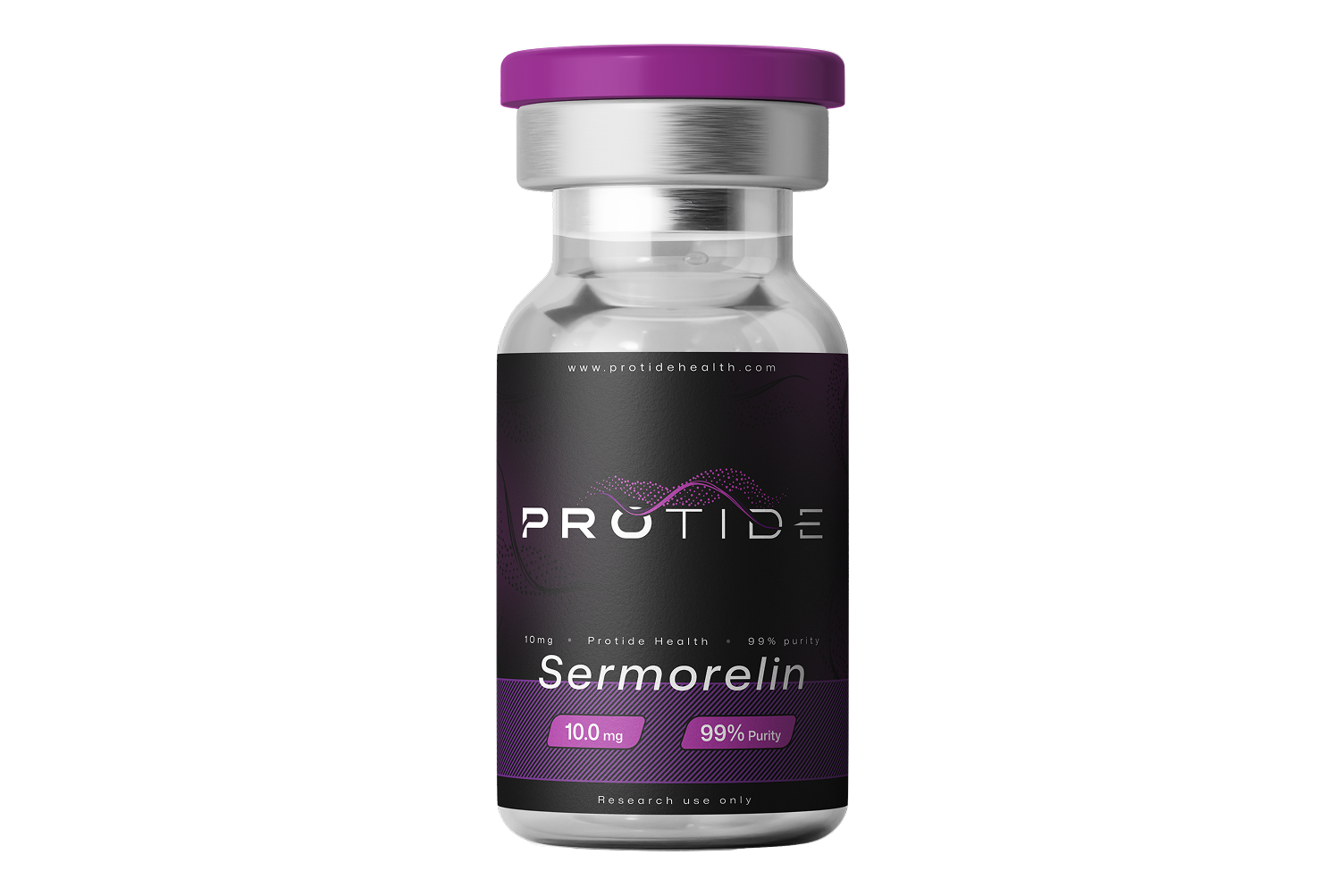
Sermorelin product shot featuring a professionally labeled Protide Health 3mL research vial containing white to off-white lyophilized powder, with available 5mg and 10mg strengths clearly displayed against a clean laboratory-style background with research-use-only labeling.


Sermorelin 5mg & 10mg – Protide Health USA
Sermorelin Peptide Overview & Technical Specifications
The peptide is a synthetic GHRH(1-29)-NH₂ fragment corresponding to the first 29 amino acids of naturally occurring human growth hormone-releasing hormone, with C-terminal amidation.
Its sequence is:
Tyr-Ala-Asp-Ala-Ile-Phe-Thr-Asn-Ser-Tyr-Arg-Lys-Val-Leu-Gly-Gln-Leu-Ser-Ala-Arg-Lys-Leu-Leu-Gln-Asp-Ile-Met-Ser-Arg-NH₂
The supplied Sermorelin PubChem chemical record identifies the free peptide as PubChem CID 16132413, CAS 86168-78-7, molecular formula C149H246N44O42S, and molecular weight approximately 3357.9 g/mol.
Protide Health supplies this research material in both 5mg and 10mg sizes as 99% purity lyophilized powder for biochemical, receptor-binding, endocrine-signaling, cellular, and preclinical investigation.
Technical Specifications
- Product Name: Sermorelin
- Available Sizes: 5mg and 10mg
- Form: Lyophilized powder
- Vial Size: 3mL
- Purity: 99%
- Testing: HPLC-MS verified; third-party tested
- Peptide Length: 29 amino acids
- Classification: GHRH(1-29)-amide
- CAS Number: 86168-78-7
- PubChem CID: 16132413
- Molecular Formula: C149H246N44O42S
- Molecular Weight: 3357.88 g/mol
- Appearance: White to off-white lyophilized powder
- Solubility: Soluble in water
- Storage: Store sealed at ≤6°C and protected from heat, light, and moisture
- Research Use: Laboratory analysis, receptor research, biochemical investigation, and qualified preclinical experimentation
Sermorelin Mechanism & Research Context
The principal research mechanism involves the growth hormone-releasing hormone receptor (GHRH-R), a class B G protein-coupled receptor expressed prominently in pituitary somatotroph research models.
GHRH-receptor activation is associated with Gs-protein signaling, stimulation of adenylate cyclase, increased intracellular cyclic AMP, protein kinase A signaling, and downstream processes associated with somatotroph activity.
Historical research with GHRH(1-29)-NH₂ demonstrated that the 29-residue N-terminal fragment retains substantial biological activity relative to longer GHRH sequences. Researchers can review broader GHRH(1-29) and peptide research indexed by PubMed for studies examining receptor activity, structure-activity relationships, pituitary biology, and endocrine signaling.
Preclinical Research Applications
GHRH Receptor Signaling Research
The 29-residue peptide provides a defined research tool for investigating GHRH receptor pharmacology.
Experimental work has examined:
- Ligand-receptor interactions
- Adenylate cyclase activation
- Intracellular cAMP production
- Somatotroph signaling
- Growth-hormone secretory pathways
- Receptor structure-activity relationships
These mechanisms are useful for endocrine and molecular research without establishing therapeutic effects for the Protide Health laboratory product.
Pituitary Somatotroph Research
GHRH receptors are strongly associated with anterior pituitary somatotroph cells.
Experimental research has used GHRH(1-29)-related peptides to examine receptor-dependent signaling and regulated endocrine responses. These studies help researchers investigate how the N-terminal region of GHRH contributes to biological receptor activity.
The findings should be interpreted according to the exact model studied and should not automatically be extrapolated from isolated cells or historical pharmaceutical preparations to independently supplied research material.
Structure-Activity Relationship Research
The 29-amino-acid fragment has also served as a foundation for extensive structure-activity research.
Investigators have synthesized modified analogues to examine how changes in individual residues affect receptor affinity, potency, conformation, enzymatic stability, and downstream signaling.
Such studies demonstrate that relatively small structural modifications can substantially change peptide activity, which is why the exact sequence and molecular form must be identified carefully in laboratory work.
GHRH Fragment Research
Naturally occurring human GHRH contains 44 amino acids, while this research peptide corresponds to the biologically active N-terminal 1-29 region with C-terminal amidation.
Research comparing different GHRH fragments has helped establish that much of the receptor-activating information is contained within this N-terminal region.
This makes the peptide useful for controlled research into minimal active sequences, receptor recognition, and endocrine signaling.
What Research on Sermorelin Benefits Actually Shows
Searches for sermorelin benefits often lead to human-use or commercial claims. For a laboratory research product, the evidence is better described through experimentally measured endpoints.
Published work has investigated:
- GHRH receptor activation
- Somatotroph signaling
- cAMP-associated pathways
- GH-release mechanisms
- Peptide structure-activity relationships
- Receptor-binding characteristics
- Endocrine research responses
These observations provide mechanistic information but do not demonstrate that this research material produces anti-aging, bodybuilding, weight-management, therapeutic, or other health benefits.
Sermorelin Side Effects and Research Limitations
The phrase sermorelin side effects generally relates to human administration and is not applicable as a safety claim for this laboratory product.
Relevant research limitations include:
- Human studies involving historical pharmaceutical preparations do not establish safety for independently supplied research material.
- Experimental endocrine responses depend on the exact model and conditions used.
- Cell-based observations cannot automatically be extrapolated to intact organisms.
- Findings from clinical research should not be converted into treatment claims for a research-use-only product.
- Molecular activity at GHRH receptors does not establish broader therapeutic outcomes.
No human safety, tolerability, dosage, or administration claims are made here.
Understanding Sermorelin Before and After Searches
The phrase sermorelin before and after typically reflects interest in human outcomes rather than laboratory science.
Protide Health does not present photographic, body-composition, performance, cosmetic, anti-aging, or other human before-and-after claims for this product. The scientifically appropriate focus is instead on measurable receptor signaling, biochemical assays, pituitary-cell research, and other controlled experimental endpoints.
Research Format and Storage
The material is supplied as white to off-white lyophilized powder in a 3mL vial.
Lyophilization removes water from frozen material under reduced pressure and provides a dry format commonly used for peptide research.
According to the supplied product specification, the unopened material should remain sealed at ≤6°C and protected from heat, light, and moisture.
This product is not marketed as sermorelin tablets, and no dosing, administration, injection, or other human-use instructions are provided.
Literature & Citation Index
Growth Hormone Responses to Growth Hormone-Releasing Hormone (1-29)-NH₂ and a D-Ala² Analog in Normal Men
PMID: 2866496
Research Context: Comparative biological activity of GHRH(1-29)-NH₂ and longer GHRH sequences.
Human Growth Hormone-Releasing Hormone hGHRH(1-29)-NH₂: Systematic Structure-Activity Relationship Studies
PMID: 9513600
Research Context: Sequence modification, receptor activation, peptide conformation, and GHRH analogue potency.
PEGylation of Growth Hormone-Releasing Hormone (GRF) Analogues
Authors: P. Esposito et al.
Year: 2003
PMID: 14499707
DOI: 10.1016/S0169-409X(03)00109-1
Research Context: GHRH(1-29) structure, bioactivity, peptide stability, and modification strategies.
Related Protide Health Research Products
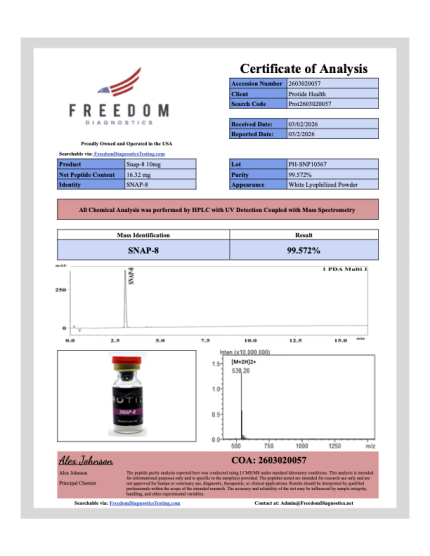
Researchers examining structurally different peptide systems may review the SNAP-8 10mg research peptide for a separate short-peptide experimental model.
The Selank 10mg research peptide provides a distinct seven-amino-acid regulatory peptide for neurochemical and molecular research.
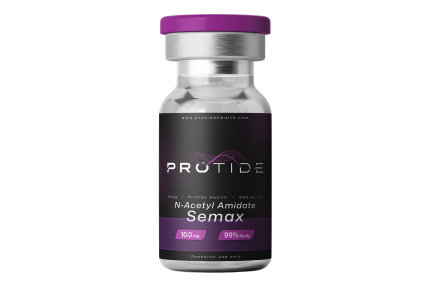
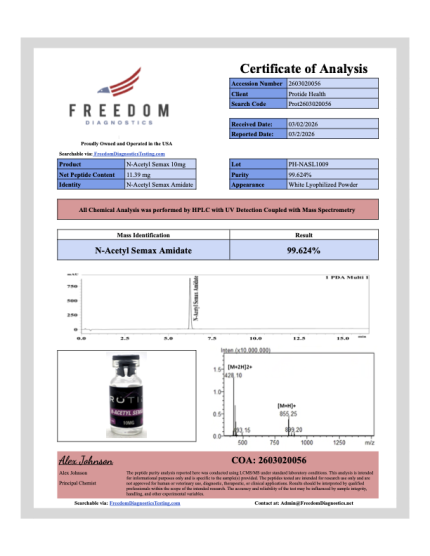
Researchers may also examine N-Acetyl Semax Amidate 10mg for a chemically distinct modified heptapeptide research system.
These compounds have different sequences, molecular targets, and experimental contexts and should not be considered interchangeable.
Frequently Asked Questions
What is Sermorelin?
Sermorelin is a synthetic 29-amino-acid peptide corresponding to GHRH(1-29)-amide, the biologically active N-terminal region of human growth hormone-releasing hormone.
What is its amino-acid sequence?
The sequence is:
Tyr-Ala-Asp-Ala-Ile-Phe-Thr-Asn-Ser-Tyr-Arg-Lys-Val-Leu-Gly-Gln-Leu-Ser-Ala-Arg-Lys-Leu-Leu-Gln-Asp-Ile-Met-Ser-Arg-NH₂
What receptors are studied with this peptide?
The principal target is the growth hormone-releasing hormone receptor, or GHRH-R. Experimental activation of this receptor is associated with Gs-protein, adenylate cyclase, and cAMP-dependent signaling.
What sizes does Protide Health supply?
The product is available in 5mg and 10mg sizes, supplied as lyophilized powder in a 3mL vial.
What purity is specified?
The supplied specification states 99% purity, with HPLC-MS verification and third-party testing.
Is this the same as Sermorelin acetate?
No. The product specification and chemical identifiers used here correspond to the free peptide, CAS 86168-78-7. The acetate salt is a related but chemically distinct form.
Is this product intended for human use?
No. It is supplied exclusively for laboratory, biochemical, receptor-signaling, analytical, and qualified preclinical research.
Laboratory Terms & Compliance
Laboratory Research Use Only
This product is supplied exclusively for laboratory research, analytical testing, in-vitro studies, preclinical research, and qualified scientific experimentation.
It is not intended for human or veterinary consumption, diagnostic use, medical use, therapeutic use, bodybuilding, anti-aging use, weight-management use, or clinical administration.
No human dosage, dosing, injection, administration, or preparation instructions are provided.
The purchaser is responsible for appropriate laboratory handling, storage, and use in accordance with applicable institutional, federal, state, and local requirements.
For research use only.
| Select vial strength |
10mg ,5mg |
|---|


MAECENAS IACULIS
Vestibulum curae torquent diam diam commodo parturient penatibus nunc dui adipiscing convallis bulum parturient suspendisse parturient a.Parturient in parturient scelerisque nibh lectus quam a natoque adipiscing a vestibulum hendrerit et pharetra fames nunc natoque dui.
ADIPISCING CONVALLIS BULUM
- Vestibulum penatibus nunc dui adipiscing convallis bulum parturient suspendisse.
- Abitur parturient praesent lectus quam a natoque adipiscing a vestibulum hendre.
- Diam parturient dictumst parturient scelerisque nibh lectus.
Scelerisque adipiscing bibendum sem vestibulum et in a a a purus lectus faucibus lobortis tincidunt purus lectus nisl class eros.Condimentum a et ullamcorper dictumst mus et tristique elementum nam inceptos hac parturient scelerisque vestibulum amet elit ut volutpat.
Related products
Reviews
There are no reviews yet.