
BPC-157 & TB-500 “Wolverine” Blend
Price range: $145.00 through $305.00
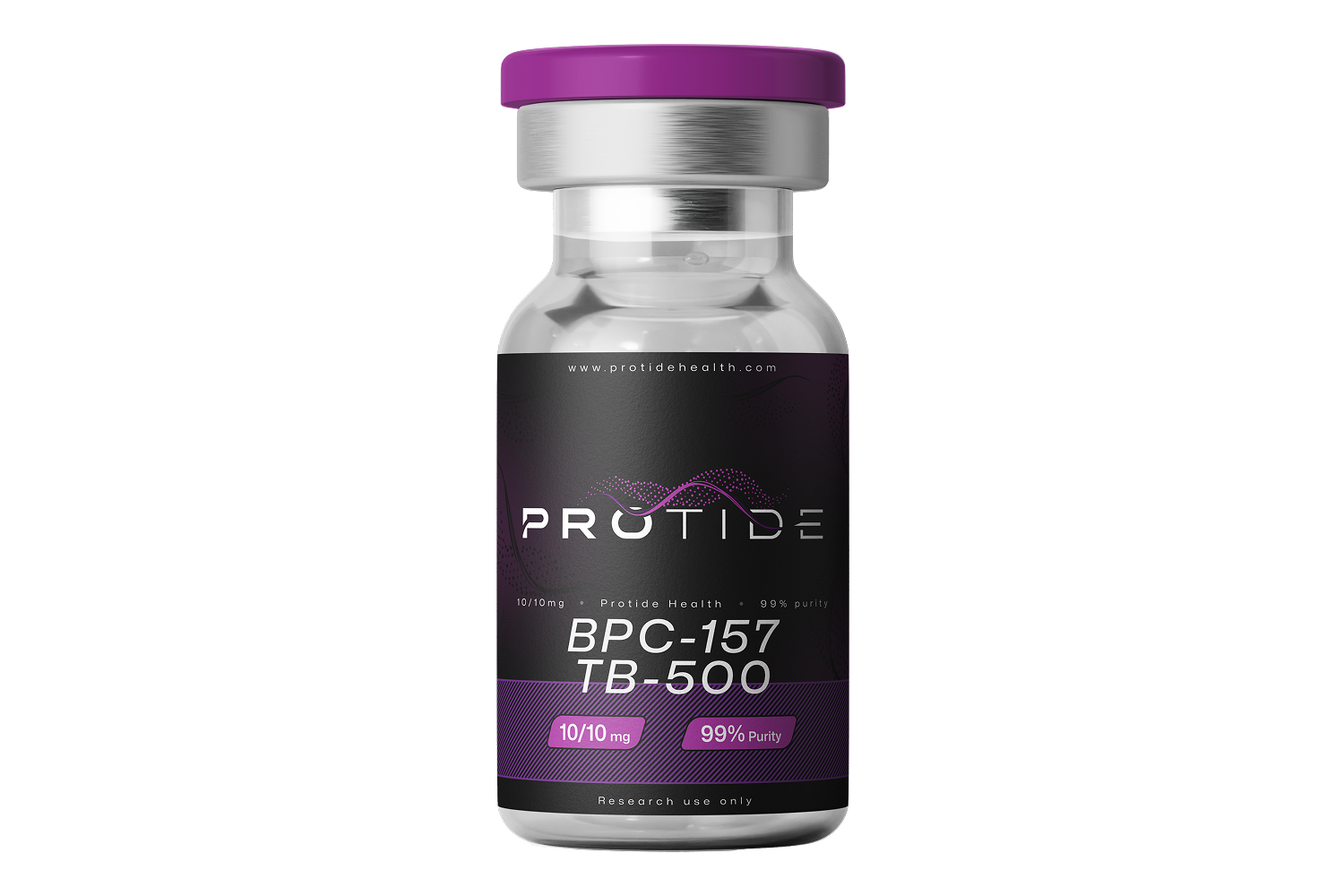
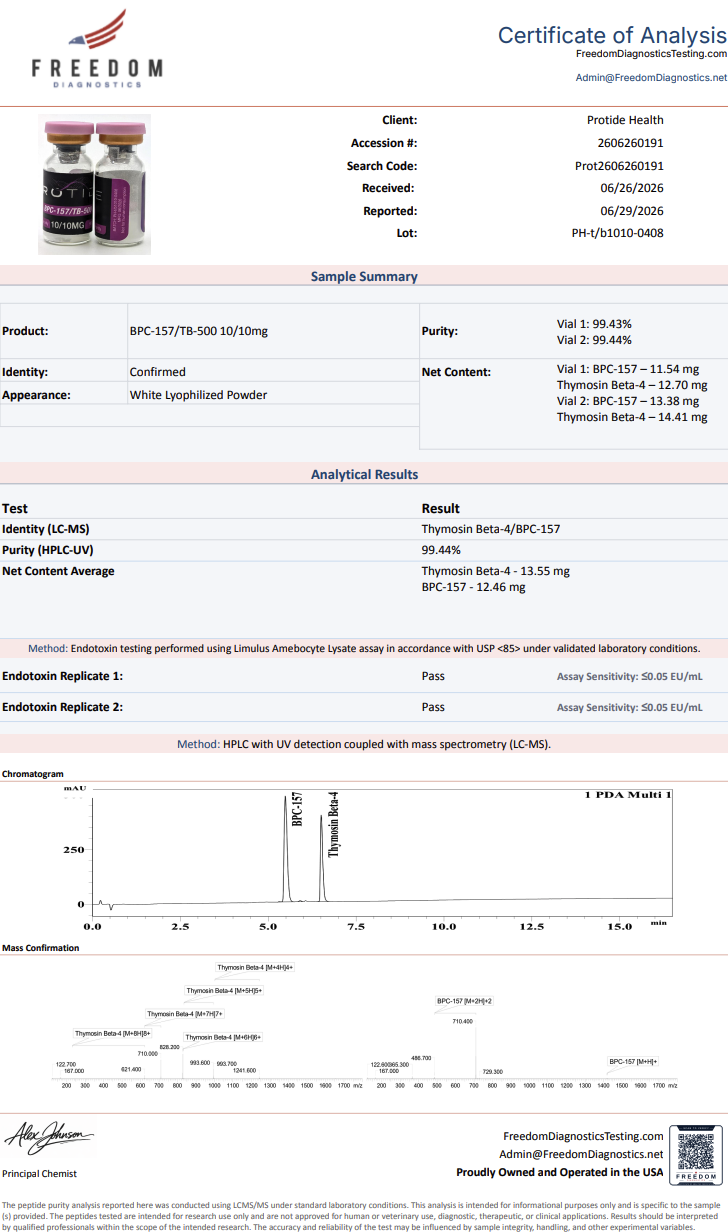
BPC-157 & TB-500 blend, also known as the “Wolverine Blend”, is a synthetic pentadecapeptide (15 amino acids) + synthetic N-acetylated 43-amino acid thymosin beta-4 peptide blend. Available in 10/10mg and 30/30mg stable lyophilized vials. Third-party HPLC-MS verified 99% purity. For research use only. Not for human consumption.


BPC 157 and TB 500 Peptide Blend – Protide Health USA
BPC 157 and TB 500 Overview & Technical Specifications
BPC 157 and TB 500 is a dual-peptide laboratory research blend containing equal quantities of BPC-157 and full-length N-acetylated thymosin beta-4.
Protide Health supplies this research formulation in two sizes:
- BPC-157 10mg / TB-500 10mg
- BPC-157 30mg / TB-500 30mg
The blend combines:
- A synthetic 15-amino-acid pentadecapeptide
- A full-length 43-amino-acid actin-binding peptide
The material is supplied as 99% purity, HPLC-MS verified, third-party tested lyophilized powder in a 3mL vial.
Technical Specifications
- Product Name: BPC-157 & TB-500 Blend
- Alternative Names: BPC-157 / TB-500 Blend, BPC 157 TB 500 Blend, Wolverine Blend
- Available Sizes: 10mg/10mg and 30mg/30mg
- Form: Lyophilized powder
- Vial Size: 3mL
- Purity: 99%
- Testing: HPLC-MS verified; third-party tested
- Appearance: White to off-white lyophilized powder
- Solubility: Soluble in water
- Storage: Store sealed at ≤6°C and protected from heat, light, and moisture
- Research Classification: Laboratory and qualified preclinical research only
BPC 157 Component
BPC-157 is a synthetic pentadecapeptide with the sequence:
Gly-Glu-Pro-Pro-Pro-Gly-Lys-Pro-Ala-Asp-Asp-Ala-Gly-Leu-Val
or:
GEPPPGKPADDAGLV
Verified reference information includes:
- PubChem CID: 9941957
- CAS Number: 137525-51-0
- Molecular Formula: C62H98N16O22
- Molecular Weight: approximately 1419.56 g/mol
- Peptide Length: 15 amino acids
Researchers can reference the supplied BPC-157 chemical structure.
TB 500 Component
The TB-500 component in this blend is specified as full-length N-acetylated thymosin beta-4.
Its sequence is:
Ac-Ser-Asp-Lys-Pro-Asp-Met-Ala-Glu-Ile-Glu-Lys-Phe-Asp-Lys-Ser-Lys-Leu-Lys-Lys-Thr-Glu-Thr-Gln-Glu-Lys-Asn-Pro-Leu-Pro-Ser-Lys-Glu-Thr-Ile-Glu-Gln-Glu-Lys-Gln-Ala-Gly-Glu-Ser
or:
Ac-SDKPDMAEIEKFDKSKLKKTETQEKNPLPSKETIEQEKQAGES-OH
Verified reference information includes:
- PubChem CID: 16132341
- CAS Number: 77591-33-4
- Molecular Formula: C212H350N56O78S
- Molecular Weight: approximately 4963.44 g/mol
- Peptide Length: 43 amino acids
This is important because the term TB-500 is sometimes used inconsistently online.
The supplied specification here corresponds to full-length thymosin beta-4 rather than a shorter peptide fragment.
BPC 157 and TB 500 Research Context
The BPC 157 and TB 500 blend combines two peptides associated with different experimental pathways.
BPC-157 Research Areas
BPC-157 research has examined:
- Vascular responses
- VEGF-associated signaling
- Nitric oxide systems
- FAK-associated pathways
- Endothelial responses
- Cell migration
- Experimental gastrointestinal models
- Tissue-response models
TB-500 / Thymosin Beta-4 Research Areas
Thymosin beta-4 research has examined:
- G-actin binding
- Actin sequestration
- Cytoskeletal dynamics
- Cellular migration
- Endothelial biology
- Tissue-remodeling models
The two compounds should therefore be treated as distinct research agents rather than as one established pharmacological molecule.
BPC 157 TB 500 Blend & Vascular Research
One of the commonly studied BPC-157 pathways involves vascular biology.
A published review discussed BPC-157 in relation to blood-vessel responses involving:
- Endothelium
- Nitric oxide
- VEGF
- FAK
- Angiogenesis
- Vasculogenesis
- Arteriogenesis
The review focused mainly on preclinical models and vascular responses to experimental injury.
These findings do not establish human therapeutic effects.
TB 500 and BPC 157: Actin & Cytoskeletal Research
Thymosin beta-4 has a well-defined biochemical relationship with actin.
Beta-thymosins help maintain a reservoir of unpolymerized actin monomers.
Experimental work has shown that thymosin beta-4 can:
- Bind G-actin
- Form approximately 1:1 peptide-actin complexes
- Inhibit actin polymerization
- Contact both barbed and pointed regions of actin
- Influence cytoskeletal organization
This actin-binding biology is one of the clearest mechanistic distinctions between TB 500 and BPC 157.
BPC 157 vs TB 500
The search phrase bpc 157 vs tb 500 compares two structurally and mechanistically distinct peptides.
BPC-157
- 15 amino acids
- Sequence: GEPPPGKPADDAGLV
- Molecular weight: ~1419.56 g/mol
- Studied primarily in vascular, gastrointestinal, nitric-oxide, FAK, and experimental tissue-response models
TB-500 / Thymosin Beta-4
- 43 amino acids
- N-terminally acetylated
- Molecular weight: ~4963.44 g/mol
- Characterized strongly through G-actin binding and cytoskeletal research
Neither compound should be described as universally superior.
They represent different experimental systems.
TB 500 vs BPC 157
The reversed comparison tb 500 vs bpc 157 involves the same distinction.
Thymosin beta-4 has one of the more clearly established molecular mechanisms because its interaction with actin has been directly characterized structurally and biochemically.
BPC-157 literature instead focuses more heavily on preclinical signaling and vascular-response models.
The two compounds therefore differ in:
- Peptide length
- Molecular size
- Sequence
- Cellular targets
- Experimental evidence
- Research applications
BPC 157 TB 500 Blend Research Design
A blend containing both peptides introduces an additional experimental question:
Are observed effects caused by BPC-157, thymosin beta-4, or their combination?
Appropriate research controls may therefore include:
- BPC-157 alone
- Thymosin beta-4 alone
- BPC-157 + thymosin beta-4
- Vehicle control
- Concentration-matched comparator groups
The presence of both components in one vial does not prove synergy.
Direct combination research would be required to establish additive or synergistic behavior.
BPC 157 and TB 500 Combination Evidence
The BPC 157 and TB 500 combination is widely discussed commercially, but the evidence base for the exact combined formulation is far smaller than the literature for each component individually.
Researchers should distinguish:
- BPC-157-only studies
- Thymosin beta-4-only studies
- True BPC-157 + thymosin beta-4 combination studies
Findings from the first two categories should not automatically be attributed to the dual blend.
Wolverine Peptide Search Context
The phrase wolverine peptide is an informal commercial nickname often used for combinations of BPC-157 and TB-500.
It is not a formal biochemical or pharmacological classification.
For scientific purposes, the product should instead be identified by its actual contents:
BPC-157 + full-length thymosin beta-4
The term should not be interpreted as evidence of enhanced healing, regeneration, or athletic recovery.
Wolverine Stack Peptide Research Context
The phrase wolverine stack peptide is another informal marketplace term.
A “stack” refers to the co-use or co-formulation of multiple compounds.
In this case, it generally refers to:
- BPC-157
- TB-500 / thymosin beta-4
The term itself does not define:
- Molecular interaction
- Synergy
- Efficacy
- Safety
- Human-use protocol
Protide Health therefore treats wolverine stack peptide strictly as a search-intent phrase rather than a scientific claim.
Wolverine Peptide Stack Evidence Limitations
The phrase wolverine peptide stack should be interpreted cautiously.
There is currently much stronger literature for BPC-157 and thymosin beta-4 individually than for a defined combined “Wolverine” formulation.
A scientifically appropriate study would require:
- Defined concentrations
- Verified identities
- Appropriate controls
- Predefined endpoints
- Statistical analysis
- Combination-versus-single-agent comparisons
Without these controls, synergy cannot be established.
BPC 157 TB 500 Dosage Search Context
The phrase bpc 157 tb 500 dosage generally concerns human administration.
Protide Health does not provide human dosing guidance.
The quantities listed on this page describe vial contents only.
Available blend sizes are:
10mg/10mg
- BPC-157: 10mg
- TB-500: 10mg
- Total peptide material: 20mg
30mg/30mg
- BPC-157: 30mg
- TB-500: 30mg
- Total peptide material: 60mg
These are not recommended human doses.
No guidance is provided for:
- Human injection
- Administration schedules
- Weekly protocols
- Daily protocols
- Body-weight calculations
- Treatment cycles
- Reconstitution for administration
- Injury protocols
- Athletic recovery protocols
Qualified laboratories should determine experimental concentrations according to validated research methodology.
BPC 157 and TB 500 & Nitric Oxide Research
BPC-157 literature frequently discusses the nitric-oxide system.
Research has examined possible interactions involving:
- NO pathways
- Endothelial responses
- Vasodilation
- Vasoconstriction
- Vascular adaptation
These observations are largely based on preclinical research and should not be converted into clinical treatment claims.
TB-500 & G-Actin Sequestration
The TB-500 component contributes a distinct biochemical mechanism.
Thymosin beta-4 binds actin monomers and can help regulate the pool of polymerizable G-actin.
This has implications for research involving:
- Cell shape
- Cell migration
- Cytoskeletal remodeling
- Motility
- Endothelial behavior
Structural research has shown that thymosin beta-4 interacts with regions spanning both ends of actin, helping explain its ability to inhibit polymerization.
BPC 157 TB 500 & Cell Migration Research
Both peptides have been investigated in research involving cellular migration, but their mechanisms differ.
BPC-157 research often discusses:
- FAK signaling
- Endothelial responses
- VEGF-associated pathways
Thymosin beta-4 research centers more strongly on:
- Actin dynamics
- G-actin sequestration
- Cytoskeletal organization
This mechanistic distinction is important when studying the blend.
Related Protide Health Research Products
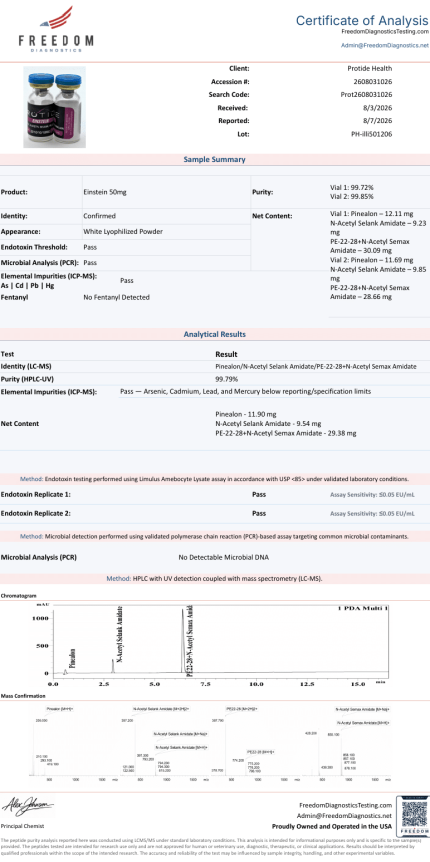
Researchers comparing other multi-component peptide formulations may review the Illumineuro Einstein Peptide Blendfor a mechanistically distinct multi-peptide research system.
The Klow Blend GHK-Cu + KPV + BPC-157 + TB-500 provides a four-component formulation containing both BPC-157 and thymosin beta-4 alongside GHK-Cu and KPV.
Researchers may also compare the TB-500 + BPC-157 + KPV Coremend Blend for another distinct combination containing KPV.
These products should not be considered interchangeable with the BPC 157 and TB 500 blend.
Research Format & Storage
Protide Health supplies the BPC 157 TB 500 blend in:
- 10mg/10mg
- 30mg/30mg
Product characteristics include:
- Form: Lyophilized powder
- Vial Size: 3mL
- Purity: 99%
- Testing: HPLC-MS verified
- Verification: Third-party tested
- Appearance: White to off-white
- Solubility: Soluble in water
Storage specifications:
- Store at ≤6°C
- Keep sealed
- Protect from heat
- Protect from direct light
- Protect from moisture
These conditions describe laboratory storage only.
Research Limitations
Several limitations should be considered when interpreting BPC 157 and TB 500 research:
- The blend contains two distinct peptides.
- Co-formulation does not establish synergy.
- BPC-157 research remains dominated by preclinical evidence.
- Human evidence for BPC-157 remains limited.
- Thymosin beta-4 research should be distinguished from shorter TB-500 fragments.
- The current specification represents full-length thymosin beta-4.
- Findings from individual components cannot automatically be attributed to the blend.
- Animal findings do not establish equivalent human effects.
- Commercial “Wolverine” terminology is not a scientific classification.
- The 10mg/10mg and 30mg/30mg values describe vial contents rather than human doses.
- The Protide Health formulation is not an FDA-approved therapeutic product.
For these reasons, the blend is supplied strictly for qualified laboratory research.
Literature & Citation Index
BPC 157 and Blood Vessels
Year: 2014
PMID: 23782145
DOI: 10.2174/13816128113199990421
Research Context: BPC-157, endothelium, nitric oxide, VEGF, FAK, angiogenesis, vasculogenesis, arteriogenesis, and vascular-response models.
Thymosin Beta 4 Binds Actin in an Extended Conformation and Contacts Both the Barbed and Pointed Ends
Year: 1997
PMID: 9153421
DOI: 10.1021/bi970185v
Research Context: Thymosin beta-4, G-actin binding, 1:1 complex formation, actin sequestration, peptide conformation, and actin polymerization.
Researchers can review broader BPC-157 and thymosin beta-4 literature indexed by PubMed for additional peer-reviewed background research.
Frequently Asked Questions
What is BPC 157 and TB 500?
BPC 157 and TB 500 is a dual-peptide research formulation containing BPC-157 and full-length N-acetylated thymosin beta-4.
What sizes are available?
Protide Health supplies:
- BPC-157 10mg / TB-500 10mg
- BPC-157 30mg / TB-500 30mg
What is BPC-157?
BPC-157 is a synthetic 15-amino-acid peptide with the sequence:
GEPPPGKPADDAGLV
What is TB-500 in this blend?
The supplied TB-500 component is full-length, N-acetylated thymosin beta-4 containing 43 amino acids.
Is TB-500 a short fragment here?
No. The supplied identity corresponds to full-length thymosin beta-4, not a short peptide fragment.
What is the difference between BPC 157 vs TB 500?
BPC 157 vs TB 500 compares a 15-amino-acid peptide associated primarily with vascular and signaling research to a 43-amino-acid peptide with a well-characterized actin-binding mechanism.
What about TB 500 vs BPC 157?
The same distinction applies. Thymosin beta-4 is strongly associated with actin dynamics, whereas BPC-157 literature centers more on preclinical vascular and signaling models.
What is a Wolverine peptide?
Wolverine peptide is an informal marketplace term often used for BPC-157 and TB-500 combinations. It is not an official scientific classification.
What is a Wolverine stack peptide?
A wolverine stack peptide generally refers to the combined use or formulation of BPC-157 and TB-500. The term itself does not establish synergy or efficacy.
What is a Wolverine peptide stack?
The phrase wolverine peptide stack is another informal term for BPC-157 plus TB-500. Protide Health uses the precise component identities for scientific clarity.
What is BPC 157 TB 500 dosage?
Protide Health does not provide human BPC 157 TB 500 dosage instructions. The listed mg quantities describe vial contents only.
Do BPC-157 and TB-500 work synergistically?
Synergy has not been established merely by combining them. Direct controlled combination studies would be required.
What purity does Protide Health specify?
Protide Health specifies 99% purity, HPLC-MS verification, and third-party testing.
Is the blend intended for human use?
No. It is supplied exclusively for vascular, cytoskeletal, actin, cellular, molecular, biochemical, analytical, in-vitro, and qualified preclinical research.
Laboratory Terms & Compliance
Laboratory Research Use Only
This BPC 157 and TB 500 blend is supplied exclusively for laboratory research, vascular-signaling investigation, actin and cytoskeletal research, analytical testing, biochemical experimentation, cellular studies, in-vitro research, and qualified preclinical experimentation.
It is not intended for human or veterinary consumption, medical use, wound treatment, injury recovery, athletic recovery, bodybuilding, injection, diagnostic use, therapeutic use, or clinical administration.
No human dosage, injection schedule, treatment cycle, injury protocol, athletic protocol, body-weight calculation, reconstitution guidance for administration, or human-use preparation instructions are provided.
The purchaser is responsible for appropriate laboratory handling, storage, and use under applicable institutional, federal, state, and local requirements.
For research use only.
| Select vial strength |
10/10mg ,30/30mg |
|---|


MAECENAS IACULIS
Vestibulum curae torquent diam diam commodo parturient penatibus nunc dui adipiscing convallis bulum parturient suspendisse parturient a.Parturient in parturient scelerisque nibh lectus quam a natoque adipiscing a vestibulum hendrerit et pharetra fames nunc natoque dui.
ADIPISCING CONVALLIS BULUM
- Vestibulum penatibus nunc dui adipiscing convallis bulum parturient suspendisse.
- Abitur parturient praesent lectus quam a natoque adipiscing a vestibulum hendre.
- Diam parturient dictumst parturient scelerisque nibh lectus.
Scelerisque adipiscing bibendum sem vestibulum et in a a a purus lectus faucibus lobortis tincidunt purus lectus nisl class eros.Condimentum a et ullamcorper dictumst mus et tristique elementum nam inceptos hac parturient scelerisque vestibulum amet elit ut volutpat.
Related products
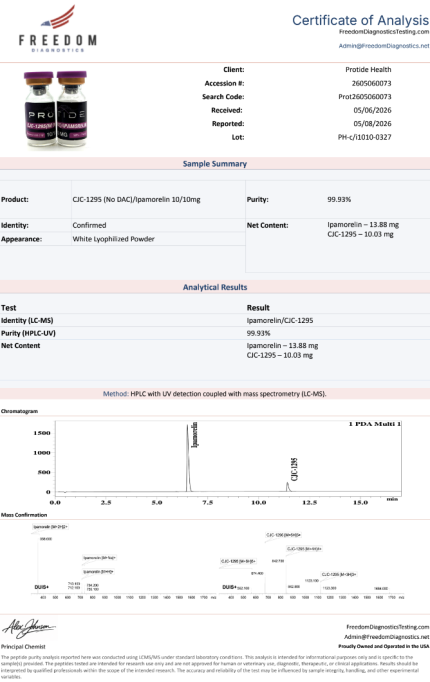
CJC-1295 (No Dac) & Ipamorelin Blend
Price range: $75.00 through $125.00
Reviews
There are no reviews yet.