
Illumineuro “Einstein” Peptide Blend
$175.00
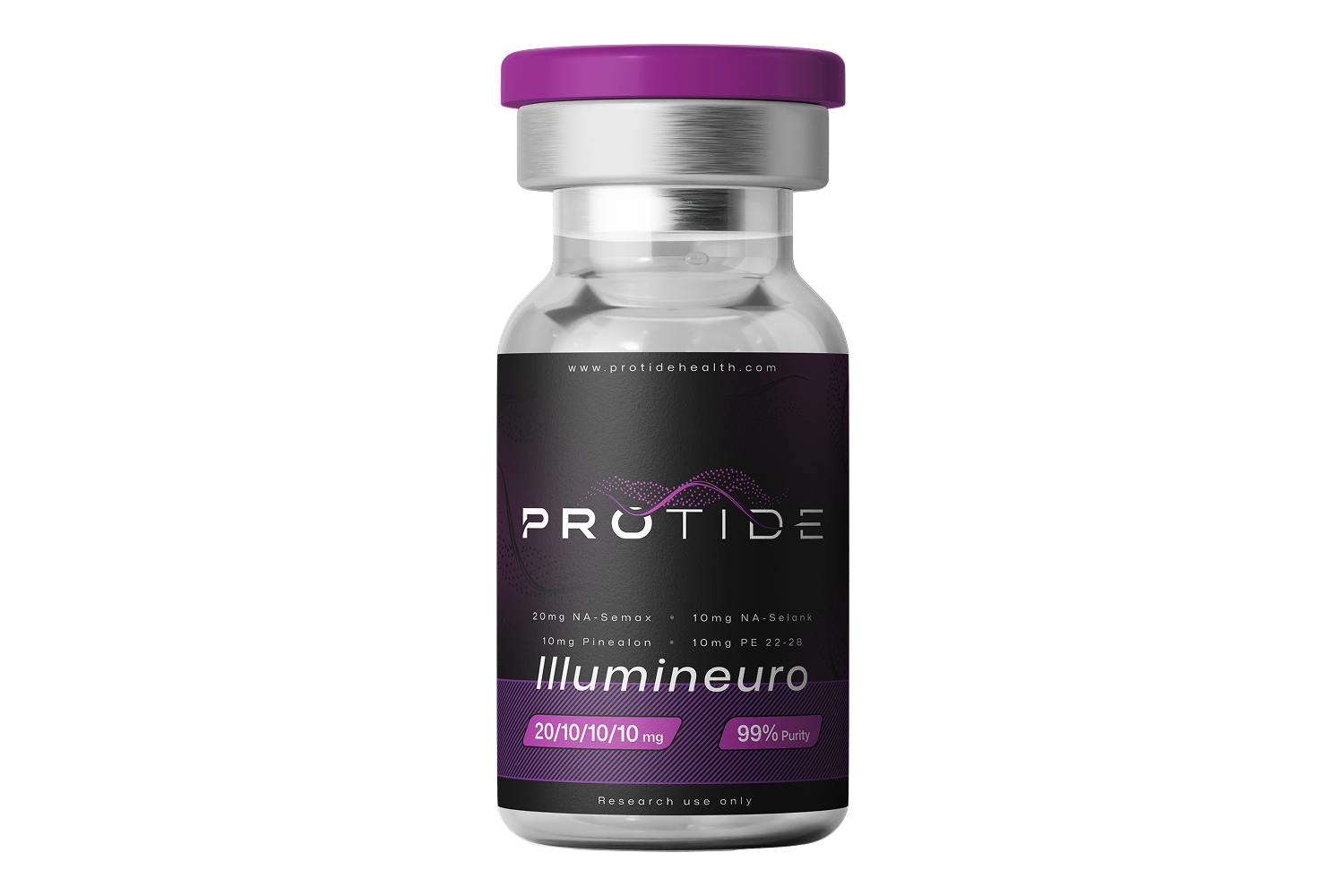
Illumineuro peptide blend 50mg product shot featuring a professionally labeled Protide Health 3mL research vial containing white to off-white lyophilized material, with N-Acetyl Semax 20mg, N-Acetyl Selank 10mg, Pinealon 10mg, and PE-22-28 10mg clearly identified alongside laboratory-research-only labeling against a clean scientific background.


Illumineuro Peptide Blend 50mg – Protide Health USA
Illumineuro Peptide Blend Overview
The Illumineuro peptide blend is a four-component research formulation supplied by Protide Health as 50mg of lyophilized material in a 3mL vial.
Each vial contains:
- N-Acetyl Semax: 20mg
- N-Acetyl Selank: 10mg
- Pinealon: 10mg
- PE-22-28: 10mg
- Total Research Material: 50mg
The Illumineuro peptide blend combines four chemically distinct research peptides associated with different experimental pathways involving neuropeptide signaling, gene expression, GABA-associated systems, short regulatory peptide biology, and TREK-1 potassium-channel research.
Protide Health specifies the blend as:
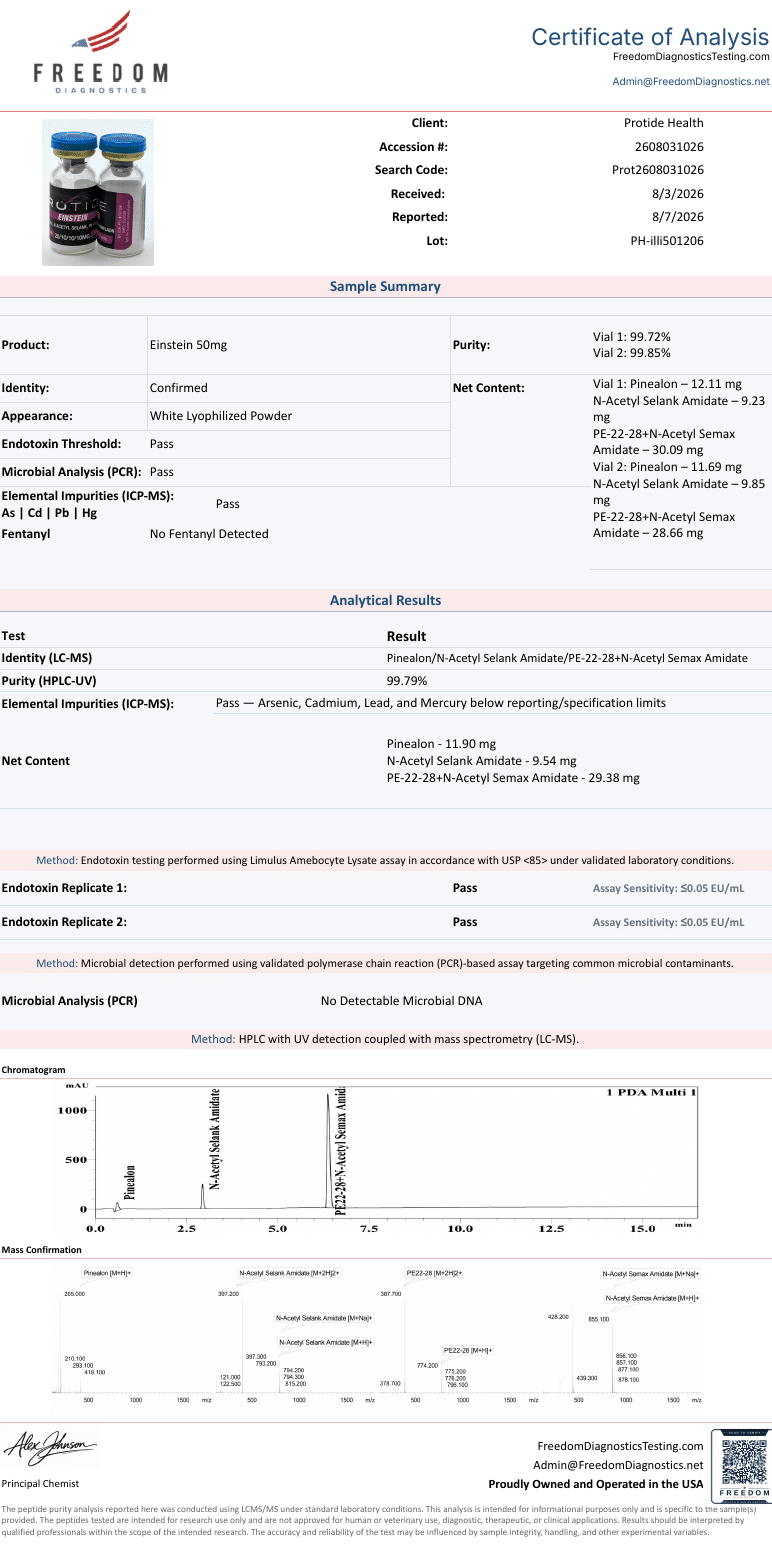
- Purity: 99%
- Testing: HPLC-MS verified
- Verification: Third-party tested
- Form: Lyophilized powder
- Vial Size: 3mL
- Appearance: White to off-white
- Solubility: Components specified as water-soluble
- Storage: Store sealed at ≤6°C and protected from heat, light, and moisture
- Research Classification: Laboratory and qualified preclinical research only
Illumineuro Peptide Blend Component Summary
The four components of the Illumineuro peptide blend are not chemically interchangeable.
N-Acetyl Semax — 20mg
N-Acetyl Semax is a terminally modified analogue of the Semax peptide sequence.
The supplied form is:
Ac-Met-Glu-His-Phe-Pro-Gly-Pro-NH₂
or:
Ac-MEHFPGP-NH₂
Verified PubChem data for this form include:
- PubChem CID: 172638603
- CAS Number: 2920938-90-3
- Molecular Formula: C39H54N10O10S
- Molecular Weight: approximately 854.97 g/mol
- Modification: N-terminal acetylation and C-terminal amidation
Researchers examining structural identity can reference the supplied N-Acetyl Semax chemical structure.
The PubChem record specifically describes the amidated form Ac-MEHFPGP-NH₂.
N-Acetyl Selank — 10mg
N-Acetyl Selank is derived from the tuftsin-related Selank sequence.
The supplied product sequence is:
Ac-Thr-Lys-Pro-Arg-Pro-Gly-Pro-NH₂
or:
Ac-TKPRPGP-NH₂
An important chemical distinction applies here.
The supplied PubChem record CID 133082488 corresponds to:
Ac-Thr-Lys-Pro-Arg-Pro-Gly-Pro-OH
rather than the amidated -NH₂ sequence.
That PubChem record reports:
- Molecular Formula: C35H59N11O10
- Molecular Weight: approximately 793.92 g/mol
- PubChem CID: 133082488
Researchers can review the supplied N-Acetyl Selank PubChem structure, but it should be recognized as the free-acid N-acetyl form rather than the fully amidated sequence.
Because the supplied sequence and supplied PubChem identity represent different terminal forms, Protide Health should confirm this component against lot-specific HPLC-MS documentation before assigning a single formula or PubChem CID to the amidated material.
Pinealon — 10mg
Pinealon is the synthetic tripeptide:
Glu-Asp-Arg
or:
EDR
Its verified chemical identity includes:
- PubChem CID: 10273502
- CAS Number: 175175-23-2
- Molecular Formula: C15H26N6O8
- Molecular Weight: approximately 418.40 g/mol
- Sequence: H-Glu-Asp-Arg-OH
Researchers can review the supplied Pinealon chemical structure.
Pinealon is chemically much smaller than the modified Semax and Selank components and should be treated as a distinct short regulatory peptide.
PE-22-28 — 10mg
PE-22-28 is a seven-amino-acid peptide with the sequence:
Gly-Val-Ser-Trp-Gly-Leu-Arg
or:
GVSWGLR
Verified reference data include:
- PubChem CID: 165437303
- CAS Number: 1801959-12-5
- Molecular Formula: C35H55N11O9
- Molecular Weight: approximately 773.89 g/mol
- Sequence: H-Gly-Val-Ser-Trp-Gly-Leu-Arg-OH
Researchers can review the supplied PE-22-28 chemical structure.
PE-22-28 is associated experimentally with TREK-1 potassium-channel research and was developed from shorter spadin-derived peptide research.
Illumineuro Peptide Blend Research Context
The Illumineuro peptide blend combines four research peptides with different structural origins and experimental targets.
The blend spans research areas involving:
- ACTH-derived peptide analogues
- Tuftsin-derived peptide research
- Short regulatory peptide biology
- GABA-associated gene-expression models
- Neurotrophin-related signaling
- TREK-1 potassium-channel research
- Cellular stress-response models
- Neurotransmission-associated gene expression
The presence of these four peptides in one formulation does not establish that they act synergistically.
Any combined effect must be investigated experimentally with appropriate control groups.
N-Acetyl Semax Research Context
Most peer-reviewed Semax literature concerns the parent peptide:
Met-Glu-His-Phe-Pro-Gly-Pro
rather than the terminally modified N-acetyl amidate analogue.
Parent Semax research has examined:
- BDNF expression
- NGF expression
- Neurotransmission-related genes
- Immune-response genes
- Vascular-response genes
- Cellular stress pathways
- Experimental cerebral ischemia models
Published rodent studies have reported changes in neurotrophin expression and transcriptomic responses following Semax exposure.
These findings provide background research for Semax-derived chemistry but should not automatically be assigned to N-Acetyl Semax Amidate.
The modified analogue requires compound-specific validation.
N-Acetyl Selank Research Context
Selank is derived from the tuftsin-related sequence:
Thr-Lys-Pro-Arg-Pro-Gly-Pro
Parent Selank research has examined:
- GABAergic neurotransmission
- Receptor-associated gene expression
- Cytokines
- Chemokines
- Enkephalin metabolism
- Neurotransmitter systems
- Behavioral stress models
A 2016 study reported changes in numerous neurotransmission-associated genes after Selank administration in rat frontal cortex, including genes associated with GABAergic signaling.
The Illumineuro peptide blend contains an N-acetyl Selank component rather than standard Selank.
Results from parent Selank should therefore be treated as mechanistic background rather than direct evidence for the modified component.
Pinealon Research Context
Pinealon, or EDR, is a three-amino-acid peptide.
Research involving Pinealon has examined:
- Reactive oxygen species
- Oxidative-stress models
- Cell viability
- ERK-associated signaling
- DNA interactions
- Gene-expression hypotheses
- Serotonin-associated experimental pathways
- Neuronal cell models
Pinealon research is distinct from both Semax and Selank because EDR is much shorter and structurally unrelated to either parent peptide system.
Its inclusion in the Illumineuro peptide blend introduces a separate short-peptide experimental pathway.
PE-22-28 & TREK-1 Research
PE-22-28 was developed from research involving spadin-derived peptides.
Published work has investigated PE-22-28 in relation to the potassium channel:
TREK-1
also known as:
KCNK2
TREK-1 belongs to the two-pore-domain potassium-channel family.
Experimental PE-22-28 studies have examined:
- TREK-1 inhibition
- Patch-clamp electrophysiology
- Peptide stability
- Neuronal signaling
- Synaptogenesis-related endpoints
- Neurogenesis-related animal models
- Behavioral research models
Published work reported greater TREK-1 affinity for PE-22-28 than for the longer parent spadin peptide under the experimental conditions studied.
These findings remain preclinical.
Four Peptides, Four Distinct Research Pathways
The Illumineuro peptide blend should not be treated as one chemically uniform peptide.
N-Acetyl Semax
Research context:
- ACTH-derived peptide chemistry
- Neurotrophin-associated pathways
- Gene-expression models
- Neuroimmune signaling
N-Acetyl Selank
Research context:
- Tuftsin-derived peptide chemistry
- GABA-associated pathways
- Neurotransmission gene expression
- Cytokine and chemokine research
Pinealon
Research context:
- EDR short-peptide biology
- Oxidative stress
- DNA interaction
- Cellular signaling
PE-22-28
Research context:
- TREK-1 potassium channels
- Electrophysiology
- Spadin-derived peptide research
- Neuronal signaling
The mechanistic diversity is one reason the blend may be useful in comparative laboratory investigations.
It does not establish therapeutic synergy.
Modified Peptides vs Parent Peptides
Both the Semax and Selank components in the Illumineuro peptide blend contain terminal modification.
Chemical modification can change properties such as:
- Molecular mass
- Charge state
- Enzymatic susceptibility
- Stability
- Receptor interactions
- Protein interactions
- Analytical retention behavior
For this reason, experimental findings involving standard Semax or standard Selank should not automatically be attributed to their modified analogues.
The correct molecular identity of each modified component should be established analytically.
Illumineuro Peptide Blend & Neurotrophin Research
Semax-related research has frequently examined neurotrophin systems.
Published experiments involving parent Semax have evaluated expression of:
- BDNF
- NGF
- Neurotrophin receptors
- Stress-response genes
- Immune-response genes
These findings are relevant when developing hypotheses involving Semax-derived compounds.
However, the Illumineuro peptide blend has not been established as a single neurotrophin-targeting pharmacological entity.
Each component should be considered individually when designing experiments.
GABA-Associated Research
Parent Selank research has investigated GABA-associated signaling and neurotransmission-related gene expression.
Experimental reports have examined:
- GABA receptor subunits
- Ion channels
- Neurotransmitter transporters
- Dopamine receptors
- Serotonin receptors
These pathways provide one experimental basis for studying the Selank-derived component of the blend.
Again, parent Selank findings do not prove identical behavior for N-acetylated or amidated variants.
TREK-1 Potassium Channel Research
PE-22-28 introduces an electrophysiological research pathway not shared by the other three peptides.
TREK-1 channels influence:
- Membrane potential
- Potassium conductance
- Neuronal excitability
- Mechanosensitive signaling
- Temperature-sensitive signaling
PE-22-28 has been studied as a short peptide inhibitor of TREK-1 in preclinical models.
This differentiates PE-22-28 from the Semax-, Selank-, and Pinealon-related components.
Research Blend Design
Because the Illumineuro peptide blend contains all four peptides in a single vial, experiments using the blend cannot automatically distinguish which component is responsible for an observed response.
Appropriate experimental interpretation may therefore require separate control conditions using:
- N-Acetyl Semax alone
- N-Acetyl Selank alone
- Pinealon alone
- PE-22-28 alone
- Vehicle controls
- Defined comparator groups
Without those controls, observed responses cannot reliably be assigned to one component.
Research Limitations
Several limitations should be considered when studying the Illumineuro peptide blend:
- The blend contains four chemically different peptides.
- The four-peptide combination has not been established as one pharmacological entity.
- Most Semax literature concerns standard Semax rather than N-Acetyl Semax Amidate.
- Most Selank literature concerns standard Selank rather than N-acetyl variants.
- The supplied N-Acetyl Selank sequence and PubChem record represent different terminal forms.
- Pinealon evidence remains substantially preclinical.
- PE-22-28 research is primarily preclinical.
- Animal neurological findings cannot establish equivalent human outcomes.
- Gene-expression findings do not establish clinical neurological effects.
- TREK-1 inhibition in laboratory models does not establish therapeutic efficacy.
- Packaging four compounds together does not prove synergy.
- This exact four-component formulation does not have an established human safety or efficacy profile.
- The 50mg quantity describes total vial contents and is not a human dose.
For these reasons, the Illumineuro peptide blend is supplied strictly for qualified laboratory research.
Literature & Citation Index
Neurotrophin Gene Expression in Rat Brain Under the Action of Semax
Year: 2007
PMID: 17353092
Research Context: Parent Semax, BDNF, NGF, hippocampal gene expression, and rat experimental models.
Selank Administration Affects the Expression of Some Genes Involved in GABAergic Neurotransmission
Year: 2016
PMID: 26924987
DOI: 10.3389/fphar.2016.00031
Research Context: Parent Selank, GABAergic signaling, neurotransmission-associated genes, receptors, transporters, and rat frontal-cortex research.
Shortened Spadin Analogs Display Better TREK-1 Inhibition, In Vivo Stability and Antidepressant Activity
Year: 2017
Research Context: PE-22-28, TREK-1 inhibition, patch-clamp research, stability, synaptogenesis, neurogenesis, and mouse behavioral models.
Pinealon Increases Cell Viability by Suppression of Free Radical Levels and Activating Proliferative Processes
Year: 2011
PMID: 21978084
Research Context: Pinealon/EDR, reactive oxygen species, cellular oxidative stress, cell viability, and ERK-associated signaling.
Researchers can review broader Semax, Selank, Pinealon and PE-22-28 literature indexed by PubMed for peer-reviewed background research.
Related Protide Health Research Products
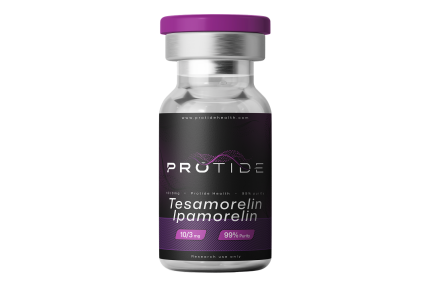
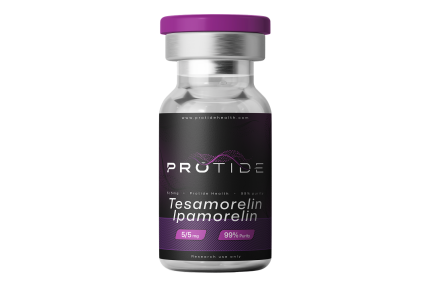
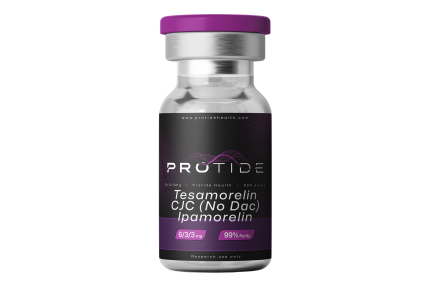
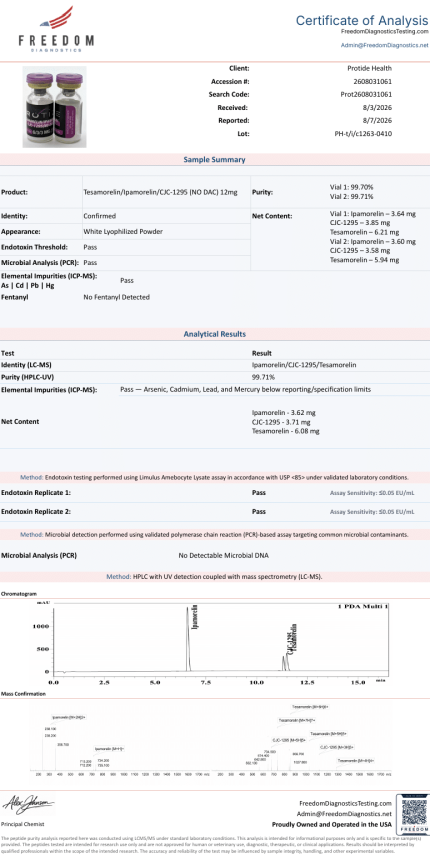
Researchers comparing multi-peptide endocrine formulations may review the Tesamorelin + Ipamorelin + CJC-1295 No DAC Blend for a chemically and mechanistically distinct research blend.
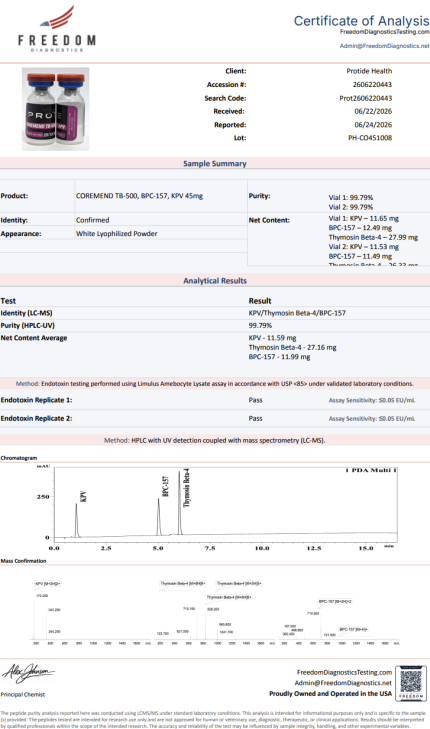
The TB-500 + BPC-157 + KPV Coremend Blend provides another multi-peptide research formulation involving different sequences and experimental pathways.
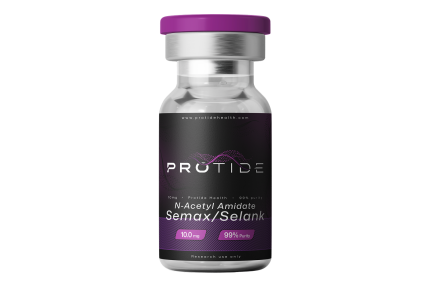
Researchers may also examine the Semax + Selank N-Acetyl Amidate Blend for a more focused two-component modified neuropeptide research formulation.
These products should not be considered interchangeable with the Illumineuro peptide blend.
Research Format & Storage
Protide Health supplies the Illumineuro peptide blend as:
- Total Quantity: 50mg
- N-Acetyl Semax: 20mg
- N-Acetyl Selank: 10mg
- Pinealon: 10mg
- PE-22-28: 10mg
- Form: Lyophilized powder
- Vial Size: 3mL
- Purity: 99%
- Testing: HPLC-MS verified; third-party tested
- Appearance: White to off-white lyophilized powder
- Solubility: Components specified as water-soluble
Storage specifications:
- Store at ≤6°C
- Keep sealed
- Protect from heat
- Protect from direct light
- Protect from moisture
These statements describe laboratory storage characteristics and are not human preparation or administration instructions.
Frequently Asked Questions
What is the Illumineuro peptide blend?
The Illumineuro peptide blend is a four-peptide laboratory research formulation containing N-Acetyl Semax, N-Acetyl Selank, Pinealon, and PE-22-28.
What does the 50mg Illumineuro blend contain?
Each vial contains:
- N-Acetyl Semax 20mg
- N-Acetyl Selank 10mg
- Pinealon 10mg
- PE-22-28 10mg
Are all four peptides premixed?
Yes. The four research components are supplied together in one 50mg lyophilized vial.
What is N-Acetyl Semax?
N-Acetyl Semax is a terminally modified Semax analogue. The supplied PubChem-supported form is Ac-MEHFPGP-NH₂.
What is N-Acetyl Selank?
N-Acetyl Selank is derived from the Selank sequence TKPRPGP. The supplied product data require careful identity verification because the stated amidated sequence and supplied PubChem record describe different terminal forms.
What is Pinealon?
Pinealon is the short regulatory tripeptide Glu-Asp-Arg, abbreviated EDR.
What is PE-22-28?
PE-22-28 is the seven-amino-acid peptide GVSWGLR studied primarily in relation to TREK-1 potassium-channel signaling.
Does the Illumineuro blend prove synergy between the four peptides?
No. Co-formulation does not establish biological synergy. Any combined interaction must be investigated using appropriate controls.
What purity does Protide Health specify?
Protide Health specifies 99% purity, with HPLC-MS verification and third-party testing.
Is the Illumineuro peptide blend intended for human use?
No. The blend is supplied solely for biochemical, cellular, molecular, analytical, electrophysiological, in-vitro, and qualified preclinical research.
Laboratory Terms & Compliance
Laboratory Research Use Only
The Illumineuro peptide blend is supplied exclusively for laboratory research, biochemical experimentation, analytical testing, in-vitro studies, molecular research, cellular models, receptor and ion-channel studies, and qualified preclinical investigation.
It is not intended for human or veterinary consumption, medical use, diagnostic use, neurological treatment, psychiatric treatment, cognitive enhancement, therapeutic use, injection, nasal administration, or clinical administration.
No human dosage, injection schedule, nasal preparation, treatment cycle, administration frequency, cognitive-enhancement protocol, or human-use preparation instructions are provided.
The purchaser is responsible for appropriate laboratory handling, storage, and use under applicable institutional, federal, state, and local requirements.
For research use only.


MAECENAS IACULIS
Vestibulum curae torquent diam diam commodo parturient penatibus nunc dui adipiscing convallis bulum parturient suspendisse parturient a.Parturient in parturient scelerisque nibh lectus quam a natoque adipiscing a vestibulum hendrerit et pharetra fames nunc natoque dui.
ADIPISCING CONVALLIS BULUM
- Vestibulum penatibus nunc dui adipiscing convallis bulum parturient suspendisse.
- Abitur parturient praesent lectus quam a natoque adipiscing a vestibulum hendre.
- Diam parturient dictumst parturient scelerisque nibh lectus.
Scelerisque adipiscing bibendum sem vestibulum et in a a a purus lectus faucibus lobortis tincidunt purus lectus nisl class eros.Condimentum a et ullamcorper dictumst mus et tristique elementum nam inceptos hac parturient scelerisque vestibulum amet elit ut volutpat.
Related products
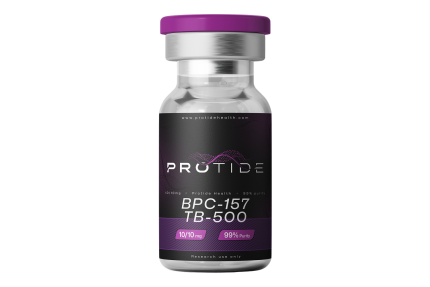
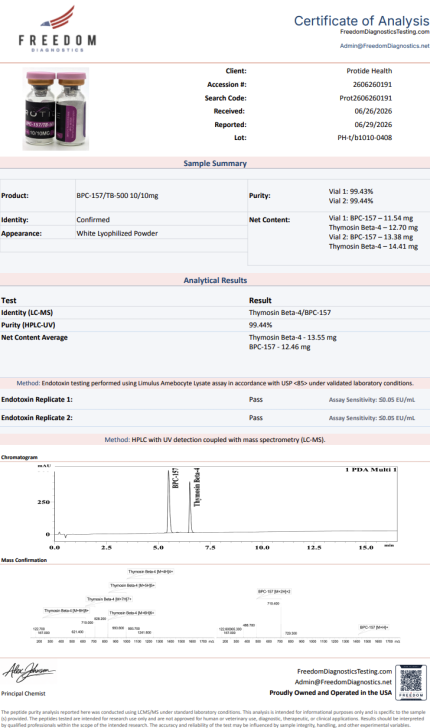
BPC-157 & TB-500 “Wolverine” Blend
Price range: $145.00 through $305.00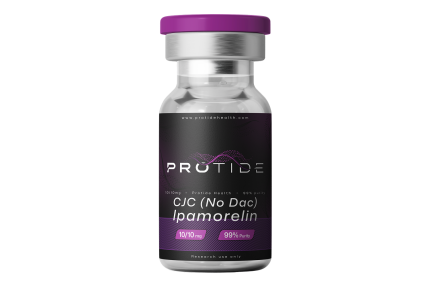
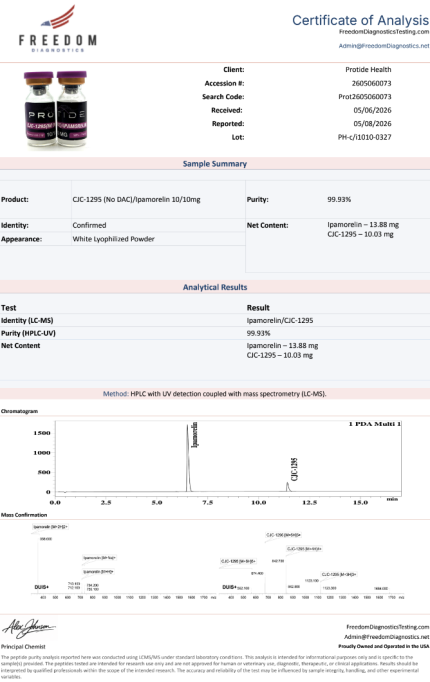
CJC-1295 (No Dac) & Ipamorelin Blend
Price range: $75.00 through $125.00
Reviews
There are no reviews yet.