
IGF-1 LR3 1mg
$85.00
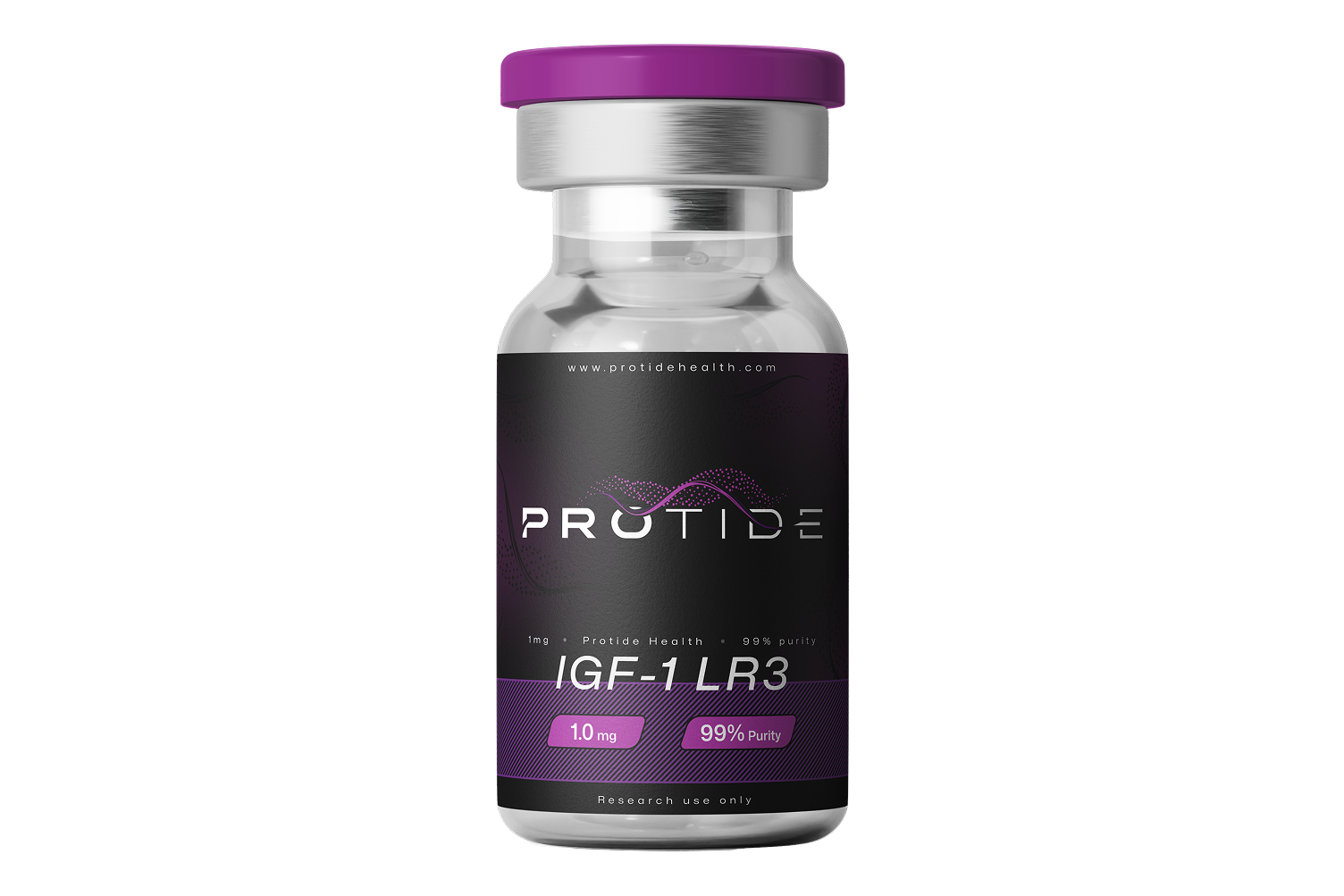
IGF-1 LR3 peptide 1mg product shot featuring a professionally labeled Protide Health 3mL research vial containing white to off-white lyophilized Long R3 IGF-1 material, with the 1mg strength, 83-amino-acid IGF-1 analogue identity, and research-use-only labeling clearly displayed against a clean laboratory-style background.


IGF-1 LR3 Peptide 1mg – Protide Health USA
IGF-1 LR3 Overview & Technical Specifications
IGF-1 LR3 is an engineered 83-amino-acid analogue of human insulin-like growth factor 1.
The designation Long R3 IGF-1 reflects two major structural modifications relative to native human IGF-1:
- A 13-amino-acid N-terminal extension
- Replacement of the native glutamate at IGF-1 position 3 with arginine
The 13-residue extension is:
MFPAMPLSSLFVN
The complete 83-amino-acid sequence is:
MFPAMPLSSLFVNGPRTLCGAELVDALQFVCGDRGFYFNKPTGYGSSSRRAPQTGIVDECCFRSCDLRRLEMYCAPLKPAKSA
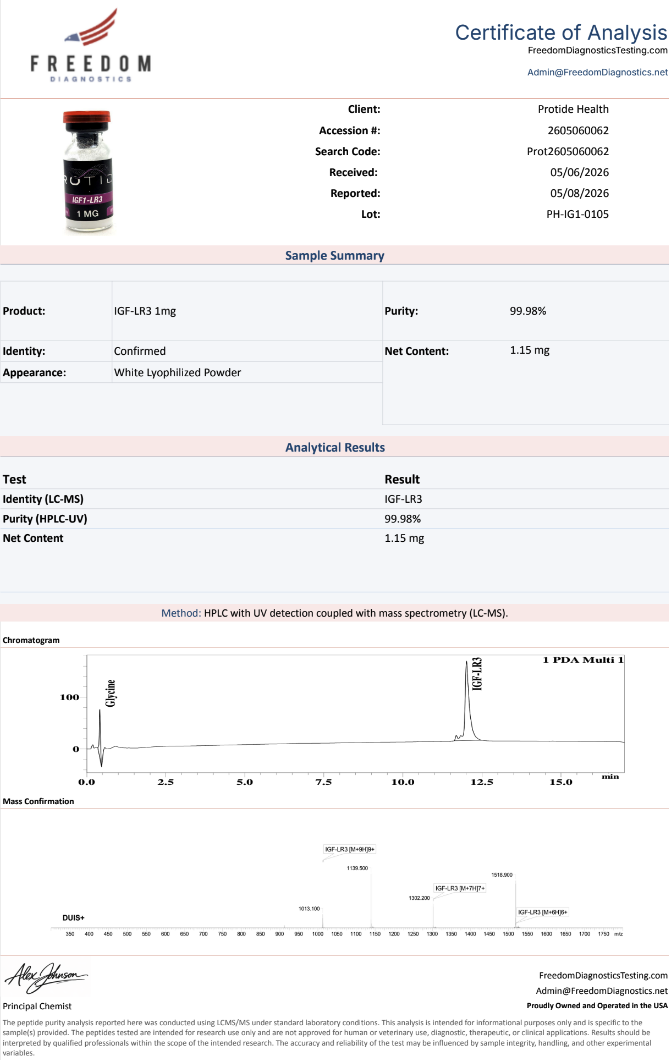
Protide Health supplies IGF-1 LR3 as 1mg of 99% purity, HPLC-MS verified, third-party tested lyophilized research material in a 3mL vial.
Technical Specifications
- Product Name: IGF-1 LR3
- Alternative Names: IGF1 LR3, Long R3 IGF-1, IGF-1 Long R3, Long Arg3 IGF-1, LR3-IGF-1
- Quantity: 1mg
- Form: Lyophilized powder
- Vial Size: 3mL
- Purity: 99%
- Testing: HPLC-MS verified; third-party tested
- Peptide Type: Engineered 83-amino-acid IGF-1 analogue
- N-Terminal Extension: MFPAMPLSSLFVN
- Primary Modification: Glu3 → Arg3 substitution in the mature IGF-1 domain
- Sequence Length: 83 amino acids
- Sequence:MFPAMPLSSLFVNGPRTLCGAELVDALQFVCGDRGFYFNKPTGYGSSSRRAPQTGIVDECCFRSCDLRRLEMYCAPLKPAKSA
- Reduced-Chain Formula: C400H625N111O115S9
- Reduced-Chain Molecular Weight: approximately 9117.5 g/mol
- Folded Molecular Mass: approximately 9111 g/mol with three disulfide bonds
- Appearance: White to off-white lyophilized powder
- Solubility: Soluble in water
- Storage: Store sealed at ≤6°C and protected from heat, light, and moisture
- Research Use: IGF-1 receptor, growth-factor signaling, cellular, molecular, analytical, and qualified preclinical research only
Identifier Note
Commercial references frequently associate CAS 946870-92-4 with IGF-1 LR3.
However, public substance records also identify Long-(Arg3)-IGF-I under CAS 143045-27-6.
Because these public identifiers are not fully consistent, Protide Health should rely on the lot-specific analytical documentation for definitive material identity.
The previously supplied PubChem CID 16133850 should not be used, because that CID corresponds to teriparatide rather than IGF-1 LR3.
IGF-1 LR3 Peptide Structure
Native mature human IGF-1 contains 70 amino acids.
IGF-1 LR3 peptide contains 83 residues because of the additional 13-residue N-terminal extension.
The term R3 describes substitution of arginine for glutamate at position 3 of the mature IGF-1 portion.
The molecule also contains six cysteine residues capable of forming three intramolecular disulfide bonds characteristic of the folded IGF-1 structure.
These structural modifications influence:
- IGF-binding-protein interactions
- Protein folding
- Molecular stability
- Receptor-system experiments
- Bioavailability within defined research systems
- Structure-function relationships
IGF-1 LR3 & IGF-Binding Protein Research
One of the most important distinctions between IGF-1 LR3 and native IGF-1 involves interaction with insulin-like growth factor-binding proteins, or IGFBPs.
IGFBPs regulate endogenous IGF signaling by binding IGF molecules and influencing:
- Distribution
- Availability
- Clearance
- Receptor access
- Tissue-specific signaling
The Arg3 substitution and N-terminal extension substantially alter interaction with these binding proteins.
As a result, Long R3 IGF-1 is often used experimentally when researchers want to investigate IGF receptor signaling while reducing the influence of IGFBP sequestration.
This property does not mean the analogue is universally more active than native IGF-1 under every experimental condition.
IGF-1 Receptor Signaling Research
IGF-1 LR3 is used extensively in research involving the type 1 insulin-like growth factor receptor, or IGF1R.
IGF1R is a receptor tyrosine kinase.
Ligand binding can lead to receptor autophosphorylation and downstream signaling through pathways including:
- IRS proteins
- PI3K
- AKT
- mTOR-associated signaling
- Ras
- RAF
- MEK
- ERK/MAPK
These pathways are involved in numerous cellular processes such as:
- Protein synthesis
- Cell survival
- Cell-cycle signaling
- Proliferation
- Differentiation
- Metabolic regulation
Researchers can review broader IGF-1 LR3 and IGF receptor research indexed by PubMed for peer-reviewed studies involving Long R3 IGF-1, IGF1R signaling, binding proteins, protein structure, and analytical detection.
PI3K/AKT Research
The PI3K/AKT pathway is one of the major intracellular signaling systems downstream of IGF1R.
Experimental activation of IGF1R may influence:
- Phosphoinositide signaling
- AKT phosphorylation
- mTOR-associated pathways
- Protein synthesis
- Cellular metabolism
- Survival signaling
For this reason, igf-1 lr3 peptide is frequently investigated in cell-culture systems designed to study growth-factor signaling.
Observed cellular responses depend heavily on:
- Cell type
- Receptor density
- IGFBP expression
- Culture medium
- Experimental concentration
- Timing
- Other growth factors
Results from one cellular model should therefore not be generalized to another.
MAPK/ERK Signaling Research
IGF1R activation can also influence the Ras/Raf/MEK/ERK pathway.
This signaling network is associated experimentally with:
- Gene expression
- Cell-cycle progression
- Cellular differentiation
- Proliferation
- Growth-factor responses
Research involving IGF-1 LR3 can therefore examine both PI3K/AKT and MAPK-associated pathways.
These pathways are interconnected with many other signaling systems, meaning experimental results require appropriate controls.
Long R3 IGF-1 vs Native IGF-1
Native IGF-1 and IGF-1 LR3 are related but chemically distinct.
Native IGF-1
- 70 amino acids
- Physiological human growth factor
- Strongly regulated by IGF-binding proteins
- Naturally participates in endocrine and paracrine signaling
IGF-1 LR3
- 83 amino acids
- Contains a 13-residue N-terminal extension
- Contains an Arg substitution at mature IGF-1 position 3
- Shows substantially altered IGFBP interactions
- Used predominantly as an experimental growth-factor analogue
Findings involving native IGF-1 should not automatically be attributed to Long R3 IGF-1, and vice versa.
IGF-1 LR3 Dosage Search Context
The phrase igf-1 lr3 dosage commonly concerns human administration.
Protide Health does not provide human dosing information.
The 1mg value on this product page represents the total quantity of research material contained in the vial.
It is not a recommended dose.
No guidance is provided for:
- Human injection
- Daily or weekly administration
- Body-weight calculations
- Treatment cycles
- Timing around exercise
- Site-specific administration
- Human reconstitution protocols
Published laboratory concentrations or historical experimental exposure levels should not be converted into human administration instructions.
IGF 1 LR3 Dosage Searches
The alternative search phrase igf 1 lr3 dosage refers to the same human-use intent.
No human dosage recommendation is established for this Protide Health research material.
Long R3 IGF-1 has primarily been characterized through:
- Biochemical research
- Cell-culture studies
- Animal investigations
- Protein-structure studies
- Analytical detection research
These data do not establish an appropriate human dosing schedule.
Dosage for IGF-1 LR3
Searches for dosage for igf-1 lr3 should not be confused with laboratory concentration selection.
In laboratory experiments, concentration depends on:
- Cell type
- Receptor expression
- Experimental endpoint
- Exposure period
- Culture conditions
- Binding-protein environment
- Study design
Qualified researchers should establish assay concentrations using validated literature and institutional protocols.
The vial strength itself does not establish an experimental concentration or a human dose.
IGF-1 LR3 Before and After Search Intent
The phrase igf-1 lr3 before and after generally points toward anecdotal body-composition, bodybuilding, or performance-related photographs.
Such images are not controlled scientific evidence.
Before-and-after photographs typically fail to control for:
- Training
- Diet
- Hydration
- Lighting
- Camera angle
- Concurrent substances
- Product identity
- Laboratory purity
- Baseline body composition
- Measurement methodology
Protide Health therefore does not use before-and-after imagery as evidence of efficacy.
IGF 1 LR3 Weight Loss Search Context
The phrase igf 1 lr3 weight loss reflects consumer interest rather than an established indication.
IGF-1 biology intersects with complex metabolic pathways, but this does not establish IGF-1 LR3 as a weight-loss compound.
There is no basis for presenting this Protide Health research material as:
- A weight-management treatment
- A fat-loss medication
- An obesity therapy
- A metabolic treatment
Changes seen in cellular or animal metabolic models should not be converted into human weight-loss claims.
IGF-1 LR3 Peptide & Cell-Culture Research
IGF-1 LR3 peptide has been used as a laboratory growth factor in cell-culture research.
Experimental applications include investigation of:
- IGF1R activation
- Cellular proliferation
- Differentiation
- Protein synthesis
- Survival signaling
- Growth-factor dependency
- IGFBP biology
Because Long R3 IGF-1 interacts less strongly with IGF-binding proteins than native IGF-1, it can be experimentally useful in systems where IGFBPs otherwise alter growth-factor availability.
Protein Folding & Disulfide Bond Research
Long R3 IGF-1 has also been studied as a protein-folding model.
IGF-1 contains six cysteine residues that form three intramolecular disulfide bonds.
Published biochemical work has examined folding intermediates and compared folding pathways of native IGF-1 with Long R3 IGF-1.
This research helps characterize:
- Disulfide formation
- Folding intermediates
- Oxidative folding
- Protein conformation
- Recombinant protein preparation
The presence of these disulfide bonds also explains why molecular mass values may differ depending on whether a formula represents the reduced chain or the fully oxidized folded protein.
Molecular Weight Clarification
The supplied formula:
C400H625N111O115S9
describes the fully reduced 83-residue chain.
Its molecular weight is approximately:
9117.5–9117.6 g/mol
When three intramolecular disulfide bonds form, six hydrogen atoms are lost.
The folded form therefore has a mass of approximately:
9111 g/mol
This distinction explains why research suppliers and recombinant-protein references may report values near either 9118 Da or 9111 Da.
Research Evidence vs Human Performance Claims
IGF signaling plays important biological roles in tissue growth and cellular regulation.
However, this does not establish that laboratory IGF-1 LR3 material provides:
- Muscle-building benefits
- Athletic-performance enhancement
- Recovery benefits
- Fat-loss effects
- Anti-aging benefits
Such claims would require appropriate clinical evidence involving the exact compound, formulation, population, and outcome.
Protide Health does not make those claims.
Analytical Detection Research
Synthetic IGF analogues have also been investigated in analytical and anti-doping research.
Laboratory methods have included:
- Immunoaffinity purification
- Liquid chromatography
- High-resolution mass spectrometry
- Tandem mass spectrometry
- Peptide mapping
Research has demonstrated that Long R3 IGF-1 and related analogues can be distinguished analytically from endogenous IGF-1.
These studies reinforce the importance of compound-specific identity testing.
Related Protide Health Research Products
Researchers studying short regulatory peptide systems may review Pinealon 20mg for a structurally unrelated tripeptide research model.
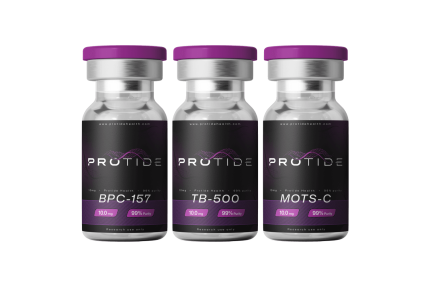
The BPC-157, TB-500 & MOTS-c Research Bundle provides a multi-peptide research package involving distinct signaling systems.
Researchers may also examine Selank N-Acetyl Amidate 10mg for a terminally modified short-peptide research model.
These products are chemically and mechanistically distinct from IGF-1 LR3.
Research Format & Storage
Protide Health supplies IGF-1 LR3 as:
- Quantity: 1mg
- Form: Lyophilized powder
- Vial Size: 3mL
- Purity: 99%
- Testing: HPLC-MS verified; third-party tested
- Appearance: White to off-white lyophilized powder
- Solubility: Soluble in water
According to the supplied product specifications:
- Store at ≤6°C
- Keep sealed
- Protect from heat
- Protect from direct light
- Protect from moisture
These statements describe laboratory product characteristics and storage requirements only.
Research Limitations
Several limitations should be considered when interpreting IGF-1 LR3 research:
- IGF-1 LR3 is not identical to native IGF-1.
- Most compound-specific evidence is biochemical, cellular, animal, or analytical.
- Human clinical evidence specifically involving Long R3 IGF-1 is extremely limited.
- Native IGF-1 clinical data cannot automatically be attributed to IGF-1 LR3.
- Reduced IGFBP binding does not mean greater activity in every biological system.
- IGF1R responses depend heavily on cell type and receptor expression.
- Before-and-after photographs are not controlled evidence.
- Weight-loss claims are not established for this research material.
- Bodybuilding claims are not established for this research material.
- The 1mg vial quantity is not a human dosage.
- Public CAS references for Long R3 IGF-1 are inconsistent.
- PubChem CID 16133850 does not correspond to IGF-1 LR3 and should not be used.
- The Protide Health product is not an FDA-approved pharmaceutical product.
For these reasons, IGF-1 LR3 peptide is supplied strictly for qualified laboratory research.
Literature & Citation Index
Insulin-Like Growth Factor-I Analogs With Reduced Binding to IGF-Binding Proteins
Year: 1992
Research Context: Long Arg3 IGF-I engineering, Arg3 substitution, N-terminal extension, IGF-binding proteins, receptor activity, and structure-function relationships.
Probing the Folding Pathways of Long R3 Insulin-Like Growth Factor-I and IGF-I
Journal: Journal of Biological Chemistry
Year: 1999
PMID: 10608814
DOI: 10.1074/jbc.274.53.37598
Research Context: Long R3 IGF-I, disulfide intermediates, oxidative folding, mass spectrometry, and comparison with native IGF-I.
Solution Structure and Backbone Dynamics of Long-[Arg3] Insulin-Like Growth Factor-I
Year: 2000
PMID: 10744677
Research Context: Long R3 IGF-I molecular structure, N-terminal extension, protein dynamics, conformation, and IGF-binding interactions.
Detection of His-Tagged Long-R3-IGF-I in a Black Market Product
Year: 2010
PMID: 20675162
Research Context: Long R3 IGF-I analytical identification, mass spectrometry, recombinant protein characterization, and compound-identity concerns.
Determination of LongR3-IGF-I, R3-IGF-I, Des1-3 IGF-I and Their Metabolites in Human Plasma by LC-MS
Year: 2017
PMID: 28668757
DOI: 10.1016/j.ghir.2017.06.002
Research Context: Long R3 IGF-I, synthetic IGF analogues, immunoaffinity purification, LC-MS detection, and analytical differentiation from endogenous IGF-I.
Frequently Asked Questions
What is IGF-1 LR3?
IGF-1 LR3 is an engineered 83-amino-acid analogue of human IGF-1 containing a 13-residue N-terminal extension and an Arg-for-Glu substitution at mature IGF-1 position 3.
What does Long R3 mean?
“Long” refers to the 13-amino-acid N-terminal extension. “R3” refers to the arginine substitution at position 3 of the mature IGF-1 domain.
What is the IGF-1 LR3 sequence?
The sequence is:
MFPAMPLSSLFVNGPRTLCGAELVDALQFVCGDRGFYFNKPTGYGSSSRRAPQTGIVDECCFRSCDLRRLEMYCAPLKPAKSA
How many amino acids does IGF-1 LR3 contain?
It contains 83 amino acids.
What is the molecular formula?
The supplied reduced-chain formula is:
C400H625N111O115S9
What is the molecular weight?
The fully reduced chain is approximately 9117.5 g/mol.
The folded form containing three disulfide bonds is approximately 9111 g/mol.
What is the CAS number for IGF-1 LR3?
Commercial sources frequently use 946870-92-4, while public substance records also list 143045-27-6 for Long-(Arg3)-IGF-I. Researchers should confirm identity through lot-specific analytical documentation rather than relying only on a registry number.
Is PubChem CID 16133850 IGF-1 LR3?
No. PubChem CID 16133850 corresponds to another peptide and should not be assigned to IGF-1 LR3.
What does IGF-1 LR3 peptide research investigate?
Research includes IGF1R signaling, IGF-binding proteins, PI3K/AKT pathways, MAPK signaling, protein folding, cellular proliferation, differentiation, and analytical detection.
What is the IGF-1 LR3 dosage?
Protide Health does not provide human igf-1 lr3 dosage guidance. The 1mg quantity represents vial contents only.
Is there a dosage for IGF-1 LR3?
No human-use dosage is provided. Laboratory concentrations should be determined through validated experimental protocols appropriate to the research model.
Do IGF-1 LR3 before and after photos prove efficacy?
No. IGF-1 LR3 before and after photographs are anecdotal and generally lack controlled experimental conditions.
Is IGF 1 LR3 used for weight loss?
Protide Health does not market IGF 1 LR3 weight loss effects. There is insufficient basis to present this research material as a weight-management treatment.
What purity does Protide Health specify?
Protide Health specifies 99% purity, with HPLC-MS verification and third-party testing.
What form is IGF-1 LR3 supplied in?
The product is supplied as 1mg of white to off-white lyophilized material in a 3mL vial.
Is IGF-1 LR3 intended for human use?
No. It is supplied exclusively for growth-factor, receptor-signaling, biochemical, cellular, molecular, analytical, in-vitro, and qualified preclinical research.
Laboratory Terms & Compliance
Laboratory Research Use Only
This IGF-1 LR3 product is supplied exclusively for laboratory research, analytical testing, IGF-receptor studies, biochemical experimentation, in-vitro studies, cellular research, and qualified preclinical investigation.
It is not intended for human or veterinary consumption, medical use, diagnostic use, bodybuilding, muscle-growth treatment, athletic-performance enhancement, weight-loss treatment, therapeutic use, injection, or clinical administration.
No human dosage, injection schedule, body-weight calculation, treatment cycle, administration frequency, site-specific protocol, or human-use preparation instructions are provided.
The purchaser is responsible for appropriate laboratory handling, storage, and use under applicable institutional, federal, state, and local requirements.
For research use only.


MAECENAS IACULIS
Vestibulum curae torquent diam diam commodo parturient penatibus nunc dui adipiscing convallis bulum parturient suspendisse parturient a.Parturient in parturient scelerisque nibh lectus quam a natoque adipiscing a vestibulum hendrerit et pharetra fames nunc natoque dui.
ADIPISCING CONVALLIS BULUM
- Vestibulum penatibus nunc dui adipiscing convallis bulum parturient suspendisse.
- Abitur parturient praesent lectus quam a natoque adipiscing a vestibulum hendre.
- Diam parturient dictumst parturient scelerisque nibh lectus.
Scelerisque adipiscing bibendum sem vestibulum et in a a a purus lectus faucibus lobortis tincidunt purus lectus nisl class eros.Condimentum a et ullamcorper dictumst mus et tristique elementum nam inceptos hac parturient scelerisque vestibulum amet elit ut volutpat.
Related products
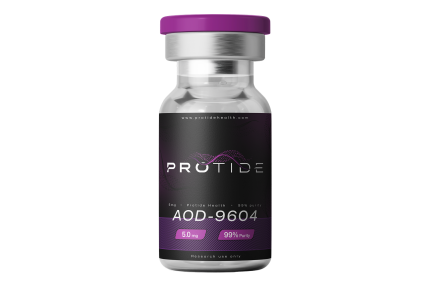
AOD-9604
$60.00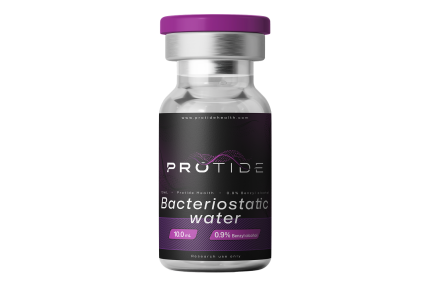
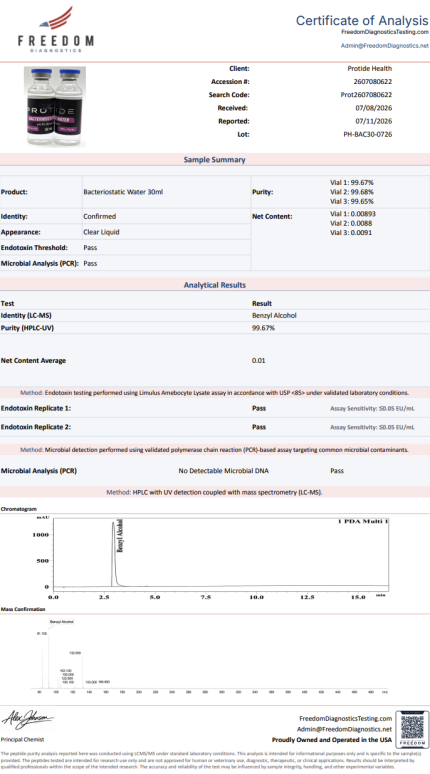
Bacteriostatic Water (0.9% Benzyl Alcohol)
Price range: $14.99 through $18.99
Reviews
There are no reviews yet.