
Acetic Acid (0.6%)
$14.99
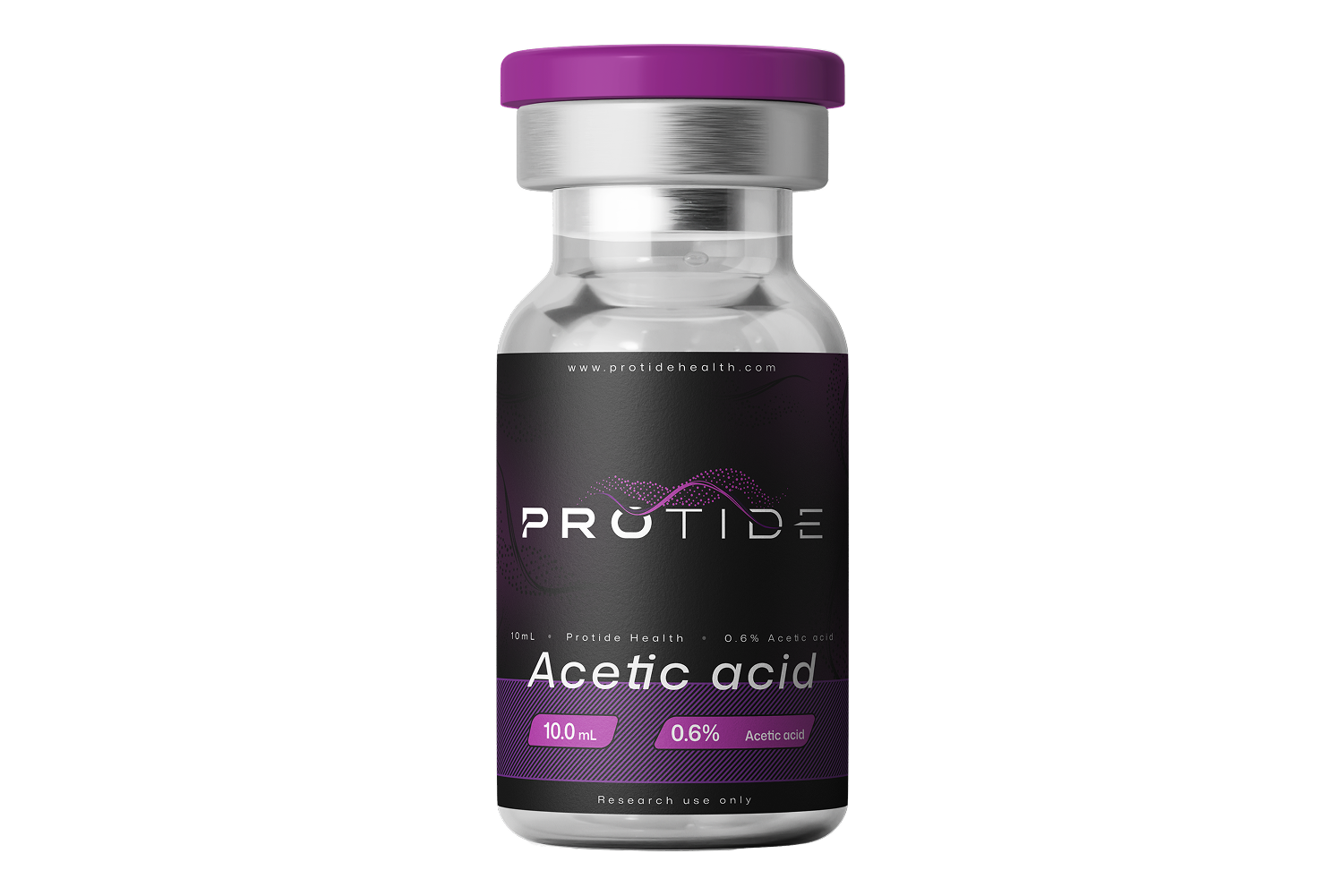
Acetic Acid 0.6% product shot featuring a professionally labeled Protide Health 10mL laboratory vial containing a clear, colorless aqueous solution, with the acetic acid formula CH₃COOH, 0.6% v/v concentration, approximately 0.1 M specification, analytical reagent classification, and laboratory-research-only labeling clearly displayed against a clean scientific background.
Acetic Acid Formula & 0.6% Laboratory Solution – Protide Health
Acetic Acid Formula & Product Overview
The acetic acid formula is:
CH₃COOH
It may also be written as:
C₂H₄O₂
Protide Health supplies Acetic Acid 0.6% as a dilute analytical-grade aqueous reagent formulated for qualified laboratory and in-vitro chemistry applications.
Each 10mL vial contains:
0.6% v/v acetic acid in deionized water
This concentration corresponds to approximately 0.1 M acetic acid, depending on the exact purity and density of the glacial acetic acid starting material.
This product is not a peptide, pharmaceutical, injectable preparation, or therapeutic solution.
Technical Specifications
- Product Name: Acetic Acid 0.6%
- Volume: 10mL
- Product Type: Analytical-grade aqueous acid reagent
- Acetic Acid Formula: CH₃COOH
- Molecular Formula: C₂H₄O₂
- Approximate Concentration: 0.1 M
- Composition: 0.6% v/v glacial acetic acid in deionized water
- Approximate Acetic Acid Volume per 10mL: 0.06mL
- Acetic Acid Molar Mass: 60.05 g/mol
- Specified pH Range: 3.0–4.0
- Appearance: Clear, colorless solution
- Grade: Laboratory reagent grade / analytical
- Unopened Storage: 20°C–25°C, sealed and protected from direct light
- After Opening: Refrigeration at 2°C–8°C recommended
- Research Use: Laboratory and in-vitro chemistry use only
What Is the Acetic Acid Formula?
The exact acetic acid formula can be expressed in several equivalent forms.
Condensed Structural Formula
CH₃COOH
Molecular Formula
C₂H₄O₂
Structural Representation
Acetic acid contains:
- One methyl group: CH₃–
- One carboxyl group: –COOH
This makes acetic acid one of the simplest carboxylic acids.
The acetic acid chemical formula C₂H₄O₂ represents two carbon atoms, four hydrogen atoms, and two oxygen atoms.
Acetic Acid Chemical Formula Explained
Understanding the acetic acid formula is useful when calculating:
- Molar concentrations
- Dilution ratios
- Acid-base equilibria
- Buffer preparations
- Titration systems
- Analytical chemistry conditions
The carboxyl group can donate a proton in aqueous solution, which is why acetic acid behaves as a weak acid.
The relevant equilibrium is:
CH₃COOH ⇌ H⁺ + CH₃COO⁻
Acetic acid does not completely dissociate in water.
This distinguishes it from strong mineral acids such as hydrochloric acid.
Equation of Acetic Acid in Water
The equation of acetic acid dissociation can be represented more explicitly as:
CH₃COOH + H₂O ⇌ H₃O⁺ + CH₃COO⁻
The reaction is reversible because acetic acid is a weak acid.
The products are:
- Hydronium ion, H₃O⁺
- Acetate ion, CH₃COO⁻
This equilibrium is fundamental to analytical applications involving:
- Acid-base chemistry
- Buffer systems
- Titration
- pH control
- Chromatographic mobile phases
Acetic Acid Molar Mass
The acetic acid molar mass is approximately:
60.05 g/mol
This value corresponds to the molecular formula:
C₂H₄O₂
Molar mass is important when preparing acetic acid solutions based on molarity rather than volume percentage.
The Protide Health formulation is specified primarily as:
0.6% v/v
which means 0.6 volumes of glacial acetic acid per 100 volumes of final solution.
What Does 0.6% v/v Acetic Acid Mean?
For a 0.6% v/v formulation:
0.6mL glacial acetic acid is present per 100mL of final solution.
Therefore, a 10mL vial contains approximately:
0.06mL glacial acetic acid
with the remaining volume consisting predominantly of deionized water.
Because concentrated glacial acetic acid is roughly 17 M, a 0.6% v/v dilution corresponds approximately to:
0.10–0.105 M
The exact molarity can vary slightly according to:
- Starting reagent purity
- Density
- Temperature
- Volumetric preparation accuracy
For most routine laboratory descriptions, approximately 0.1 M is appropriate.
Why Is Pure Acetic Acid Often Called Glacial Acetic Acid?
The question why is pure acetic acid often called glacial acetic acid relates to its physical behavior.
Highly concentrated acetic acid has a melting/freezing point near:
16.6°C
When cooled close to this temperature, purified acetic acid can form colorless crystalline material resembling ice.
This appearance historically led to the name:
glacial acetic acid
The term therefore refers to highly concentrated or essentially water-free acetic acid, not to dilute aqueous acetic acid.
Protide Health Acetic Acid 0.6% is prepared from glacial acetic acid but is itself a dilute aqueous reagent.
Glacial Acetic Acid vs Acetic Acid 0.6%
Glacial acetic acid and this 0.6% product differ substantially in concentration.
Glacial Acetic Acid
- Highly concentrated
- Typically approximately 99–100%
- Strong characteristic odor
- Corrosive concentrated reagent
- Freezing point near 16.6°C
Acetic Acid 0.6%
- Dilute aqueous solution
- 0.6% v/v
- Approximately 0.1 M
- Primarily deionized water
- Designed as a laboratory reagent for dilute-acid applications
These materials should not be treated as interchangeable.
Acetic Acid Formula & pH
The acetic acid formula CH₃COOH contains a carboxylic-acid functional group capable of donating a proton in aqueous solution.
Because acetic acid is weak, only a fraction of the molecules dissociate at equilibrium.
A nominal 0.1 M unbuffered acetic acid solution would theoretically be expected to have an acidic pH around the high-2 to low-3 range under ideal conditions.
The Protide Health finished reagent is specified at:
pH 3.0–4.0
Actual measured pH may vary according to:
- Concentration accuracy
- Temperature
- Water quality
- Ionic composition
- Measurement method
- Electrode calibration
For quality control, the measured finished-product pH should take priority over a purely theoretical calculation.
Acetic Acid in Analytical Laboratory Research
Dilute acetic acid solutions are commonly encountered in laboratory workflows involving:
- pH adjustment
- Acidification
- Analytical chemistry
- Protein and peptide research
- Chromatography
- Sample preparation
- Buffer research
- Solubility studies
- Chemical stability testing
The specific suitability of any reagent depends on the experimental protocol and required analytical grade.
This Protide Health product is supplied for bona fide laboratory and in-vitro chemistry research only.
Acetic Acid Formula in Peptide Research
Knowledge of the acetic acid formula and concentration can be relevant in analytical peptide work because dilute organic acids are frequently used in biochemical and chromatographic research environments.
Researchers examining peptide systems may also review IGF-1 LR3 1mg as a separate synthetic polypeptide research material.
The GLP-3 research product provides another chemically distinct research system.
Researchers may also review MOTS-c for mitochondrial-derived peptide research.
These compounds are research analytes and should not be confused with Acetic Acid 0.6%, which is an analytical reagent rather than a peptide.
Acetic Acid Formula & Laboratory Calculations
The acetic acid formula CH₃COOH allows researchers to calculate relevant experimental quantities.
For example:
Moles = mass ÷ molecular weight
Using the acetic acid molar mass of 60.05 g/mol:
1 mole CH₃COOH ≈ 60.05 grams
For dilute formulations based on glacial acetic acid, volumetric concentration can instead be calculated from the starting reagent concentration and dilution ratio.
This product is already supplied as a prepared 0.6% v/v aqueous solution, so its stated concentration should be used for experimental documentation.
Acetic Acid Formula vs Acetate
Acetic acid and acetate are related but chemically distinct species.
Acetic Acid
CH₃COOH
Acetate
CH₃COO⁻
When acetic acid loses a proton, acetate is formed.
This acid/base pair is important in buffer chemistry because the relative concentrations of acetic acid and acetate determine solution pH.
Storage & Laboratory Handling
Protide Health supplies Acetic Acid 0.6% in a sealed 10mL vial.
Unopened Storage
Store at:
20°C–25°C
Keep:
- Sealed
- Away from direct light
- Away from excessive heat
- Protected from contamination
After Opening
Refrigeration at:
2°C–8°C
is recommended after opening.
Use appropriate laboratory procedures to minimize contamination and concentration changes.
This storage information relates to reagent integrity only.
Research Applications
Qualified laboratories may use Acetic Acid 0.6% in appropriately validated experiments involving:
- Acid-base chemistry
- pH modification
- Analytical sample preparation
- Chromatographic research
- Peptide chemistry
- Protein research
- Solubility studies
- Chemical stability testing
- Buffer-development studies
- In-vitro analytical workflows
Suitability should always be confirmed for the specific analytical method.
Research Limitations
Several points should be considered when using Acetic Acid 0.6%:
- It is an analytical reagent, not a peptide.
- The 0.6% specification is v/v.
- Approximately 0.1 M is an estimate based on glacial acetic acid concentration and density.
- Exact molarity can vary slightly with source reagent purity and preparation.
- Finished-product measured pH should take precedence over theoretical pH.
- The reagent is not intended as an injectable or pharmaceutical diluent.
- It is not bacteriostatic water.
- It is not intended for human or veterinary administration.
- It is not supplied for therapeutic, diagnostic, or clinical applications.
Researchers can review broader peer-reviewed laboratory and biochemical literature indexed by PubMed when evaluating analytical methods that use dilute acetic acid.
Frequently Asked Questions
What is the acetic acid formula?
The acetic acid formula is:
CH₃COOH
Its molecular formula is C₂H₄O₂.
What is the acetic acid chemical formula?
The acetic acid chemical formula can be written as either CH₃COOH or C₂H₄O₂.
What is the acetic acid molar mass?
The acetic acid molar mass is approximately 60.05 g/mol.
What is the equation of acetic acid in water?
The equation of acetic acid dissociation is:
CH₃COOH + H₂O ⇌ H₃O⁺ + CH₃COO⁻
Why is pure acetic acid often called glacial acetic acid?
Highly concentrated acetic acid freezes near 16.6°C and forms ice-like crystals. This physical behavior led to the term glacial acetic acid.
Is this product glacial acetic acid?
No. Glacial acetic acid is highly concentrated. This product contains only 0.6% v/v acetic acid in deionized water.
What does 0.6% v/v mean?
It means approximately 0.6mL of glacial acetic acid per 100mL of finished solution.
How much glacial acetic acid is in a 10mL vial?
Approximately:
0.06mL
is represented by a 0.6% v/v formulation.
What is the approximate molarity?
The solution is approximately:
0.1 M
depending on the exact starting reagent concentration and density.
What is the pH?
The specified finished-product pH range is:
3.0–4.0
What does the product look like?
It is supplied as a:
clear, colorless aqueous solution
Is Acetic Acid 0.6% a peptide?
No. It is a dilute aqueous analytical reagent.
Can this product be used on humans or animals?
No. It is supplied strictly for laboratory and in-vitro chemistry use and is not intended for use in or on humans or animals.
Laboratory Terms & Compliance
Laboratory Research Use Only
Acetic Acid 0.6% is supplied exclusively as an analytical laboratory reagent for bona fide in-vitro chemistry, biochemical research, analytical testing, sample preparation, and related laboratory applications.
It is not intended for human or veterinary use, injection, reconstitution for human administration, therapeutic use, diagnostic use, clinical use, topical application, medical treatment, or consumption.
The purchaser is responsible for appropriate laboratory handling, storage, experimental validation, and use under applicable institutional, federal, state, and local requirements.
For research use only.


MAECENAS IACULIS
Vestibulum curae torquent diam diam commodo parturient penatibus nunc dui adipiscing convallis bulum parturient suspendisse parturient a.Parturient in parturient scelerisque nibh lectus quam a natoque adipiscing a vestibulum hendrerit et pharetra fames nunc natoque dui.
ADIPISCING CONVALLIS BULUM
- Vestibulum penatibus nunc dui adipiscing convallis bulum parturient suspendisse.
- Abitur parturient praesent lectus quam a natoque adipiscing a vestibulum hendre.
- Diam parturient dictumst parturient scelerisque nibh lectus.
Scelerisque adipiscing bibendum sem vestibulum et in a a a purus lectus faucibus lobortis tincidunt purus lectus nisl class eros.Condimentum a et ullamcorper dictumst mus et tristique elementum nam inceptos hac parturient scelerisque vestibulum amet elit ut volutpat.
Related products
BPC-157
Price range: $65.00 through $195.00
DSIP
$100.00
Reviews
There are no reviews yet.