
LL-37 Peptide 5mg
$75.00
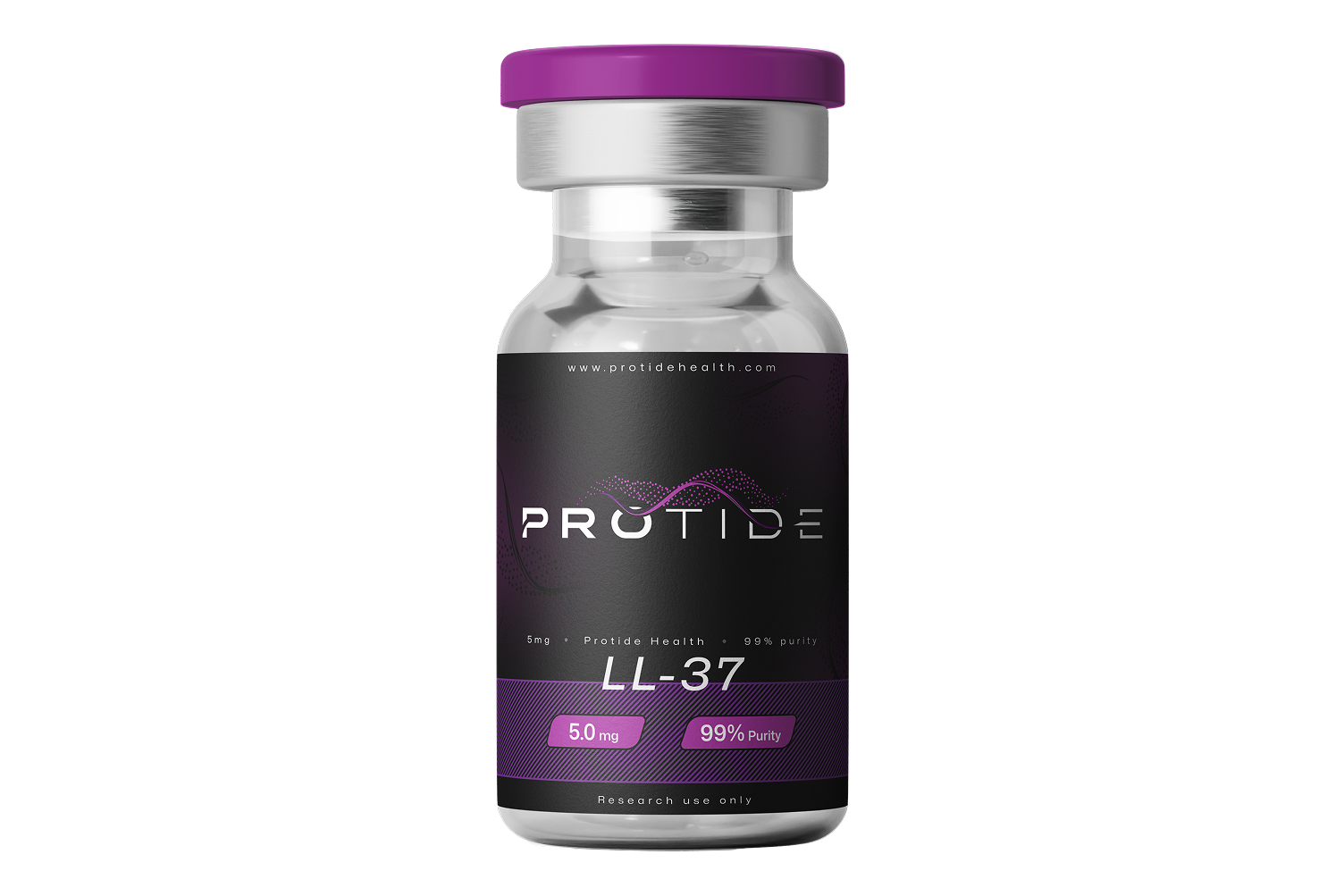
LL 37 peptide 5mg product shot featuring a professionally labeled Protide Health 3mL research vial containing white to off-white lyophilized LL-37 material, with the 5mg strength, 37-amino-acid cathelicidin identity, and research-use-only labeling clearly displayed against a clean laboratory-style background.


LL 37 Peptide 5mg – Protide Health USA
LL 37 Peptide Overview & Technical Specifications
LL 37 peptide is a synthetic 37-amino-acid peptide corresponding to the mature human cathelicidin LL-37.
Its amino-acid sequence is:
LLGDFFRKSKEKIGKEFKRIVQRIKDFLRNLVPRTES
LL-37 is derived from the human cathelicidin precursor protein hCAP-18 and represents the C-terminal antimicrobial peptide released after proteolytic processing.
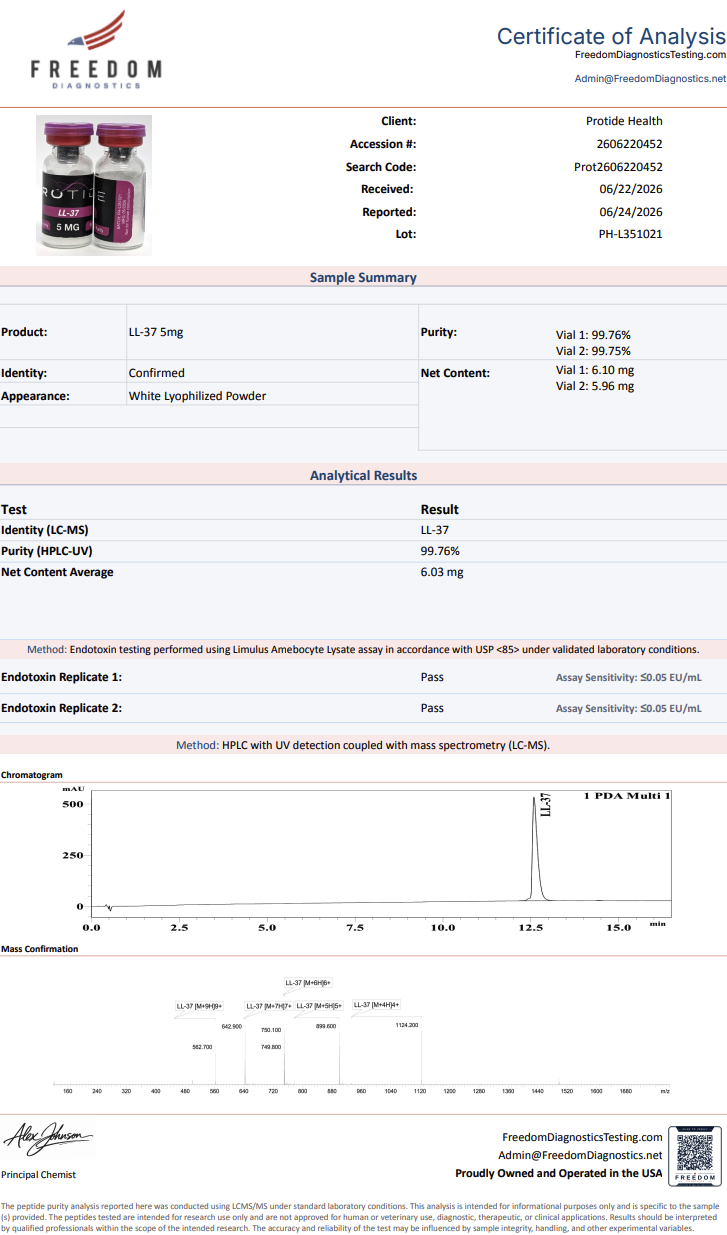
Protide Health supplies LL 37 peptide as 5mg of 99% purity, HPLC-MS verified, third-party tested lyophilized research material in a 3mL vial.
Technical Specifications
- Product Name: LL-37
- Alternative Names: LL37, Cathelicidin LL-37, hCAP-18-derived peptide, CAP-18
- Quantity: 5mg
- Form: Lyophilized powder
- Vial Size: 3mL
- Purity: 99%
- Testing: HPLC-MS verified; third-party tested
- Peptide Type: Synthetic cathelicidin-derived peptide
- Peptide Length: 37 amino acids
- Sequence: LLGDFFRKSKEKIGKEFKRIVQRIKDFLRNLVPRTES
- CAS Number: 154947-66-7
- PubChem CID: 16198951
- Molecular Formula: C205H340N60O53
- Molecular Weight: approximately 4493.34 g/mol
- Appearance: White to off-white lyophilized powder
- Solubility: Soluble in water
- Storage: Store sealed at ≤6°C and protected from heat, light, and moisture
- Research Use: Antimicrobial-peptide, innate-immunity, membrane, cellular, biochemical, analytical, and qualified preclinical research only
What Is LL 37?
The phrase what is LL 37 refers to the mature antimicrobial peptide derived from the human cathelicidin precursor hCAP-18.
LL-37 is notable because it is the only known human cathelicidin-derived antimicrobial peptide.
It is produced in or associated with multiple cell types and tissues, including:
- Neutrophils
- Epithelial cells
- Macrophage-related systems
- Mucosal surfaces
- Skin
- Airway tissues
LL-37 is widely studied because its biological activity extends beyond direct antimicrobial effects.
Published literature has examined roles in:
- Innate immunity
- Microbial membrane disruption
- Chemotaxis
- Cytokine signaling
- Angiogenesis
- Wound-healing models
- Cell migration
- Receptor activation
- Inflammatory regulation
These research areas do not establish therapeutic use for the Protide Health product.
LL 37 Peptide & Cathelicidin Biology
The human cathelicidin precursor is commonly known as:
hCAP-18
or:
CAP-18
The precursor contains a conserved cathelin domain and a variable C-terminal region.
Proteolytic cleavage releases the mature LL 37 peptide, which begins with two leucine residues and contains 37 amino acids.
This mature peptide has an amphipathic, cationic structure that contributes to interactions with biological membranes.
Published reviews describe LL-37 as a multifunctional host-defense peptide involved in both direct antimicrobial mechanisms and broader immunomodulatory signaling.
LL 37 Peptide & Membrane Research
One of the most established areas of LL 37 peptide research involves microbial membranes.
LL-37 has been studied for its ability to interact with negatively charged membrane components and influence membrane integrity.
Experimental work has examined:
- Membrane binding
- Oligomer formation
- Amphipathic helical structure
- Pore formation
- Membrane disruption
- Lipid interactions
- Structure-activity relationships
The peptide’s cationic and amphipathic properties contribute to its interaction with microbial membrane systems.
These effects vary substantially depending on ionic strength, membrane composition, peptide concentration, and experimental environment.
LL 37 & Antimicrobial Research
LL-37 is frequently described as a broad-spectrum antimicrobial peptide.
Published research has examined activity involving:
- Gram-positive bacteria
- Gram-negative bacteria
- Fungi
- Enveloped viruses
- Mycobacteria
However, direct antimicrobial activity observed in purified laboratory systems can differ considerably from activity in complex biological environments.
LL-37 can also interact with host molecules such as:
- DNA
- F-actin
- Lipoproteins
- Serum proteins
These interactions can alter measured peptide activity.
Accordingly, antimicrobial findings should be interpreted according to the actual experimental system used.
LL 37 Peptides & Innate Immunity Research
The keyword ll 37 peptides often refers broadly to LL-37 and related cathelicidin-derived research systems.
LL-37 is particularly important in innate-immunity research because it can influence:
- Chemotaxis
- Cytokine production
- Chemokine signaling
- Neutrophil responses
- Epithelial activation
- Host-defense signaling
Published reviews emphasize that LL-37 acts as more than a simple antimicrobial molecule.
It can function as an immunomodulatory host-defense peptide whose activity depends strongly on the local biological environment.
LL 37 Peptide & Receptor Signaling
LL-37 has been associated experimentally with several receptor and signaling systems.
Studies and reviews have discussed:
- Formyl peptide receptor-like pathways
- P2X7-related signaling
- Toll-like receptor-associated pathways
- Epidermal growth factor receptor transactivation
- Intracellular signaling targets
- Membrane-dependent signaling mechanisms
However, LL-37 does not behave like a simple one-receptor/one-ligand system.
A review of receptor activation noted that LL-37 can influence multiple structurally unrelated receptors and intracellular targets, while the exact molecular mechanisms remain incompletely defined.
LL 37 & FPRL1/FPR2 Research
One of the better-characterized receptor-associated pathways involves the formyl peptide receptor family.
Published angiogenesis research reported that LL-37 activated endothelial cells through formyl peptide receptor-like 1, now commonly associated with FPR2 nomenclature.
Experimental outcomes included:
- Endothelial-cell activation
- Cell proliferation
- Vessel-like structure formation
- Angiogenic signaling
These data provide mechanistic context but do not establish a human therapeutic indication.
LL 37 Peptide Benefits: Evidence Context
The phrase ll 37 peptide benefits commonly appears in consumer searches.
Published literature has examined LL-37 in relation to:
- Antimicrobial activity
- Innate immune signaling
- Chemotaxis
- Angiogenesis
- Cell migration
- Wound-healing models
- Cytokine modulation
- Tissue-response pathways
These are experimental research findings.
They do not establish that the Protide Health LL 37 peptide:
- Treats infection
- Heals wounds in humans
- Improves immune function
- Treats inflammatory disease
- Provides dermatologic benefits
- Prevents disease
The Protide Health product is supplied strictly as laboratory research material.
LL 37 & Wound-Healing Research
LL-37 has been studied in wound-healing models.
Experimental work has examined:
- Endothelial proliferation
- Cell migration
- Tubule-like structure formation
- Angiogenesis
- Re-epithelialization
- Tissue regeneration
One study using a recombinant LL-37-related peptide reported angiogenic and wound-healing activity in vitro and in mouse models.
These findings are preclinical and should not be translated into claims that this research vial treats human wounds.
LL 37 & Angiogenesis Research
Angiogenesis is another important area of LL-37 research.
A landmark study demonstrated that LL-37 could activate endothelial cells and promote neovascularization in experimental models.
The proposed pathway involved formyl peptide receptor-like signaling.
This work linked LL-37 to:
- Endothelial activation
- Cell proliferation
- Vessel formation
- Tissue vascular responses
Again, these are research findings rather than established human treatment effects.
LL 37 & Inflammatory Signaling
LL-37 can produce both pro-inflammatory and anti-inflammatory effects depending on the experimental context.
Published reviews describe effects involving:
- Cytokine induction
- Endotoxin neutralization
- Chemokine signaling
- Immune-cell recruitment
- Modulation of inflammatory responses
This apparent duality is one reason LL-37 is often described as an immunomodulatory peptide rather than simply an anti-inflammatory peptide.
Experimental responses can depend on:
- Cell type
- Peptide concentration
- Microbial products present
- Ionic conditions
- Tissue environment
- Timing
The literature therefore does not support a single universal description of LL-37 as either purely pro-inflammatory or purely anti-inflammatory.
Peptide LL 37 Search Context
The phrase peptide LL 37 refers to the same 37-amino-acid cathelicidin-derived molecule.
For scientific product evaluation, relevant characteristics include:
- Correct sequence
- Peptide length
- Molecular identity
- Purity
- HPLC-MS verification
- Storage conditions
- Analytical documentation
Protide Health specifies its LL 37 peptide as 99% purity, HPLC-MS verified, and third-party tested.
LL 37 Peptide for Sale: Laboratory Sourcing Context
The phrase ll 37 peptide for sale has transactional search intent.
For qualified laboratory sourcing, the relevant criteria should include:
- Verified identity
- Correct 37-residue sequence
- Defined purity
- HPLC-MS confirmation
- Appropriate storage
- Research-only labeling
- Traceability
Protide Health supplies LL-37 strictly as research material.
It is not marketed for personal treatment, injection, wound care, infection treatment, or other human use.
LL 37 Peptide Dosage Searches
The phrase ll 37 peptide dosage generally concerns human administration.
Protide Health does not provide human dosing instructions.
The 5mg value identifies the total quantity of research material contained in the vial.
It is not a recommended dose.
No guidance is provided for:
- Human injection
- Topical human use
- Oral use
- Intranasal administration
- Daily dosing
- Infection-treatment protocols
- Wound-treatment protocols
- Reconstitution for administration
Laboratory researchers should establish experimental concentrations according to validated assay design.
LL 37 & Cell Migration Research
LL-37 has been investigated in several cell-migration models.
Published literature includes research involving:
- Endothelial cells
- Epithelial cells
- Immune cells
- Chemotaxis
- Tissue-repair models
Cell migration is biologically complex and depends on multiple receptors and signaling systems.
Observed migration in vitro does not establish clinical wound-healing efficacy.
LL 37 & Cancer Research Context
LL-37 has also been investigated in cancer biology.
The literature is complex because LL-37 has been associated experimentally with both:
- Antitumor mechanisms in some models
- Pro-tumor signaling in other models
These apparently opposing findings depend heavily on cell type, tumor context, concentration, and signaling environment.
For that reason, LL-37 should not be described as a cancer treatment or universal anticancer peptide.
LL 37 & Vitamin D Research
Expression of endogenous LL-37 can be influenced by vitamin D signaling.
Published reviews describe vitamin D3-dependent regulation of cathelicidin expression as one pathway linking environmental and metabolic signals with innate immunity.
This regulatory relationship concerns endogenous gene expression and should not be confused with the properties of an externally supplied synthetic research peptide.
Related Protide Health Research Products
Researchers examining short inflammatory-signaling peptides may review KPV 10mg for an α-MSH-derived tripeptide research model.
The IGF-1 LR3 1mg research peptide provides a structurally and mechanistically distinct growth-factor research system.
Researchers may also examine Epithalon 10mg for a short regulatory peptide with a separate experimental literature.
These peptides should not be considered interchangeable with LL 37 peptide.
Research Format & Storage
Protide Health supplies LL 37 peptide as:
- Quantity: 5mg
- Form: Lyophilized powder
- Vial Size: 3mL
- Purity: 99%
- Testing: HPLC-MS verified; third-party tested
- Appearance: White to off-white
- Solubility: Soluble in water
Storage specifications:
- Store at ≤6°C
- Keep sealed
- Protect from heat
- Protect from direct light
- Protect from moisture
These specifications describe laboratory storage characteristics only.
Research Limitations
Several limitations should be considered when interpreting LL-37 research:
- LL-37 is multifunctional rather than a single-target peptide.
- Antimicrobial activity depends strongly on experimental conditions.
- Host proteins and nucleic acids can alter peptide activity.
- Receptor mechanisms remain incompletely defined.
- LL-37 can produce different inflammatory effects depending on context.
- Wound-healing and angiogenesis evidence is substantially preclinical.
- Antimicrobial findings do not establish clinical infection treatment.
- Cancer-related findings are model dependent and can be contradictory.
- Human safety and efficacy are not established for the Protide Health research material.
- The 5mg vial quantity is not a human dose.
- The Protide Health product is not an FDA-approved pharmaceutical product.
For these reasons, LL 37 peptide is supplied strictly for qualified laboratory research.
Literature & Citation Index
LL-37, the Only Human Member of the Cathelicidin Family of Antimicrobial Peptides
Year: 2006
PMID: 16716248
DOI: 10.1016/j.bbamem.2006.03.030
Research Context: LL-37 structure, amphipathic helical properties, cathelicidin biology, antimicrobial mechanisms, and innate immunity.
The Role of the Multifunctional Peptide LL-37 in Host Defense
Year: 2008
PMID: 18508470
Research Context: LL-37, chemotaxis, endotoxin neutralization, angiogenesis, wound-healing models, epithelial biology, and immune regulation.
The Roles of Cathelicidin LL-37 in Immune Defences and Novel Clinical Applications
Year: 2009
PMID: 19068548
Research Context: Cathelicidin expression, innate immunity, chemokines, antimicrobial effects, inflammatory regulation, angiogenesis, and tissue response.
Cathelicidin LL-37: A Multitask Antimicrobial Peptide
Year: 2010
PMID: 20049649
DOI: 10.1007/s00005-009-0057-2
Research Context: LL-37 antimicrobial activity, endotoxin interactions, chemotaxis, cytokines, angiogenesis, tissue regeneration, and vitamin-D-associated regulation.
An Angiogenic Role for the Human Peptide Antibiotic LL-37/hCAP-18
Year: 2003
PMID: 12782669
Research Context: LL-37, endothelial cells, FPRL1/FPR2-associated signaling, angiogenesis, vascularization, and preclinical tissue models.
Molecular Mechanisms of LL-37-Induced Receptor Activation: An Overview
Year: 2016
PMID: 27609777
DOI: 10.1016/j.peptides.2016.09.002
Research Context: LL-37, receptor activation, GPCRs, membrane channels, Toll-like receptors, tyrosine kinase receptors, and signaling mechanisms.
Researchers can review broader LL-37 and cathelicidin research indexed by PubMed for peer-reviewed literature on innate immunity, host-defense peptides, membrane interactions, angiogenesis, and receptor signaling.
Frequently Asked Questions
What is LL 37?
LL 37 is the 37-amino-acid mature human cathelicidin peptide derived from hCAP-18.
What is LL 37 peptide?
LL 37 peptide is a synthetic research version of the human cathelicidin-derived antimicrobial peptide LL-37.
What is the LL-37 sequence?
The sequence is:
LLGDFFRKSKEKIGKEFKRIVQRIKDFLRNLVPRTES
How many amino acids does LL-37 contain?
LL-37 contains 37 amino acids.
What is the molecular formula?
The molecular formula is:
C205H340N60O53
What is the molecular weight?
The molecular weight is approximately:
4493.34 g/mol
What is the CAS number?
The CAS number is:
154947-66-7
What is the PubChem CID?
The PubChem identifier is:
CID 16198951
What does LL 37 peptide research investigate?
Research includes antimicrobial mechanisms, membrane interactions, innate immunity, chemotaxis, cytokine signaling, angiogenesis, wound-healing models, and receptor-associated signaling.
What are LL 37 peptide benefits?
Published studies report experimental antimicrobial, immunomodulatory, angiogenic, and tissue-response effects, but these findings do not establish human therapeutic benefits for the Protide Health product.
Is LL 37 peptide for sale for human use?
No. Protide Health supplies LL-37 only for qualified laboratory and preclinical research.
What is LL 37 peptide dosage?
Protide Health does not provide human LL 37 peptide dosage instructions. The 5mg quantity represents vial contents only.
Are LL 37 peptides anti-inflammatory?
LL-37 can produce both pro-inflammatory and anti-inflammatory effects depending on the experimental context, so it should not be described as universally anti-inflammatory.
What purity does Protide Health specify?
Protide Health specifies 99% purity, with HPLC-MS verification and third-party testing.
Is LL-37 intended for human use?
No. It is supplied solely for antimicrobial-peptide, innate-immunity, biochemical, cellular, molecular, analytical, in-vitro, and qualified preclinical research.
Laboratory Terms & Compliance
Laboratory Research Use Only
This LL 37 peptide product is supplied exclusively for laboratory research, antimicrobial-peptide research, innate-immunity studies, membrane research, analytical testing, biochemical experimentation, cellular research, in-vitro investigation, and qualified preclinical experimentation.
It is not intended for human or veterinary consumption, medical use, infection treatment, wound treatment, immune therapy, diagnostic use, cancer treatment, topical human use, injection, or clinical administration.
No human dosage, injection schedule, topical-use protocol, infection-treatment plan, wound-care protocol, administration frequency, body-weight calculation, or human-use preparation instructions are provided.
The purchaser is responsible for appropriate laboratory handling, storage, and use under applicable institutional, federal, state, and local requirements.
For research use only.


MAECENAS IACULIS
Vestibulum curae torquent diam diam commodo parturient penatibus nunc dui adipiscing convallis bulum parturient suspendisse parturient a.Parturient in parturient scelerisque nibh lectus quam a natoque adipiscing a vestibulum hendrerit et pharetra fames nunc natoque dui.
ADIPISCING CONVALLIS BULUM
- Vestibulum penatibus nunc dui adipiscing convallis bulum parturient suspendisse.
- Abitur parturient praesent lectus quam a natoque adipiscing a vestibulum hendre.
- Diam parturient dictumst parturient scelerisque nibh lectus.
Scelerisque adipiscing bibendum sem vestibulum et in a a a purus lectus faucibus lobortis tincidunt purus lectus nisl class eros.Condimentum a et ullamcorper dictumst mus et tristique elementum nam inceptos hac parturient scelerisque vestibulum amet elit ut volutpat.
Related products
AOD-9604
$60.00
DSIP
$100.00
GLP-3
Price range: $145.00 through $550.00
Reviews
There are no reviews yet.