
Klow Blend (GHK-CU, KPV, BPC-157, TB-500)
$175.00
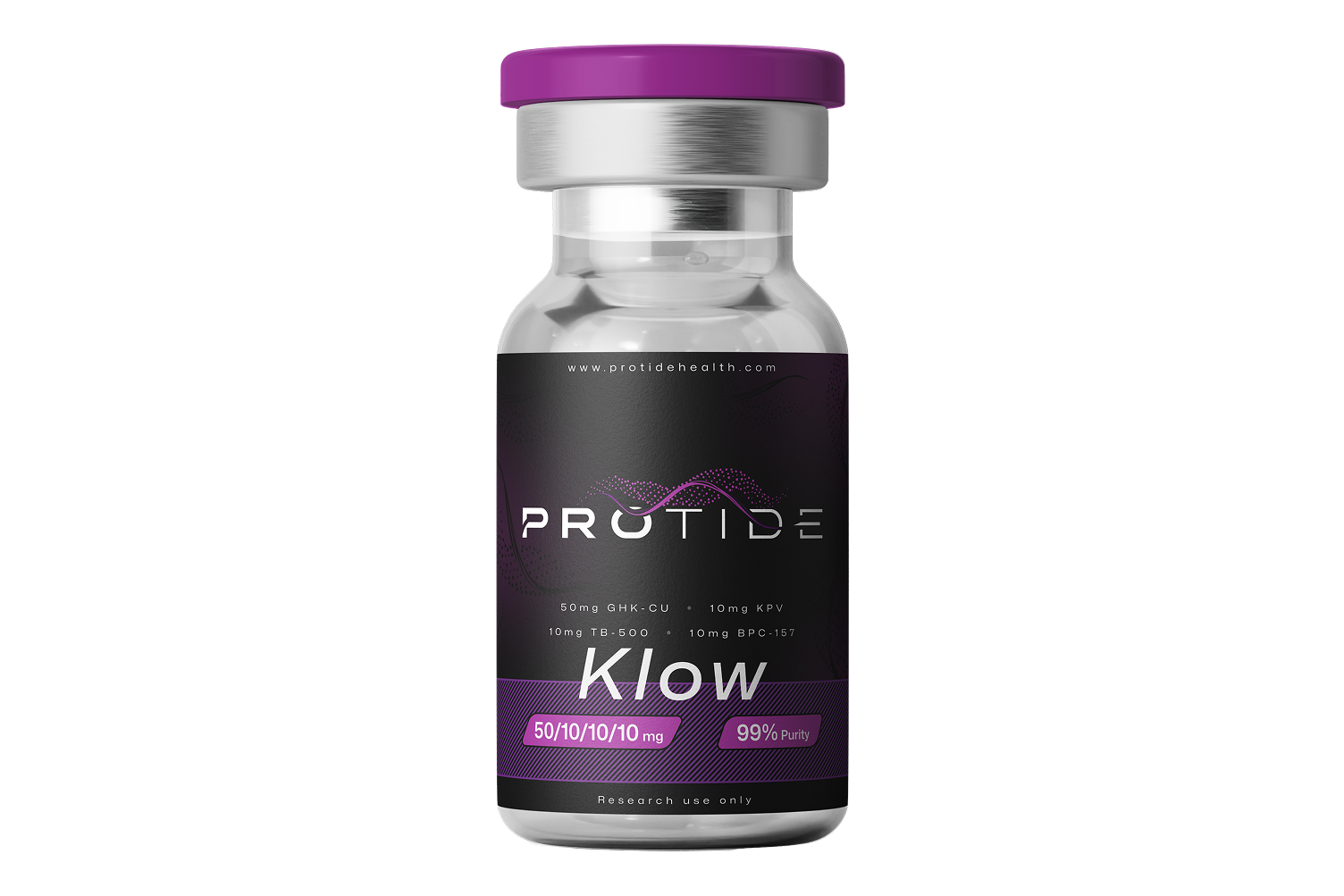
Klow Blend peptide 80mg product shot featuring a professionally labeled Protide Health 3mL research vial containing blue to blue-white lyophilized material, with GHK-Cu 50mg, KPV 10mg, BPC-157 10mg, and TB-500 10mg clearly displayed alongside research-use-only labeling against a clean laboratory-style background.


Klow Blend Peptide 80mg – Protide Health USA
Klow Blend Overview & Technical Specifications
The Klow Blend is a four-component peptide research formulation containing GHK-Cu, KPV, BPC-157, and TB-500 in a single 80mg lyophilized vial.
Each vial contains:
- GHK-Cu: 50mg
- KPV: 10mg
- BPC-157: 10mg
- TB-500 / Thymosin Beta-4: 10mg
- Total Research Material: 80mg
- Vial Size: 3mL
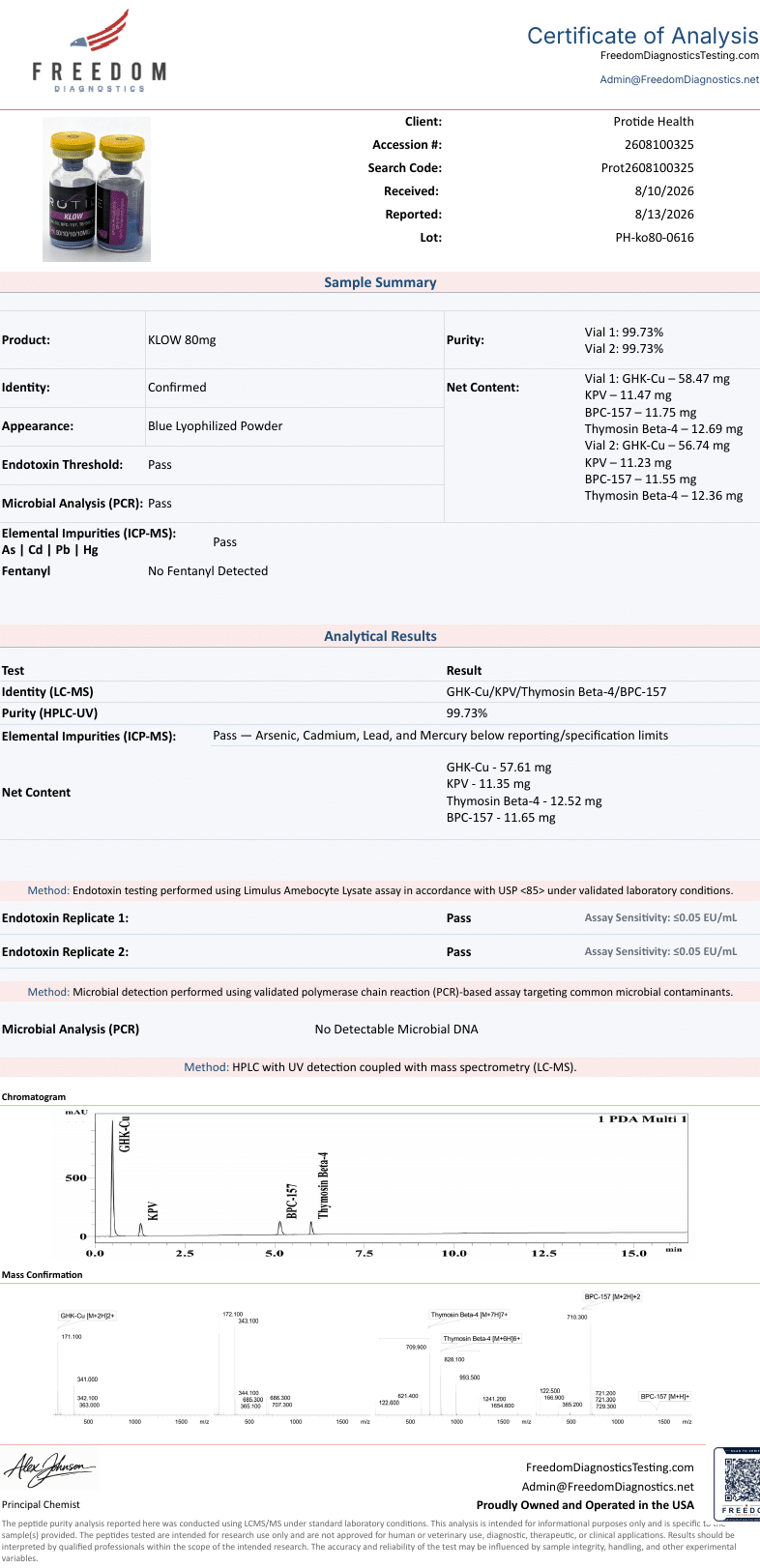
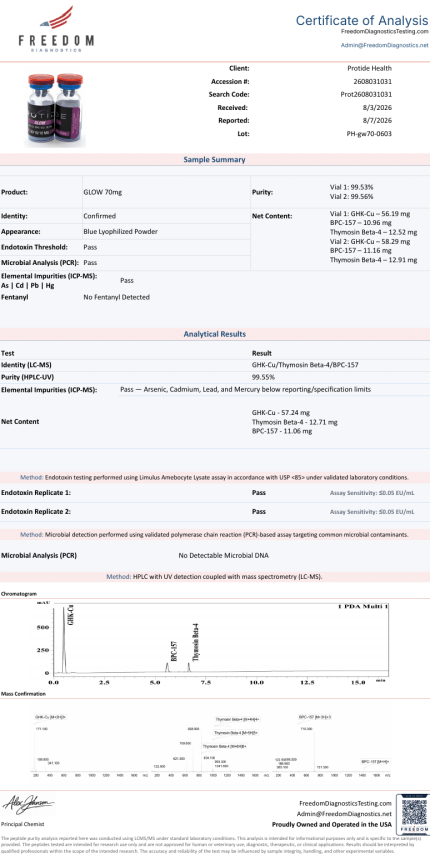
- Purity: 99%
- Testing: HPLC-MS verified; third-party tested
The Klow Blend combines four chemically distinct research peptides associated with copper-binding peptide biology, melanocortin-derived short-peptide research, vascular and cellular signaling models, and actin-associated cytoskeletal research.
Protide Health supplies the Klow Blend peptide exclusively for laboratory, analytical, biochemical, cellular, in-vitro, and qualified preclinical investigation.
Technical Specifications
- Product Name: Klow Blend
- Alternative Names: Klow Peptide Blend, GHK-Cu KPV BPC-157 TB-500 Blend
- Total Quantity: 80mg
- GHK-Cu: 50mg
- KPV: 10mg
- BPC-157: 10mg
- TB-500 / Thymosin Beta-4: 10mg
- Form: Lyophilized powder
- Vial Size: 3mL
- Purity: 99%
- Testing: HPLC-MS verified; third-party tested
- Appearance: Blue to blue-white lyophilized material
- Solution Appearance: Blue when dissolved due to copper content
- Solubility: Soluble in water
- Storage: Store sealed at ≤6°C and protected from heat, light, and moisture
- Research Classification: Laboratory and qualified preclinical research only
Klow Blend Component Overview
The four components in the Klow Blend represent different peptide classes.
GHK-Cu — 50mg
GHK-Cu is the copper complex of the tripeptide:
Gly-His-Lys
The peptide portion is commonly abbreviated:
GHK
The copper complex is commonly referred to as:
GHK-Cu, Copper Tripeptide-1, or Prezatide Copper.
The supplied PubChem structure for GHK-Cu CID 378611 describes a copper-associated GHK complex with:
- Formula: C14H24CuN6O4
- Molecular Weight: approximately 403.92 g/mol
- Peptide Sequence: Gly-His-Lys with copper
GHK-Cu Identifier Clarification
The originally supplied CAS number 49557-75-7 corresponds to metal-free GHK rather than the copper complex.
For the copper complex, FDA/GSRS and a dedicated PubChem prezatide-copper record associate:
CAS 89030-95-5
with GHK-Cu / prezatide copper.
Because several PubChem records represent different protonation, coordination, and stoichiometric forms of GHK-Cu, researchers should use lot-specific analytical documentation to define the exact copper-peptide species.
KPV — 10mg
KPV is the tripeptide:
Lys-Pro-Val
or:
KPV
It corresponds to the C-terminal three amino acids of α-melanocyte-stimulating hormone.
Verified reference information includes:
- PubChem CID: 125672
- CAS Number: 67727-97-3
- Molecular Formula: C16H30N4O4
- Molecular Weight: approximately 342.43 g/mol
- Sequence: H-Lys-Pro-Val-OH
Researchers can reference the supplied KPV chemical structure.
KPV has been investigated primarily in preclinical models involving inflammatory signaling, epithelial biology, and melanocortin-derived peptide mechanisms.
BPC-157 — 10mg
BPC-157 is a synthetic pentadecapeptide composed of 15 amino acids:
Gly-Glu-Pro-Pro-Pro-Gly-Lys-Pro-Ala-Asp-Asp-Ala-Gly-Leu-Val
or:
GEPPPGKPADDAGLV
Verified reference data include:
- PubChem CID: 9941957
- CAS Number: 137525-51-0
- Molecular Formula: C62H98N16O22
- Molecular Weight: approximately 1419.5 g/mol
Researchers can reference the supplied BPC-157 chemical structure.
BPC-157 research has examined pathways involving:
- Vascular responses
- Endothelial signaling
- VEGF-associated systems
- FAK-associated signaling
- Nitric-oxide pathways
- Cell migration
- Experimental tissue-response models
Much of this evidence remains preclinical.
TB-500 / Thymosin Beta-4 — 10mg
The Klow Blend specification describes TB-500 as full-length thymosin beta-4.
The sequence is:
Ac-Ser-Asp-Lys-Pro-Asp-Met-Ala-Glu-Ile-Glu-Lys-Phe-Asp-Lys-Ser-Lys-Leu-Lys-Lys-Thr-Glu-Thr-Gln-Glu-Lys-Asn-Pro-Leu-Pro-Ser-Lys-Glu-Thr-Ile-Glu-Gln-Glu-Lys-Gln-Ala-Gly-Glu-Ser
or:
Ac-SDKPDMAEIEKFDKSKLKKTETQEKNPLPSKETIEQEKQAGES-OH
Verified reference data include:
- PubChem CID: 16132341
- CAS Number: 77591-33-4
- Molecular Formula: C212H350N56O78S
- Molecular Weight: approximately 4963 g/mol
- Length: 43 amino acids
Researchers can reference the supplied TB-500 / thymosin beta-4 chemical structure.
This identity corresponds to full-length N-acetylated thymosin beta-4 rather than a short TB-500 fragment.
Klow Blend Peptide Research Context
The Klow Blend peptide combines four research compounds associated with separate molecular pathways.
GHK-Cu Research Context
GHK-Cu research has examined:
- Copper coordination
- Extracellular matrix biology
- Gene-expression responses
- Cellular migration
- Metallopeptide signaling
- Oxidative and redox-associated processes
GHK has strong copper-binding properties, and the resulting copper complex differs chemically from the unbound GHK tripeptide.
The blue appearance of the Klow Blend is consistent with the inclusion of a copper-containing peptide complex.
KPV Research Context
KPV is derived from the C-terminal portion of α-MSH but does not reproduce the full pharmacology of α-MSH.
Experimental research has investigated KPV in relation to:
- Inflammatory signaling
- NF-κB-associated pathways
- Epithelial-cell systems
- Intestinal research models
- Cytokine-associated responses
These findings are primarily cellular and preclinical and should not be translated into human therapeutic claims.
BPC-157 Research Context
BPC-157 is one of the most frequently studied components of the Klow Blend peptides in experimental vascular and tissue-response literature.
Published preclinical studies have examined:
- Angiogenesis-related signaling
- VEGF-associated pathways
- Endothelial responses
- Nitric oxide
- FAK signaling
- Cell migration
- Vascular adaptation
These findings do not establish equivalent outcomes in humans.
Thymosin Beta-4 & Actin Research
Thymosin beta-4 is well characterized as an actin-binding peptide.
One of its key biochemical functions is interaction with monomeric G-actin.
Experimental work has investigated:
- G-actin sequestration
- Actin polymerization
- Cytoskeletal organization
- Cell migration
- Endothelial biology
- Tissue-remodeling models
Full-length thymosin beta-4 can form approximately 1:1 complexes with actin monomers.
This provides a well-defined molecular research pathway for the TB-500 component of the Klow Blend.
Four Peptides, Four Distinct Molecular Systems
The Klow Blend peptides should not be treated as one established pharmacological molecule.
GHK-Cu
Primarily associated with:
- Copper-binding biology
- Metallopeptide chemistry
- Extracellular matrix research
- Cellular signaling
KPV
Primarily associated with:
- Melanocortin-derived peptide research
- Inflammatory signaling
- Epithelial models
BPC-157
Primarily associated with:
- Vascular signaling
- VEGF-associated research
- Nitric oxide
- Cell migration
TB-500 / Thymosin Beta-4
Primarily associated with:
- G-actin binding
- Cytoskeletal regulation
- Cellular migration
- Actin dynamics
The presence of all four components in the Klow Blend does not establish biological synergy.
Klow Blend Peptide Benefits: Evidence Limitations
The phrase klow blend peptide benefits commonly appears in consumer-oriented searches.
The scientific literature supports experimental investigation of the individual components but does not establish clinical benefits for the four-peptide blend.
Individual component research has examined areas including:
- Copper-peptide signaling
- Cell migration
- Inflammatory pathways
- Endothelial systems
- Cytoskeletal biology
- Actin sequestration
- Vascular signaling
- Extracellular matrix models
These research areas do not establish that the Klow Blend peptide:
- Heals injuries
- Improves skin
- Accelerates recovery
- Reduces inflammation in humans
- Enhances athletic performance
- Improves muscle growth
- Provides anti-aging effects
The complete four-component formulation requires direct testing before combined biological properties can be established.
Benefits of Klow Peptide Blend Searches
The phrase benefits of klow peptide blend should be interpreted as a question about research hypotheses rather than established therapeutic outcomes.
There is an important difference between:
- Evidence involving one individual component
- Evidence involving two components together
- Evidence involving the complete four-component Klow Blend
Results from GHK-Cu, KPV, BPC-157, or thymosin beta-4 individually cannot automatically be attributed to the mixture.
Likewise, combining compounds does not prove additive or synergistic effects.
Klow Blend Dosage Searches
The phrase klow blend dosage generally concerns human administration.
Protide Health does not provide human dosing information.
The quantities on this page describe vial contents only:
- GHK-Cu: 50mg
- KPV: 10mg
- BPC-157: 10mg
- TB-500: 10mg
- Total: 80mg
These quantities are not recommended human doses.
No instructions are provided for:
- Human injection
- Administration frequency
- Treatment cycles
- Reconstitution for administration
- Body-weight calculations
- Injury protocols
- Cosmetic use
- Athletic-performance use
Qualified laboratories should determine experimental concentrations according to assay-specific protocols.
Peptide Klow Blend Search Context
The phrase peptide klow blend is another search variation referring to the same four-component research formulation.
The Klow Blend should be characterized according to its actual composition rather than as a single peptide.
It contains:
- One copper-peptide complex
- One tripeptide
- One pentadecapeptide
- One 43-amino-acid actin-binding peptide
This chemical diversity is important when designing analytical methods or interpreting experimental responses.
Klow Blend & Copper Chemistry
GHK-Cu contributes a feature not present in the other three components: coordinated copper.
Copper coordination affects:
- Molecular mass
- Charge
- Spectroscopic properties
- Solution color
- Coordination chemistry
- Analytical behavior
This explains why the Klow Blend peptide may exhibit a blue to blue-white appearance as a dry material and a blue solution after dissolution.
That appearance should be interpreted as a physical characteristic of the copper-containing formulation rather than as an indicator of biological potency.
Klow Blend & Cytoskeletal Research
TB-500 / thymosin beta-4 provides the strongest direct cytoskeletal mechanism among the four components.
Thymosin beta-4 binds G-actin and regulates the balance of polymerizable actin within cells.
Research into actin dynamics is relevant to:
- Cell shape
- Motility
- Migration
- Cytoskeletal organization
- Endothelial-cell behavior
BPC-157 and GHK-Cu have also been examined in cell-migration models, but those findings arise through distinct experimental pathways.
Research Blend Design
Because all four components are present in a single Klow Blend vial, experiments using the blend alone cannot determine which component produced an observed response.
Appropriate experimental designs may require:
- GHK-Cu-only controls
- KPV-only controls
- BPC-157-only controls
- Thymosin beta-4-only controls
- Combination controls
- Vehicle controls
- Concentration-matched comparator groups
This distinction is particularly important when investigating possible component interactions.
Research Format & Storage
Protide Health supplies the Klow Blend as:
- Total Quantity: 80mg
- GHK-Cu: 50mg
- KPV: 10mg
- BPC-157: 10mg
- TB-500: 10mg
- Form: Lyophilized powder
- Vial Size: 3mL
- Purity: 99%
- Testing: HPLC-MS verified; third-party tested
- Appearance: Blue to blue-white
- Solubility: Soluble in water
Storage specifications:
- Store at ≤6°C
- Keep sealed
- Protect from heat
- Protect from direct light
- Protect from moisture
These conditions describe laboratory storage only.
Research Limitations
Several limitations should be considered when interpreting Klow Blend research:
- The formulation contains four chemically distinct research peptides.
- The four-peptide blend is not one established pharmacological entity.
- GHK-Cu exists in multiple coordination and protonation representations.
- CAS 49557-75-7 belongs to metal-free GHK, not the canonical prezatide-copper identity.
- KPV evidence remains primarily preclinical.
- BPC-157 evidence remains heavily preclinical.
- Thymosin beta-4 findings depend on confirming that full-length peptide is actually present.
- Evidence for one component cannot automatically be attributed to the complete blend.
- Combining components does not demonstrate synergy.
- Animal findings cannot establish human therapeutic outcomes.
- The complete blend does not have an established human safety or efficacy profile.
- The 80mg quantity identifies vial contents and is not a human dose.
For these reasons, the Klow Blend peptide is supplied strictly for qualified laboratory research.
Literature & Citation Index
GHK Copper Peptide in Skin Remodeling and Signaling Research
Research Context: GHK-Cu, copper coordination, extracellular matrix research, cellular responses, gene-expression studies, and metallopeptide biology.
KPV as a C-Terminal α-MSH-Derived Tripeptide
Research Context: KPV, Lys-Pro-Val, melanocortin-derived peptide biology, inflammatory signaling, epithelial models, and preclinical cellular research.
BPC-157 and Blood Vessels
Year: 2014
PMID: 23782145
DOI: 10.2174/13816128113199990421
Research Context: BPC-157, vascular responses, VEGF-associated pathways, FAK signaling, nitric oxide, and experimental vascular models.
Thymosin Beta-4 Binds Actin in an Extended Conformation
Year: 1997
PMID: 9153421
DOI: 10.1021/bi970185v
Research Context: Thymosin beta-4, actin binding, G-actin sequestration, molecular conformation, and actin-polymerization research.
Frequently Asked Questions
What is the Klow Blend?
The Klow Blend is a four-component laboratory research formulation containing GHK-Cu, KPV, BPC-157, and TB-500 / thymosin beta-4.
What does the Klow Blend contain?
Each 80mg vial contains:
- GHK-Cu 50mg
- KPV 10mg
- BPC-157 10mg
- TB-500 10mg
What is the Klow Blend peptide?
The Klow Blend peptide is not one single peptide. It is a mixture of four distinct peptide-based research compounds supplied together in one vial.
What are Klow Blend peptides?
The Klow Blend peptides are GHK-Cu, KPV, BPC-157, and full-length thymosin beta-4.
Why is Klow Blend blue?
The blue coloration is associated with the copper component of GHK-Cu.
What is GHK-Cu?
GHK-Cu is the copper complex of the Gly-His-Lys tripeptide.
Is CAS 49557-75-7 the CAS number for GHK-Cu?
CAS 49557-75-7 corresponds to metal-free GHK. The FDA/GSRS-associated identifier for prezatide copper / GHK-Cu is 89030-95-5.
What is KPV?
KPV is the tripeptide Lys-Pro-Val, corresponding to the C-terminal three residues of α-MSH.
What is BPC-157?
BPC-157 is the 15-amino-acid peptide:
GEPPPGKPADDAGLV
What is TB-500 in this blend?
The supplied specification describes TB-500 as full-length N-acetylated thymosin beta-4, a 43-amino-acid G-actin-binding peptide.
What are Klow Blend peptide benefits?
Individual components have been investigated in multiple experimental systems, but no established human Klow Blend peptide benefits can be claimed for the complete four-component formulation.
What are the benefits of Klow peptide blend?
The phrase describes potential research interest in the component pathways. Co-formulation does not establish therapeutic benefits or synergy.
What is the Klow Blend dosage?
Protide Health does not provide a human Klow Blend dosage. The 80mg value describes total vial contents only.
What purity does Protide Health specify?
Protide Health specifies 99% purity, with HPLC-MS verification and third-party testing.
Is Klow Blend intended for human use?
No. It is supplied solely for biochemical, cellular, molecular, analytical, in-vitro, and qualified preclinical research.
Laboratory Terms & Compliance
Laboratory Research Use Only
The Klow Blend is supplied exclusively for laboratory research, analytical testing, peptide characterization, biochemical experimentation, cellular studies, molecular research, in-vitro studies, and qualified preclinical investigation.
It is not intended for human or veterinary consumption, medical use, wound treatment, injury recovery, cosmetic treatment, skin treatment, diagnostic use, bodybuilding, athletic-performance enhancement, injection, or clinical administration.
No human dosage, injection schedule, reconstitution protocol for administration, treatment cycle, cosmetic-use instructions, injury protocol, body-weight calculation, or human-use preparation guidance is provided.
The purchaser is responsible for appropriate laboratory handling, storage, and use under applicable institutional, federal, state, and local requirements.
For research use only.


MAECENAS IACULIS
Vestibulum curae torquent diam diam commodo parturient penatibus nunc dui adipiscing convallis bulum parturient suspendisse parturient a.Parturient in parturient scelerisque nibh lectus quam a natoque adipiscing a vestibulum hendrerit et pharetra fames nunc natoque dui.
ADIPISCING CONVALLIS BULUM
- Vestibulum penatibus nunc dui adipiscing convallis bulum parturient suspendisse.
- Abitur parturient praesent lectus quam a natoque adipiscing a vestibulum hendre.
- Diam parturient dictumst parturient scelerisque nibh lectus.
Scelerisque adipiscing bibendum sem vestibulum et in a a a purus lectus faucibus lobortis tincidunt purus lectus nisl class eros.Condimentum a et ullamcorper dictumst mus et tristique elementum nam inceptos hac parturient scelerisque vestibulum amet elit ut volutpat.
Related products
Reviews
There are no reviews yet.