
GHK-Cu & KPV Blend
$180.00
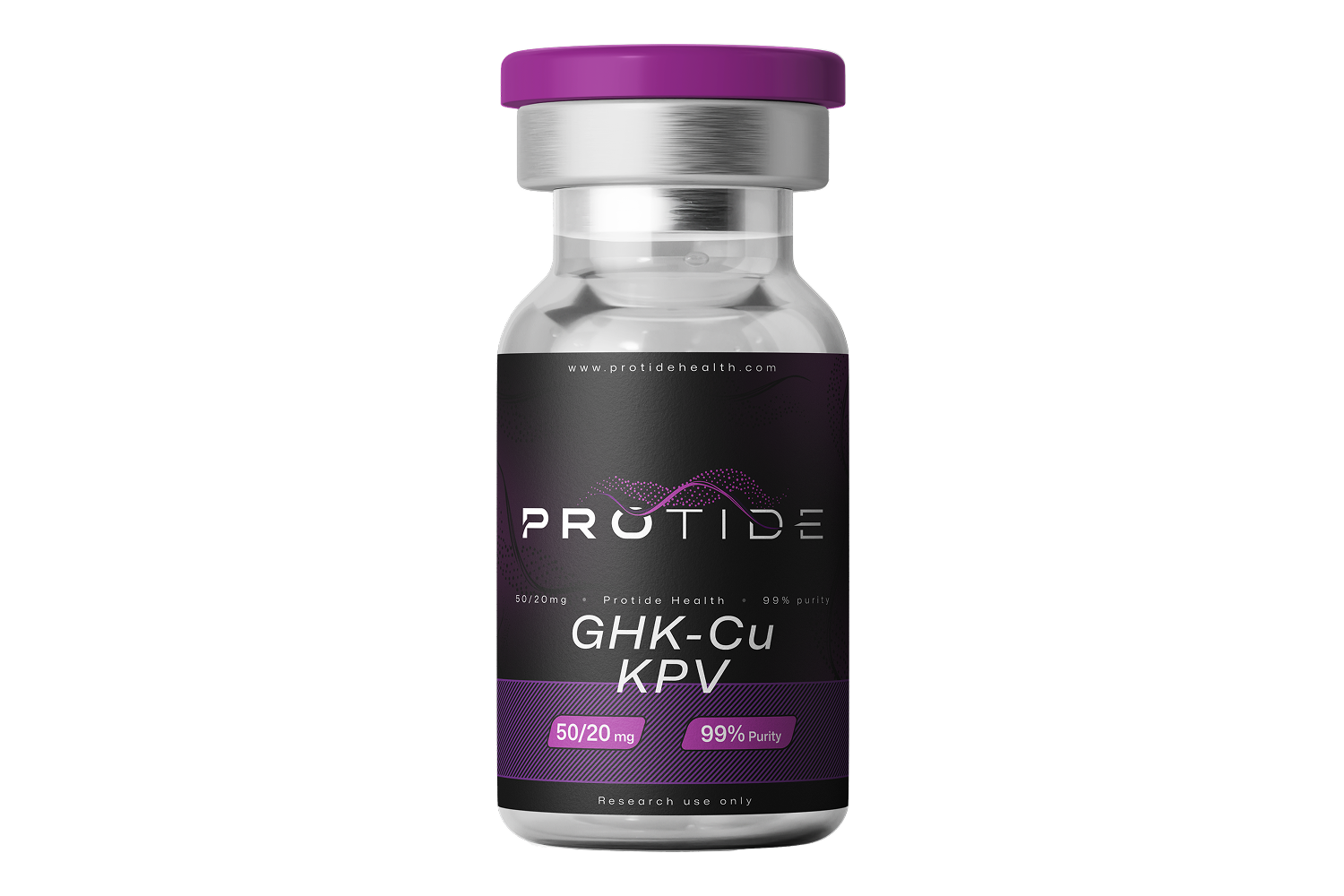
GHK Cu and KPV blend 70mg product shot featuring a professionally labeled Protide Health 3mL research vial containing blue to blue-violet lyophilized material, with GHK-Cu 50mg and KPV 20mg clearly identified alongside 99% purity, HPLC-MS verification, and laboratory-research-only labeling against a clean scientific background.


GHK Cu & KPV Blend 70mg – Protide Health USA
GHK Cu & KPV Blend Overview & Technical Specifications
The GHK Cu and KPV blend is a dual-peptide laboratory research formulation containing:
- GHK-Cu: 50mg
- KPV: 20mg
- Total Research Material: 70mg
- Vial Size: 3mL
The formulation combines a copper-binding tripeptide complex with a separate α-MSH-derived tripeptide.
GHK Cu consists of the Gly-His-Lys peptide coordinated with copper, while KPV consists of the sequence Lys-Pro-Val.
Protide Health supplies this dual research blend as 99% purity, HPLC-MS verified, third-party tested lyophilized material.
Technical Specifications
- Product Name: GHK-Cu & KPV Blend
- GHK-Cu Content: 50mg
- KPV Content: 20mg
- Total Quantity: 70mg
- Form: Lyophilized powder
- Vial Size: 3mL
- Purity: 99%
- Testing: HPLC-MS verified; third-party tested
- Peptide Type: Dual-tripeptide research blend
- Appearance: Blue to blue-violet lyophilized material
- Solubility: Soluble in water
- Storage: Store sealed at ≤6°C and protected from heat, light, and moisture
- Research Use: Copper-peptide, cellular, extracellular-matrix, epithelial, inflammatory-signaling, biochemical, analytical, and qualified preclinical research only
GHK Cu Component — 50mg
GHK Cu is the copper complex formed by the naturally occurring tripeptide:
Gly-His-Lys
or:
GHK
The supplied PubChem structure is represented by:
- PubChem CID: 378611
- Molecular Formula: C14H24CuN6O4
- Molecular Weight: approximately 403.93 g/mol
- Peptide Sequence: Gly-His-Lys
- Metal Component: Copper
Researchers can review the supplied GHK-Cu chemical structure.
GHK Cu CAS Number Clarification
An important identifier distinction applies to this component.
CAS 49557-75-7 corresponds to metal-free Gly-His-Lys rather than the canonical copper complex.
For prezatide copper / Copper Tripeptide-1, FDA-associated substance records use:
CAS 89030-95-5
PubChem also represents GHK-copper chemistry through more than one structure record because copper coordination, protonation state, and charge representation may differ between databases.
For this reason, researchers should prioritize lot-specific HPLC-MS and analytical documentation when identifying the exact GHK Cu species in the product.
KPV Component — 20mg
KPV is the synthetic tripeptide:
Lys-Pro-Val
or:
KPV
KPV corresponds to the C-terminal three-amino-acid fragment of alpha-melanocyte-stimulating hormone:
α-MSH (11-13)
Verified reference information includes:
- PubChem CID: 125672
- CAS Number: 67727-97-3
- Molecular Formula: C16H30N4O4
- Molecular Weight: approximately 342.43 g/mol
- Sequence: Lys-Pro-Val
- Terminal Representation: H-Lys-Pro-Val-OH
Researchers can review the supplied KPV chemical structure.
GHK Cu Peptide Research Context
The GHK Cu peptide has been investigated for decades in experimental systems involving copper transport, extracellular-matrix biology, fibroblast signaling, gene expression, and tissue-remodeling pathways.
Published research has examined effects involving:
- Collagen-associated systems
- Glycosaminoglycans
- Decorin
- Fibroblast biology
- Matrix metalloproteinases
- Tissue inhibitors of metalloproteinases
- Cellular migration
- Angiogenic signaling
- Oxidative-stress pathways
- Gene-expression regulation
GHK itself naturally binds copper ions with high affinity.
Coordination with Cu²⁺ changes its physicochemical and biological characteristics compared with the unbound GHK tripeptide.
GHK Cu & Extracellular Matrix Research
One of the best-developed areas of GHK Cu research concerns extracellular-matrix remodeling.
Experimental fibroblast research has examined:
- Collagen synthesis
- Matrix turnover
- Glycosaminoglycan synthesis
- Metalloproteinase activity
- TIMP regulation
- Fibroblast responses
Published experiments demonstrated that GHK-Cu can influence matrix metalloproteinase-2 expression in cultured fibroblasts while also affecting tissue inhibitors of metalloproteinases.
This suggests that copper-peptide research involves both matrix production and matrix-remodeling pathways rather than simply increased collagen synthesis.
GHK Cu & Gene-Expression Research
Research literature has also investigated GHK-associated gene-expression changes.
Reported areas include genes involved in:
- Tissue remodeling
- Oxidative stress
- Inflammatory signaling
- DNA repair
- Protein degradation
- Cellular differentiation
- Extracellular matrix organization
Gene-expression findings should be interpreted carefully.
Changes observed in cultured cells or computational transcriptomic comparisons do not automatically establish therapeutic effects in humans.
The exact response may depend on:
- Cell type
- Copper concentration
- Peptide concentration
- Exposure period
- Culture conditions
- Oxidative environment
KPV & PepT1 Research
KPV introduces a different experimental pathway into the blend.
Research has demonstrated that KPV can be transported through the peptide transporter:
PepT1
Experimental studies involving epithelial and immune-cell models have examined:
- KPV uptake
- NF-κB signaling
- MAPK signaling
- Cytokine expression
- Intestinal epithelial systems
- Immune-cell responses
KPV has also been investigated in several murine inflammatory models.
These studies remain primarily preclinical and do not establish a human indication.
KPV & NF-κB Signaling
KPV research has frequently focused on the NF-κB pathway.
NF-κB regulates expression of numerous inflammatory-response genes.
Published cellular work has reported KPV-associated changes involving:
- NF-κB activation
- MAP kinase pathways
- Pro-inflammatory cytokines
- Chemokine signaling
- Epithelial-cell responses
The KPV component should therefore be interpreted as a distinct research tripeptide rather than simply an extension of GHK Cu peptide biology.
Dual-Peptide Research Design
The GHK Cu and KPV formulation contains two different tripeptide systems.
GHK-Cu
Research context includes:
- Copper coordination
- Fibroblast signaling
- Extracellular-matrix biology
- Matrix remodeling
- Cellular migration
- Gene-expression models
KPV
Research context includes:
- α-MSH-derived peptide biology
- PepT1 transport
- NF-κB signaling
- MAPK signaling
- Epithelial-cell models
- Cytokine-associated pathways
The presence of both compounds in one vial does not prove that they are synergistic.
Any interaction between the two components should be tested experimentally using appropriate controls.
GHK Cu Benefits: Evidence Context
The phrase ghk cu benefits commonly appears in consumer-oriented searches.
Published research has examined GHK Cu in relation to:
- Fibroblast activity
- Collagen-associated pathways
- Extracellular matrix remodeling
- Cellular migration
- Oxidative-stress responses
- Copper-dependent signaling
- Gene-expression patterns
Some cosmetic and dermatologic literature also discusses GHK-Cu in skin-related applications.
However, those findings do not establish that the Protide Health research blend:
- Rejuvenates human skin
- Removes wrinkles
- Treats wounds
- Stimulates hair growth
- Produces anti-aging effects
- Treats inflammatory conditions
The product is supplied as laboratory research material rather than a cosmetic, drug, serum, or treatment.
GHK Cu Before and After Search Intent
The phrase ghk cu before and after commonly refers to consumer photographs involving skin, hair, or cosmetic appearance.
Before-and-after photographs are weak scientific evidence because they may lack:
- Standardized lighting
- Consistent camera settings
- Objective measurements
- Verified compound identity
- Controlled formulation
- Defined exposure
- Matched control groups
- Blinded assessment
Controlled laboratory measurements provide stronger evidence than anecdotal photography.
Protide Health therefore does not use GHK Cu before and after imagery as proof of efficacy.
GHK Cu Dosage Search Context
The phrase ghk cu dosage generally concerns human administration.
Protide Health does not provide human dosing recommendations.
The quantities on this page represent vial contents only:
- GHK-Cu: 50mg
- KPV: 20mg
- Total: 70mg
These figures are not recommended doses.
No instructions are provided for:
- Human dosing
- Injection
- Daily administration
- Treatment cycles
- Reconstitution for human use
- Body-weight calculations
- Cosmetic administration
- Skin application
Qualified laboratories should determine experimental concentrations using validated assay methodology.
GHK Cu Peptide Injection Search Context
The phrase ghk cu peptide injection concerns a human administration route.
This product page does not provide injection instructions.
Protide Health does not specify:
- Injection volume
- Injection site
- Administration frequency
- Needle selection
- Reconstitution for injection
- Human treatment protocols
The 3mL vial describes the container size rather than a human administration volume.
The product is supplied strictly for laboratory research.
GHK Cu Topical Research Context
The search phrase ghk cu topical reflects the history of copper peptides in cosmetic and skin-related research.
Topical GHK and GHK-Cu literature has examined areas such as:
- Skin permeability
- Fibroblast activity
- Extracellular matrix biology
- Cosmetic formulation
- Collagen-associated pathways
However, recent reviews continue to identify limitations in the clinical evidence and delivery literature.
The Protide Health product is not supplied as a topical preparation or finished cosmetic formulation.
Topical GHK Cu Search Intent
The phrase topical ghk cu refers to formulations designed for application to skin.
This lyophilized research blend should not be represented as equivalent to:
- Commercial creams
- Cosmetic lotions
- Prepared gels
- Dermatologic formulations
- Finished topical solutions
Formulation can substantially influence stability, permeability, concentration, and biological exposure.
Research involving a topical formulation therefore cannot automatically be transferred to a lyophilized laboratory vial.
GHK Cu Serum Search Context
A ghk cu serum is normally a finished cosmetic formulation containing GHK or GHK-Cu together with solvents, stabilizers, preservatives, and other formulation ingredients.
The Protide Health product is not a GHK Cu serum.
It is a lyophilized research blend containing:
GHK-Cu 50mg + KPV 20mg
Researchers evaluating published cosmetic serum data should account for differences in:
- Formulation
- Concentration
- Delivery
- Stability
- Excipient composition
- Skin permeability
GHK Cu Peptides & Copper Coordination
The phrase ghk cu peptides often refers broadly to GHK-based copper complexes.
Copper binding is central to the chemistry of GHK-Cu.
The histidine residue contributes importantly to metal coordination, while other donor atoms within the peptide participate in the copper-binding environment.
Coordination can influence:
- Molecular charge
- Spectroscopic characteristics
- Solution color
- Molecular structure
- Reactivity
- Analytical behavior
The blue to blue-violet appearance specified for this product is consistent with the presence of Cu²⁺-associated peptide material.
GHK Cu vs Metal-Free GHK
Metal-free GHK and GHK Cu should not be treated as identical compounds.
Metal-Free GHK
- Sequence: Gly-His-Lys
- Formula: C14H24N6O4
- CAS: 49557-75-7
- Does not contain coordinated copper
GHK-Cu
- GHK complexed with copper
- Copper Tripeptide-1 / prezatide copper terminology may be used
- FDA/GSRS CAS association: 89030-95-5
- Different molecular mass and coordination chemistry
This distinction is important for analytical documentation, product labeling, and literature interpretation.
GHK Cu & KPV Blend Research Applications
Qualified laboratories may investigate this dual formulation in experimental systems involving:
- Copper-peptide chemistry
- Fibroblast biology
- Extracellular matrix regulation
- Metalloproteinase pathways
- Cellular migration
- Epithelial-cell signaling
- PepT1 transport
- NF-κB signaling
- MAPK signaling
- Cytokine-associated pathways
- Comparative peptide biology
- Analytical characterization
The blend should be experimentally evaluated as a combination rather than assuming that individual-component findings automatically describe the mixture.
Related Protide Health Research Products
Researchers comparing other multi-peptide systems may review the BPC-157 + TB-500 Wolverine Blend for a separate dual-peptide research formulation.
The CJC-1295 No DAC + Ipamorelin Blend provides a mechanistically distinct endocrine-signaling peptide combination.
Researchers may also examine the TB-500 + BPC-157 + KPV Coremend Blend for another multi-component formulation containing KPV alongside unrelated research peptides.
These formulations should not be considered interchangeable with the GHK Cu and KPV blend.
Research Format & Storage
Protide Health supplies the blend as:
- GHK-Cu: 50mg
- KPV: 20mg
- Total Quantity: 70mg
- Form: Lyophilized powder
- Vial Size: 3mL
- Purity: 99%
- Testing: HPLC-MS verified; third-party tested
- Appearance: Blue to blue-violet
- Solubility: Soluble in water
According to the supplied specifications:
- Store at ≤6°C
- Keep sealed
- Protect from heat
- Protect from direct light
- Protect from moisture
These specifications describe laboratory storage characteristics only.
Research Limitations
Several limitations should be considered when interpreting this GHK Cu peptide blend:
- GHK-Cu and KPV are chemically distinct compounds.
- Co-formulation does not establish biological synergy.
- Most mechanistic KPV evidence remains preclinical.
- Much of the GHK-Cu literature is cellular, animal, cosmetic, or limited clinical research.
- Recent reviews continue to identify gaps in standardized human GHK-Cu trials.
- Findings from metal-free GHK should not automatically be attributed to copper-complexed GHK.
- Results from a prepared topical formulation should not automatically be assigned to lyophilized research material.
- Cosmetic serum data cannot establish effects of this two-peptide blend.
- Before-and-after photographs do not constitute controlled evidence.
- The 50mg/20mg quantities describe vial contents rather than human doses.
- The exact copper coordination species should be confirmed through analytical documentation.
- The product is not an FDA-approved pharmaceutical or cosmetic product.
For these reasons, the GHK-Cu/KPV blend is supplied strictly for qualified laboratory research.
Literature & Citation Index
The Tripeptide-Copper Complex Glycyl-L-Histidyl-L-Lysine-Cu2+ Stimulates Matrix Metalloproteinase-2 Expression by Fibroblast Cultures
Year: 2000
PMID: 11045606
Research Context: GHK-Cu, dermal fibroblasts, MMP-2, TIMP-1, TIMP-2, extracellular matrix production, and matrix remodeling.
GHK Peptide as a Natural Modulator of Multiple Cellular Pathways in Skin Regeneration
Year: 2015
PMID: 26236730
Research Context: GHK/GHK-Cu, fibroblast biology, collagen, glycosaminoglycans, decorin, extracellular matrix, gene-expression research, and tissue-remodeling models.
Regenerative and Protective Actions of the GHK-Cu Peptide in the Light of New Gene Data
Year: 2018
PMID: 29986520
DOI: 10.3390/ijms19071987
Research Context: GHK-Cu, gene expression, extracellular matrix, fibroblasts, oxidative stress, tissue-remodeling pathways, and preclinical research.
PepT1-Mediated Tripeptide KPV Uptake Reduces Intestinal Inflammation
Year: 2008
PMID: 18061177
DOI: 10.1053/j.gastro.2007.10.026
Research Context: KPV, PepT1, epithelial cells, immune cells, NF-κB, MAPK, cytokine signaling, and murine inflammatory models.
Researchers can review broader GHK-Cu and KPV literature indexed by PubMed for peer-reviewed background research.
Frequently Asked Questions
What is GHK Cu?
GHK Cu is a copper complex of the tripeptide Gly-His-Lys used experimentally in copper-binding, extracellular-matrix, fibroblast, and cellular-signaling research.
What is GHK Cu peptide?
The GHK Cu peptide is the copper-bound form of the GHK tripeptide. This Protide Health blend contains 50mg of GHK-Cu together with 20mg of KPV.
What is KPV?
KPV is the tripeptide Lys-Pro-Val and corresponds to α-MSH residues 11-13.
What does the GHK-Cu & KPV blend contain?
Each vial contains:
- GHK-Cu 50mg
- KPV 20mg
- Total 70mg
Why is the powder blue?
The blue to blue-violet appearance is associated with copper contained in the GHK-Cu component.
What is the GHK-Cu molecular formula?
The supplied Cu-GHK representation, PubChem CID 378611, has the molecular formula:
C14H24CuN6O4
What is the GHK-Cu CAS number?
CAS 49557-75-7 belongs to metal-free GHK. FDA/GSRS associates prezatide copper / Copper Tripeptide-1 with CAS 89030-95-5.
What is the KPV CAS number?
The KPV CAS number is:
67727-97-3
What are GHK Cu benefits?
Published research has examined GHK Cu benefits in experimental extracellular-matrix, fibroblast, copper-signaling, and tissue-remodeling models, but these findings do not establish therapeutic or cosmetic benefits for this laboratory product.
Are GHK Cu before and after photos reliable scientific evidence?
No. GHK Cu before and after images generally lack the controls required to demonstrate efficacy scientifically.
What is the GHK Cu dosage?
Protide Health does not provide a human ghk cu dosage. The 50mg GHK-Cu and 20mg KPV values describe vial contents only.
Is GHK Cu peptide injection recommended?
No human ghk cu peptide injection guidance is provided. This material is intended solely for laboratory research.
Is this GHK Cu topical material?
The product is laboratory research material rather than a finished ghk cu topical formulation.
Is this a GHK Cu serum?
No. A ghk cu serum is a formulated cosmetic product. This product is a lyophilized GHK-Cu/KPV laboratory research blend.
What does KPV research investigate?
KPV research includes PepT1 transport, epithelial-cell signaling, NF-κB, MAPK, cytokine pathways, and preclinical inflammatory models.
What purity does Protide Health specify?
Protide Health specifies 99% purity, with HPLC-MS verification and third-party testing.
Is this blend intended for human use?
No. It is supplied exclusively for copper-peptide, epithelial, biochemical, cellular, molecular, analytical, in-vitro, and qualified preclinical research.
Laboratory Terms & Compliance
Laboratory Research Use Only
This GHK Cu and KPV blend is supplied exclusively for laboratory research, analytical testing, copper-peptide studies, extracellular-matrix research, epithelial models, biochemical experimentation, cellular investigation, in-vitro research, and qualified preclinical experimentation.
It is not intended for human or veterinary consumption, cosmetic use, skin treatment, wound treatment, hair treatment, medical use, injection, topical human application, serum preparation, diagnostic use, or clinical administration.
No human dosage, injection schedule, topical protocol, serum formulation, cosmetic-use instructions, treatment cycle, body-weight calculation, or human-use preparation guidance is provided.
The purchaser is responsible for appropriate laboratory handling, storage, and use under applicable institutional, federal, state, and local requirements.
For research use only.


MAECENAS IACULIS
Vestibulum curae torquent diam diam commodo parturient penatibus nunc dui adipiscing convallis bulum parturient suspendisse parturient a.Parturient in parturient scelerisque nibh lectus quam a natoque adipiscing a vestibulum hendrerit et pharetra fames nunc natoque dui.
ADIPISCING CONVALLIS BULUM
- Vestibulum penatibus nunc dui adipiscing convallis bulum parturient suspendisse.
- Abitur parturient praesent lectus quam a natoque adipiscing a vestibulum hendre.
- Diam parturient dictumst parturient scelerisque nibh lectus.
Scelerisque adipiscing bibendum sem vestibulum et in a a a purus lectus faucibus lobortis tincidunt purus lectus nisl class eros.Condimentum a et ullamcorper dictumst mus et tristique elementum nam inceptos hac parturient scelerisque vestibulum amet elit ut volutpat.
Related products
Reviews
There are no reviews yet.