
GHK-Cu – Copper Peptide
Price range: $55.00 through $65.00
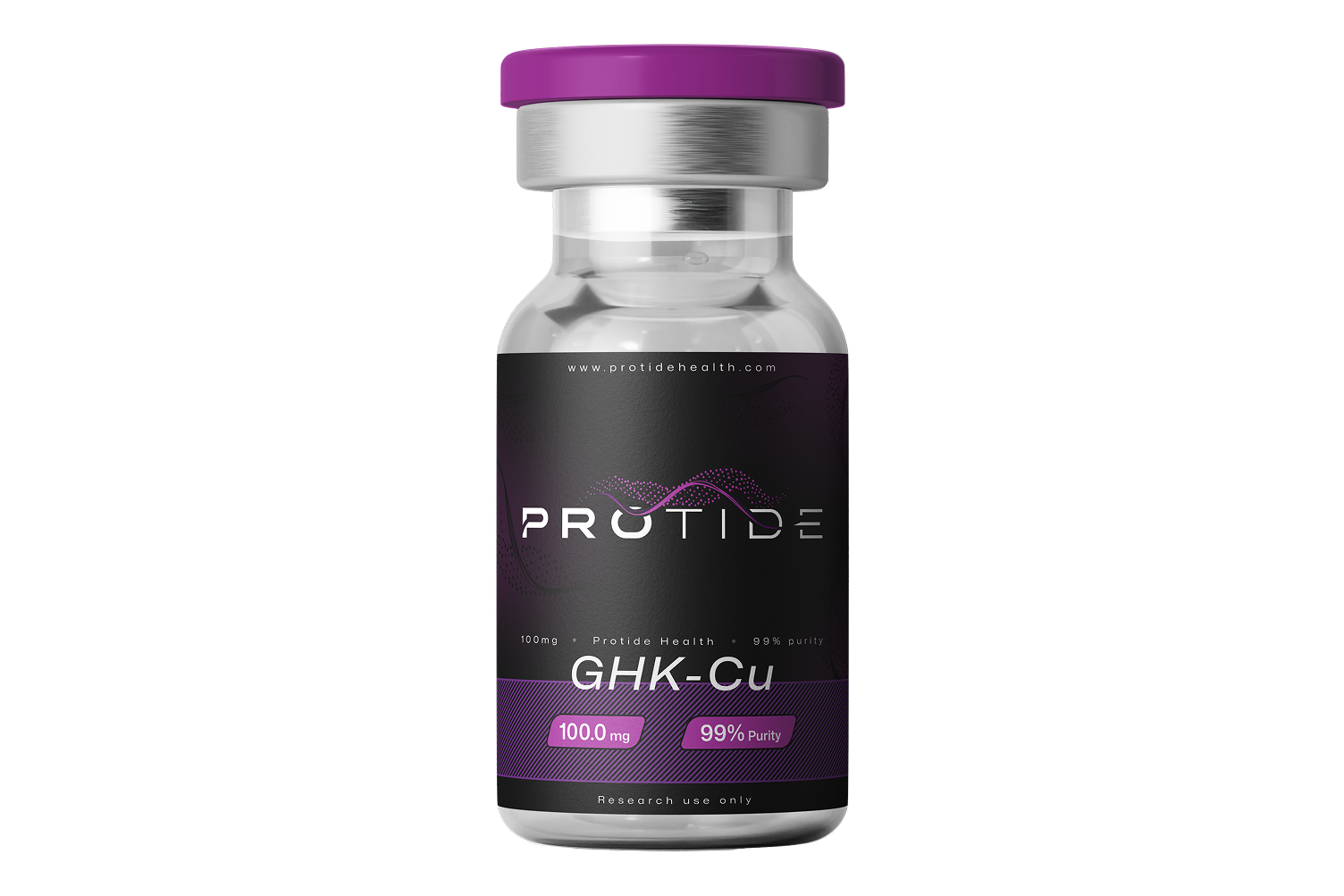
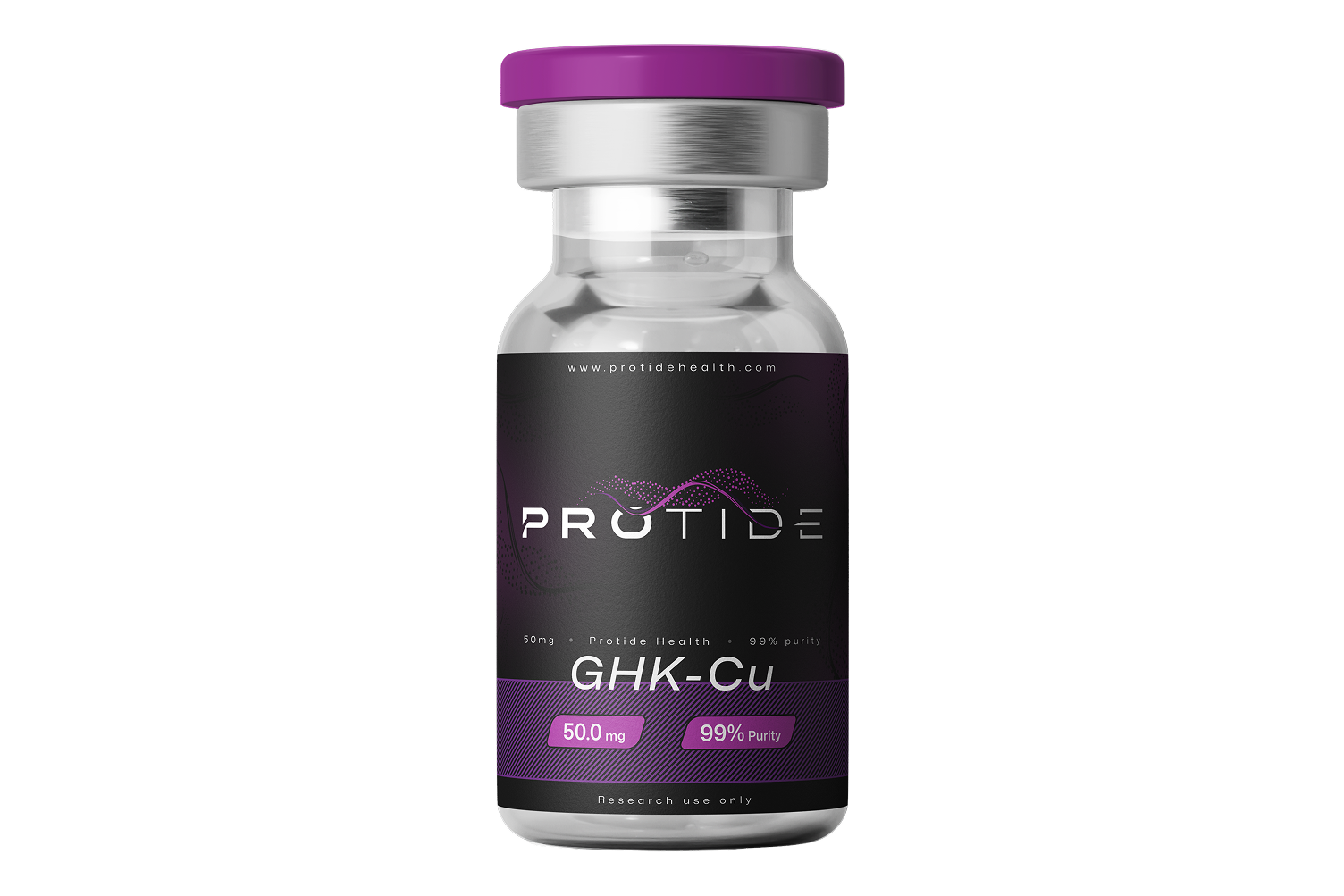
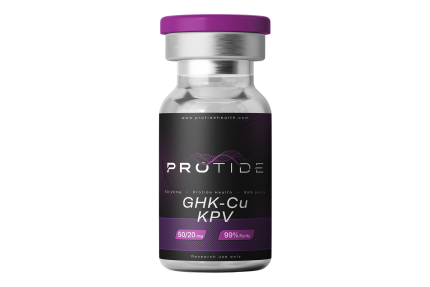
GHK Cu copper peptide product shot featuring professionally labeled Protide Health 3mL research vials containing blue to blue-violet lyophilized Cu-GHK material in 50mg and 100mg sizes, with Gly-His-Lys copper-complex identity, 99% purity, and laboratory-research-only labeling clearly displayed against a clean scientific background.


GHK Cu Copper Peptide 50mg & 100mg – Protide Health USA
GHK Cu Copper Peptide Overview & Technical Specifications
GHK Cu copper peptide is a copper-binding tripeptide complex formed from:
Gly-His-Lys
or:
GHK
in association with copper.
GHK is a naturally occurring tripeptide, while its copper-associated form is commonly described as:
- GHK-Cu
- GHK Cu
- Copper Peptide
- Copper Tripeptide-1
- Prezatide Copper
- Gly-His-Lys(II)
Protide Health supplies GHK Cu copper peptide as 99% purity, HPLC-MS verified, third-party tested lyophilized research material in:
- 50mg
- 100mg
Each product is supplied in a 3mL vial strictly for qualified laboratory research.
Technical Specifications
- Product Name: GHK-Cu
- Available Sizes: 50mg, 100mg
- Form: Lyophilized powder
- Vial Size: 3mL
- Purity: 99%
- Testing: HPLC-MS verified; third-party tested
- Peptide Type: Copper(II)-binding tripeptide complex
- Peptide Sequence: Gly-His-Lys
- PubChem CID: 378611
- Molecular Formula: C14H24CuN6O4
- Molecular Weight: approximately 403.93 g/mol
- Appearance: Blue to blue-violet lyophilized powder
- Solubility: Soluble in water
- Storage: Store sealed at ≤6°C and protected from heat, light, and moisture
- Research Use: Copper-peptide, extracellular-matrix, fibroblast, cellular, biochemical, analytical, and qualified preclinical research only
Researchers can review the supplied GHK-Cu chemical structure.
GHK Cu Copper Peptide Identity & CAS Clarification
An important chemical-identifier distinction applies to GHK Cu copper peptide.
The supplied PubChem record:
CID 378611
corresponds to Cu-GHK with:
- Formula: C14H24CuN6O4
- Molecular weight: approximately 403.92 g/mol
- Components: GHK and copper
However, CAS 49557-75-7 corresponds to the metal-free GHK peptide, rather than the canonical copper complex.
FDA/GSRS identifies prezatide copper / Copper Tripeptide-1 with:
CAS 89030-95-5
Copper-peptide records can differ according to coordination state, protonation, charge, and stoichiometric representation.
For definitive product identity, researchers should therefore prioritize the lot-specific HPLC-MS and analytical documentation supplied with the material.
GHK Cu Peptide & Copper Coordination
The GHK tripeptide consists of:
- Glycine
- Histidine
- Lysine
The histidine-containing sequence allows GHK to coordinate copper ions.
Copper coordination changes several physicochemical characteristics compared with metal-free GHK, including:
- Molecular mass
- Electronic structure
- Charge distribution
- Spectroscopic properties
- Color
- Chemical reactivity
The characteristic blue to blue-violet appearance of GHK Cu copper peptide reflects the presence of the copper-associated complex.
GHK Cu Copper Peptide & Extracellular Matrix Research
One of the best-characterized areas of GHK Cu copper peptide research involves extracellular-matrix biology.
Published fibroblast studies have examined GHK-Cu in relation to:
- Collagen-associated pathways
- Matrix metalloproteinases
- TIMP proteins
- Glycosaminoglycans
- Decorin
- Fibroblast activity
- Matrix remodeling
A published fibroblast study reported that GHK-Cu increased MMP-2 expression while also influencing TIMP-1 and TIMP-2 secretion.
This suggests that GHK-Cu research involves both extracellular-matrix production and controlled matrix remodeling rather than a single collagen pathway.
GHK Cu Copper Peptide & Fibroblast Research
Fibroblasts are a major experimental focus in GHK Cu copper peptide literature.
Research has investigated:
- Fibroblast proliferation
- Collagen synthesis
- Elastin-related pathways
- Extracellular matrix production
- Cell migration
- Recovery following experimental cellular stress
These findings help explain why GHK-Cu has become an important peptide in cellular and matrix-remodeling research.
They should not be interpreted as proof that the Protide Health material produces equivalent cosmetic or clinical effects in humans.
GHK Cu & Gene-Expression Research
Research involving GHK and GHK-Cu has also examined changes in gene-expression patterns.
Reported research areas include genes associated with:
- Extracellular matrix organization
- Oxidative stress
- DNA repair
- Inflammatory signaling
- Protein degradation
- Cellular differentiation
- Tissue remodeling
Gene-expression findings are strongly dependent on:
- Cell type
- Copper availability
- Peptide concentration
- Exposure time
- Experimental model
Changes in transcription do not automatically establish therapeutic outcomes.
GHK Cu Copper Peptide Benefits: Research Context
The phrase GHK Cu copper peptide benefits is commonly used in consumer and cosmetic searches.
Published research has investigated GHK-Cu in experimental systems involving:
- Fibroblast biology
- Extracellular-matrix remodeling
- Collagen-associated pathways
- Copper-dependent signaling
- Cell migration
- Angiogenesis-related pathways
- Oxidative-stress models
- Gene expression
These findings do not establish that the Protide Health GHK Cu copper peptide:
- Treats skin aging
- Eliminates wrinkles
- Restores hair
- Treats hair loss
- Heals human wounds
- Provides anti-aging effects
The product is supplied as laboratory research material rather than a finished cosmetic or approved therapeutic.
GHK Cu Copper Peptide for Hair Growth
The phrase ghk cu copper peptide for hair growth commonly appears in consumer searches.
Copper-peptide research has included experimental investigation of hair follicle biology and dermal papilla systems.
However, an important distinction is that one frequently cited human-hair study investigated AHK-Cu, a related but chemically different copper tripeptide, rather than GHK-Cu itself.
That study reported effects on cultured dermal papilla cells and ex-vivo human hair follicles.
Those results should not be automatically attributed to GHK Cu copper peptide.
Research reviews have discussed GHK-Cu in relation to tissue remodeling and hair-follicle biology, but direct clinical evidence for GHK-Cu as a hair-growth treatment remains limited.
GHK Cu Copper Peptide for Hair Loss
The keyword ghk cu copper peptide for hair loss reflects similar consumer intent.
Hair loss involves multiple biological pathways that may include:
- Androgen signaling
- Dermal papilla biology
- Inflammation
- Fibrosis
- Hair-cycle regulation
- Genetic factors
Research involving copper peptides does not establish that this Protide Health laboratory product treats androgenetic alopecia or other forms of hair loss.
The product should therefore not be represented as a hair-loss medication.
GHK Cu Copper Peptide Serum Search Context
A ghk cu copper peptide serum is a finished formulation intended for topical cosmetic application.
Such products may contain:
- GHK-Cu
- Water or solvent systems
- Preservatives
- Stabilizers
- Humectants
- Additional cosmetic ingredients
The Protide Health product is not a serum.
It is lyophilized GHK Cu copper peptide research material.
Results involving finished cosmetic formulations cannot automatically be transferred to this laboratory product because formulation can affect:
- Stability
- Skin penetration
- Exposure
- Copper coordination
- Peptide degradation
Copper Peptide GHK Cu Research Context
The phrase copper peptide GHK Cu refers to the same GHK-copper research system.
Metal-free GHK and copper-bound GHK should be distinguished experimentally.
Metal-Free GHK
- Sequence: Gly-His-Lys
- CAS: 49557-75-7
- Does not include coordinated copper
GHK-Cu
- GHK associated with copper
- PubChem CID 378611 for the supplied representation
- Formula: C14H24CuN6O4
- Molecular weight: approximately 403.93 g/mol
Different molecular forms should not be treated as analytically interchangeable.
Buy Copper Peptide GHK Cu: Research Sourcing Context
The phrase buy copper peptide ghk cu has transactional search intent.
For laboratory sourcing, researchers should evaluate:
- Correct chemical identity
- Peptide sequence
- Copper-associated composition
- Purity
- HPLC-MS verification
- Independent testing
- Storage conditions
- Traceability
Protide Health specifies this GHK Cu copper peptide as 99% purity, HPLC-MS verified, and third-party tested.
It is supplied strictly for research use.
GHK Cu Copper Peptide Injections Search Context
The phrase ghk cu copper peptide injections concerns human administration.
Protide Health does not provide injection instructions.
The 50mg and 100mg quantities identify total research material supplied in each vial.
They are not recommended doses.
No information is provided for:
- Human injection
- Injection sites
- Injection frequency
- Syringe selection
- Reconstitution for administration
- Body-weight dosing
- Treatment cycles
The 3mL specification describes vial capacity rather than a recommended administration volume.
GHK Cu Topical Research Context
GHK-Cu has a substantial history in topical and dermatologic research.
Experimental and cosmetic research has examined:
- Fibroblast activity
- Extracellular matrix remodeling
- Skin appearance
- Collagen-associated signaling
- Elasticity-associated measurements
- Cellular responses to environmental stress
However, a lyophilized research peptide is not automatically equivalent to a formulated topical product.
Protide Health does not provide topical-use instructions for this material.
GHK Cu vs Other Research Peptides
Researchers comparing GHK Cu copper peptide with other peptide systems may review LL-37 5mg for a structurally unrelated cathelicidin-derived peptide research model.
The KPV 10mg peptide provides a separate α-MSH-derived tripeptide system involving PepT1 and inflammatory-signaling research.
Researchers may also examine Kisspeptin 10mg for a completely different KISS1R-focused neuroendocrine peptide model.
These products are not chemically or mechanistically interchangeable with GHK-Cu.
Research Format & Storage
Protide Health supplies GHK Cu copper peptide in:
- 50mg
- 100mg
Product characteristics include:
- Form: Lyophilized powder
- Vial Size: 3mL
- Purity: 99%
- Testing: HPLC-MS verified
- Verification: Third-party tested
- Appearance: Blue to blue-violet
- Solubility: Soluble in water
Storage specifications:
- Store at ≤6°C
- Keep sealed
- Protect from heat
- Protect from direct light
- Protect from moisture
These conditions describe laboratory storage only.
Research Limitations
Several limitations should be considered when interpreting GHK Cu copper peptide research:
- Metal-free GHK and copper-bound GHK are not identical chemical entities.
- GHK-Cu has multiple database representations depending on coordination chemistry.
- Much of the literature involves cellular, animal, cosmetic, or limited human research.
- Fibroblast findings do not establish human cosmetic efficacy.
- Extracellular-matrix changes do not establish clinical anti-aging effects.
- A frequently cited hair-growth study evaluated AHK-Cu rather than GHK-Cu.
- Topical formulations cannot automatically be compared with lyophilized laboratory material.
- Hair-loss treatment efficacy has not been established for this research product.
- The 50mg and 100mg quantities are vial contents rather than human doses.
- Protide Health GHK-Cu is not an FDA-approved drug or finished cosmetic product.
For these reasons, GHK Cu copper peptide is supplied strictly for qualified laboratory research.
Literature & Citation Index
The Tripeptide-Copper Complex Glycyl-L-Histidyl-L-Lysine-Cu2+ Stimulates Matrix Metalloproteinase-2 Expression by Fibroblast Cultures
Year: 2000
PMID: 11045606
DOI: 10.1016/S0024-3205(00)00803-1
Research Context: GHK-Cu, dermal fibroblasts, MMP-2, TIMP-1, TIMP-2, extracellular matrix production, and matrix remodeling.
The Human Tri-Peptide GHK and Tissue Remodeling
Year: 2008
PMID: 18644225
Research Context: GHK, GHK-Cu, extracellular matrix, collagen, elastin, fibroblast biology, angiogenesis, and tissue-remodeling research.
GHK Peptide as a Natural Modulator of Multiple Cellular Pathways in Skin Regeneration
Year: 2015
PMID: 26236730
Research Context: GHK/GHK-Cu, collagen, glycosaminoglycans, decorin, fibroblast activity, gene expression, and cellular regeneration models.
Regenerative and Protective Actions of the GHK-Cu Peptide in the Light of New Gene Data
Year: 2018
PMID: 29986520
DOI: 10.3390/ijms19071987
Research Context: GHK-Cu, gene-expression patterns, fibroblast biology, extracellular matrix, oxidative-stress research, and tissue-remodeling pathways.
Researchers can review broader GHK-Cu and copper peptide literature indexed by PubMed for additional peer-reviewed research.
Frequently Asked Questions
What is GHK Cu copper peptide?
GHK Cu copper peptide is a copper complex formed from the tripeptide Gly-His-Lys and copper.
What is the GHK-Cu sequence?
The peptide sequence is:
Gly-His-Lys
or:
GHK
What is the molecular formula?
The supplied PubChem Cu-GHK representation has the formula:
C14H24CuN6O4
What is the molecular weight?
The molecular weight is approximately:
403.93 g/mol
What is the PubChem CID?
The supplied PubChem identifier is:
CID 378611
What is the CAS number for GHK-Cu?
The previously supplied CAS 49557-75-7 identifies metal-free GHK. FDA/GSRS associates CAS 89030-95-5 with prezatide copper / Copper Tripeptide-1.
Why is GHK-Cu blue?
The characteristic blue to blue-violet color results from the copper-associated complex.
What are GHK Cu copper peptide benefits?
Research has examined extracellular-matrix remodeling, fibroblast activity, copper-dependent signaling, and gene expression, but those findings do not establish therapeutic or cosmetic benefits for this research product.
Does GHK Cu copper peptide promote hair growth?
Copper-peptide research has examined hair-follicle and dermal-papilla systems, but direct evidence establishing this GHK-Cu laboratory material as a human hair-growth treatment is insufficient.
Is GHK Cu copper peptide for hair loss?
Protide Health does not market ghk cu copper peptide for hair loss as a treatment. This product is supplied for laboratory research only.
Is this a GHK Cu copper peptide serum?
No. This is lyophilized research material, not a finished ghk cu copper peptide serum or cosmetic formulation.
Can GHK Cu copper peptide be injected?
Protide Health does not provide ghk cu copper peptide injections guidance. The product is not supplied for human administration.
What sizes are available?
Protide Health supplies GHK-Cu in:
- 50mg
- 100mg
What purity does Protide Health specify?
Protide Health specifies 99% purity, HPLC-MS verification, and third-party testing.
Is GHK-Cu intended for human use?
No. It is supplied exclusively for copper-peptide, extracellular-matrix, fibroblast, biochemical, cellular, analytical, in-vitro, and qualified preclinical research.
Laboratory Terms & Compliance
Laboratory Research Use Only
This GHK Cu copper peptide product is supplied exclusively for laboratory research, copper-peptide chemistry, extracellular-matrix investigation, fibroblast studies, analytical testing, biochemical experimentation, cellular research, in-vitro studies, and qualified preclinical experimentation.
It is not intended for human or veterinary consumption, medical use, hair-loss treatment, hair-growth treatment, cosmetic use, anti-aging treatment, wound treatment, topical human application, injection, serum preparation, diagnostic use, or clinical administration.
No human dosage, injection protocol, topical-use instructions, hair-growth protocol, serum formulation, treatment cycle, body-weight calculation, or human-use preparation guidance is provided.
The purchaser is responsible for appropriate laboratory handling, storage, and use under applicable institutional, federal, state, and local requirements.
For research use only.
| Select vial strength |
100mg ,50mg |
|---|


MAECENAS IACULIS
Vestibulum curae torquent diam diam commodo parturient penatibus nunc dui adipiscing convallis bulum parturient suspendisse parturient a.Parturient in parturient scelerisque nibh lectus quam a natoque adipiscing a vestibulum hendrerit et pharetra fames nunc natoque dui.
ADIPISCING CONVALLIS BULUM
- Vestibulum penatibus nunc dui adipiscing convallis bulum parturient suspendisse.
- Abitur parturient praesent lectus quam a natoque adipiscing a vestibulum hendre.
- Diam parturient dictumst parturient scelerisque nibh lectus.
Scelerisque adipiscing bibendum sem vestibulum et in a a a purus lectus faucibus lobortis tincidunt purus lectus nisl class eros.Condimentum a et ullamcorper dictumst mus et tristique elementum nam inceptos hac parturient scelerisque vestibulum amet elit ut volutpat.
Reviews
There are no reviews yet.