
Kisspeptin 10mg
$75.00
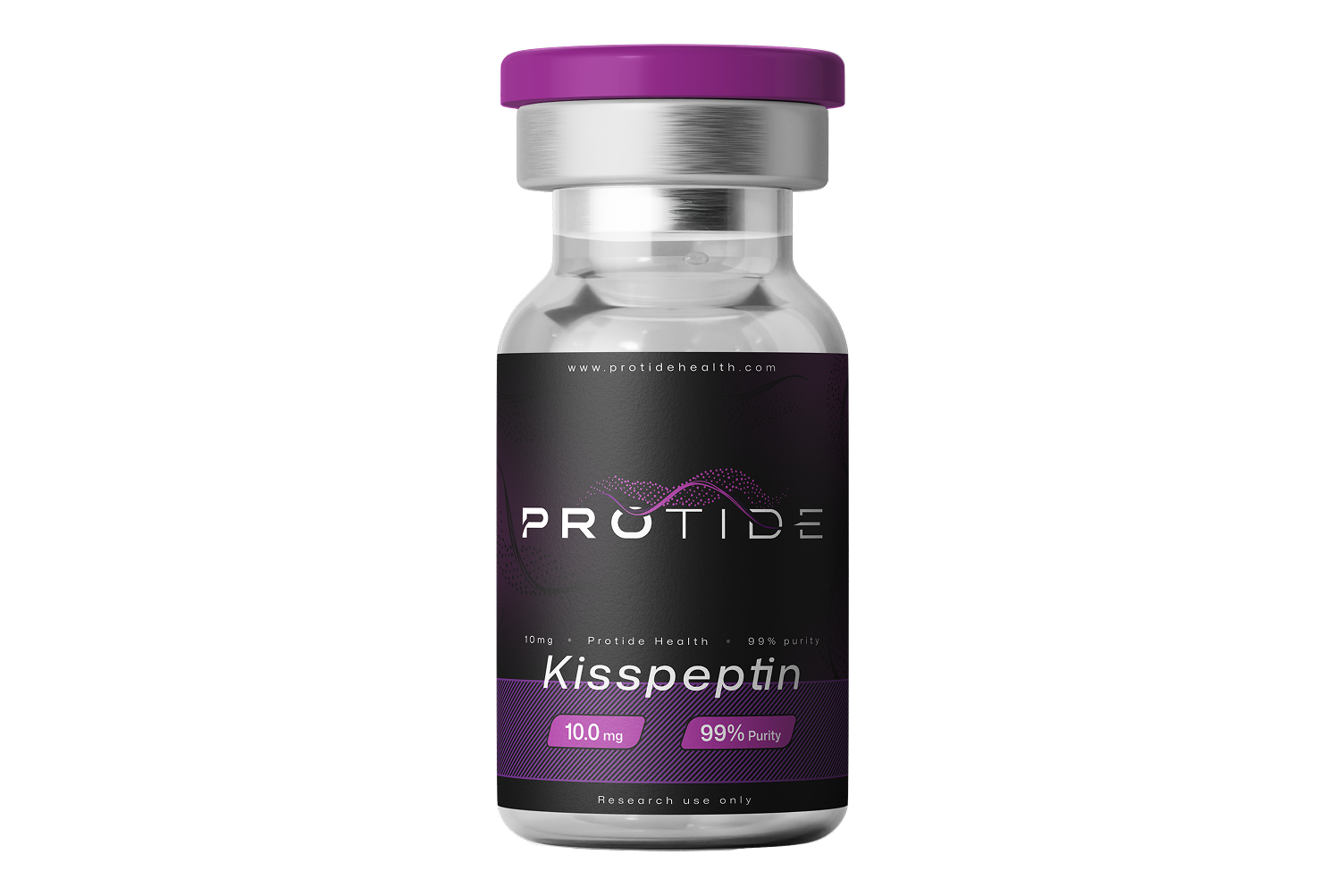
Kisspeptin 10mg product shot featuring a professionally labeled Protide Health 3mL research vial containing white to off-white lyophilized Kisspeptin-10 material, with the 10mg strength, YNWNSFGLRF-NH₂ sequence identity, KISS1R research positioning, and research-use-only labeling clearly displayed against a clean laboratory-style background.


Kisspeptin Peptide 10mg – Protide Health USA
Kisspeptin Overview & Technical Specifications
Kisspeptin is a synthetic decapeptide corresponding to the biologically active C-terminal fragment of the human KISS1-derived kisspeptin system.
The peptide supplied here is Kisspeptin-10, also known as:
- Kisspeptin 10
- KP-10
- Metastin 45-54
- KISS1 (112-121)
Its sequence is:
Tyr-Asn-Trp-Asn-Ser-Phe-Gly-Leu-Arg-Phe-NH₂
or:
YNWNSFGLRF-NH₂
PubChem identifies Kisspeptin-10 with:
- PubChem CID: 25240297
- CAS Number: 374675-21-5
- Molecular Formula: C63H83N17O14
- Molecular Weight: approximately 1302.44 g/mol
- Sequence: H-Tyr-Asn-Trp-Asn-Ser-Phe-Gly-Leu-Arg-Phe-NH₂
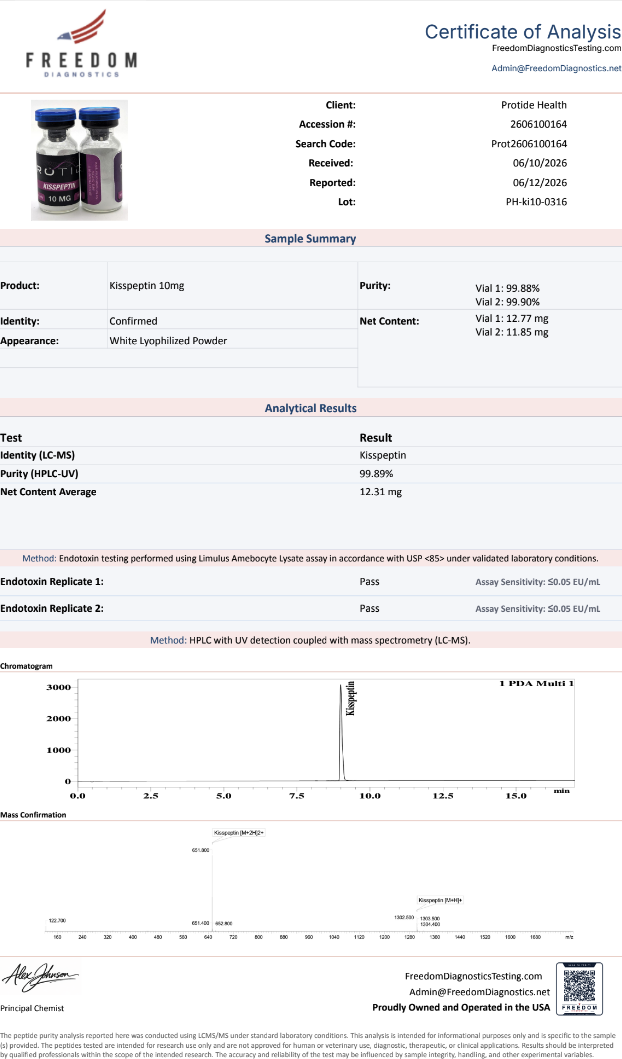
Protide Health supplies kisspeptin as 10mg of 99% purity, HPLC-MS verified, third-party tested lyophilized research material in a 3mL vial.
Technical Specifications
- Product Name: Kisspeptin-10
- Alternative Names: Kisspeptin 10, KP-10, Metastin 45-54, KISS1 (112-121)
- Quantity: 10mg
- Form: Lyophilized powder
- Vial Size: 3mL
- Purity: 99%
- Testing: HPLC-MS verified; third-party tested
- Peptide Type: Synthetic decapeptide
- Biological Class: C-terminal kisspeptin fragment
- Receptor: KISS1R
- Sequence: Tyr-Asn-Trp-Asn-Ser-Phe-Gly-Leu-Arg-Phe-NH₂
- CAS Number: 374675-21-5
- PubChem CID: 25240297
- Molecular Formula: C63H83N17O14
- Molecular Weight: approximately 1302.44 g/mol
- Appearance: White to off-white lyophilized powder
- Solubility: Soluble in water
- Storage: Store sealed at ≤6°C and protected from heat, light, and moisture
- Research Use: KISS1R signaling, reproductive-neuroendocrine, biochemical, cellular, analytical, and qualified preclinical research only
Researchers examining the molecular structure can reference the supplied Kisspeptin-10 chemical-structure record associated with CID 25240297.
What Is Kisspeptin?
The search phrase what is kisspeptin commonly refers to the family of peptides produced from the KISS1 precursor.
Kisspeptins are endogenous ligands for the G-protein-coupled receptor now officially called the kisspeptin receptor, KISS1R.
Historically, this receptor was also known as:
- GPR54
- AXOR12
- hOT7T175
The endogenous kisspeptin system includes several active C-terminal fragments, including:
- Kisspeptin-54
- Kisspeptin-14
- Kisspeptin-13
- Kisspeptin-10
Among these, Kisspeptin-10 is the shortest fragment retaining full intrinsic biological activity at KISS1R.
Kisspeptin Peptide & KISS1R Signaling
Kisspeptin peptide research centers heavily on KISS1R signaling.
KISS1R is a G protein-coupled receptor.
Experimental receptor activation can involve:
- Gq/11-associated signaling
- Phospholipase C
- Inositol phosphate signaling
- Intracellular calcium mobilization
- Protein kinase C
- Neuronal signaling
- GnRH-associated pathways
Kisspeptin signaling is especially important in research involving the hypothalamic-pituitary-gonadal axis.
Kisspeptin & GnRH Research
One of the most established areas of kisspeptin research is regulation of gonadotropin-releasing hormone, or GnRH.
Kisspeptin neurons provide upstream signaling to GnRH neuronal systems.
Experimental and clinical studies have shown that exogenous Kisspeptin-10 can stimulate GnRH-associated activity and increase luteinizing hormone responses under controlled conditions.
Research areas include:
- GnRH pulse generation
- LH secretion
- FSH-associated pathways
- Reproductive neuroendocrinology
- Pubertal signaling
- HPG-axis function
These findings provide mechanistic context for Kisspeptin-10 research but do not establish human use for the Protide Health product.
Kisspeptin 10 Research Context
Kisspeptin 10 is the C-terminal decapeptide of the larger kisspeptin precursor-derived sequence.
Its relatively short length makes it a useful experimental ligand for KISS1R research.
Published studies have examined Kisspeptin-10 in:
- Healthy male volunteers
- Reproductive hormone research
- GnRH pulse-frequency experiments
- Congenital hypogonadotropic hypogonadism research
- Endocrine challenge studies
A controlled study in healthy men found that Kisspeptin-10 increased LH secretion and altered LH pulse frequency, supporting its use as a probe of GnRH neuronal activity.
Kisspeptin & Reproductive Axis Research
Kisspeptin and KISS1R are widely recognized as central regulators of the hypothalamic-pituitary-gonadal axis.
Clinical genetic studies have also demonstrated the importance of KISS1R signaling through observations in individuals with receptor-inactivating mutations.
These findings support research into:
- Pubertal development
- GnRH neuronal function
- LH and FSH signaling
- Reproductive endocrine regulation
- Fertility-related physiology
A review of human case studies describes kisspeptin and Kiss1R as key regulators of reproductive neuroendocrine function.
Kisspeptin Dosage Search Context
The phrase kisspeptin dosage generally concerns human administration.
Protide Health does not provide human dosing instructions.
The 10mg quantity listed for this product describes the total amount of research material contained in the vial.
It is not a recommended dose.
No instructions are provided for:
- Human injection
- Daily administration
- Weekly administration
- Fertility treatment
- Hormone protocols
- Reconstitution for human use
- Body-weight calculations
- Clinical endocrine use
Human studies used specific research protocols under medical supervision.
Those protocols should not be converted into self-administration guidance.
Kisspeptin 10 Dosage Searches
The phrase kisspeptin 10 dosage refers to the same general human-use intent.
Kisspeptin-10 has been investigated in clinical studies using controlled intravenous research protocols, but those study conditions do not establish dosing for independently supplied laboratory material.
Protide Health therefore provides no human administration schedule.
Kisspeptin Dosage for Men
The search phrase kisspeptin dosage for men is especially common because some controlled human studies involved healthy male volunteers.
For example, a 2011 study evaluated intravenous Kisspeptin-10 in men and measured LH pulse responses.
Those study data are useful for understanding reproductive neuroendocrine pharmacology.
They should not be interpreted as a dosing recommendation for the Protide Health product.
The 10mg vial strength is product content only.
Kisspeptin Peptide Benefits: Research Context
The phrase kisspeptin peptide benefits is often used in consumer search.
Scientifically, Kisspeptin-10 research has investigated:
- GnRH stimulation
- LH responses
- HPG-axis signaling
- Reproductive hormone physiology
- Pubertal control mechanisms
- GnRH neuronal function
These findings demonstrate biological activity in defined experimental settings.
They do not establish that the Protide Health research vial provides human reproductive, fertility, testosterone, sexual-health, or therapeutic benefits.
Human Kisspeptin Research
Human research has played an important role in understanding Kisspeptin physiology.
Studies have examined:
- Healthy men
- Healthy women
- Individuals with reproductive endocrine disorders
- Subjects with idiopathic hypogonadotropic hypogonadism
- Hormonal responses following experimental Kisspeptin administration
A review of human studies notes that different kisspeptin isoforms, doses, and routes have been used to study LH secretion as a surrogate marker of GnRH release.
These studies provide pharmacological and physiological context, not instructions for use of research-grade material.
Kisspeptin & Idiopathic Hypogonadotropic Hypogonadism Research
Kisspeptin has also been used experimentally as a probe of GnRH neuronal function in subjects with idiopathic hypogonadotropic hypogonadism.
A 2014 study examined responses to both Kisspeptin and GnRH in individuals with congenital IHH.
The research demonstrated variability in Kisspeptin responsiveness depending on the functional state of the GnRH neuronal network.
This work reinforces the importance of KISS1R signaling in reproductive-neuroendocrine research.
KISS1R Receptor Nomenclature
The official receptor name is:
Kisspeptin receptor
Gene symbol:
KISS1R
Older literature may use:
- GPR54
- AXOR12
- hOT7T175
The International Union of Basic and Clinical Pharmacology recommended the Kisspeptin receptor nomenclature after identification of kisspeptins as the endogenous ligands.
Researchers reviewing older literature should recognize these names as referring to the same receptor system.
Kisspeptin vs Larger Kisspeptin Fragments
Kisspeptin-10 belongs to a family of active peptides sharing the same C-terminal sequence.
Kisspeptin-54
A longer endogenous peptide historically called metastin.
Kisspeptin-14
Shorter C-terminal cleavage product.
Kisspeptin-13
Another active C-terminal fragment.
Kisspeptin-10
The shortest fully active fragment commonly used in receptor and endocrine research.
All share the C-terminal RF-amide motif important for receptor activation.
Kisspeptin & LH Research
Luteinizing hormone is frequently used as an indirect readout of GnRH activation in Kisspeptin research.
In healthy men, experimental Kisspeptin-10 exposure has been associated with:
- Increased LH secretion
- Increased LH pulse frequency
- GnRH-associated endocrine activation
These outcomes were measured in controlled clinical settings rather than consumer-use environments.
Kisspeptin & FSH Research
Kisspeptin-related research may also monitor follicle-stimulating hormone.
FSH responses can differ from LH responses depending on:
- Sex
- Hormonal state
- Dose
- Kisspeptin isoform
- Route
- Duration of exposure
This variability is one reason why Kisspeptin physiology should not be simplified into a single universal endocrine effect.
KISS1 & Metastasis Research History
The KISS1 gene was originally identified in the context of metastasis-suppressor research.
The peptide product was initially called metastin.
Subsequent discovery of the receptor-ligand relationship led to the wider adoption of the name kisspeptin.
This historical background explains why older literature may discuss both:
- Metastin
- Kisspeptin
The names may refer to related KISS1-derived peptide products depending on fragment length.
Related Protide Health Research Products
Researchers examining structurally distinct signaling peptides may review TB-500 / Thymosin Beta-4 10mg for actin-associated cytoskeletal research.
The Survodutide 10mg research peptide provides a separate metabolic receptor research model.
Researchers may also examine SNAP-8 10mg for a synthetic peptide associated with distinct neuromuscular-signaling research applications.
These peptides are chemically and mechanistically distinct from kisspeptin.
Research Format & Storage
Protide Health supplies kisspeptin as:
- Quantity: 10mg
- Form: Lyophilized powder
- Vial Size: 3mL
- Purity: 99%
- Testing: HPLC-MS verified; third-party tested
- Appearance: White to off-white
- Solubility: Soluble in water
Storage specifications:
- Store at ≤6°C
- Keep sealed
- Protect from heat
- Protect from direct light
- Protect from moisture
These statements describe laboratory storage conditions only.
Research Limitations
Several limitations should be considered when interpreting kisspeptin research:
- Kisspeptin-10 is one member of a family of KISS1-derived peptides.
- Findings from Kisspeptin-54 should not automatically be attributed to Kisspeptin-10.
- Human research has used defined clinical formulations and controlled protocols.
- LH responses are often used as an indirect measure of GnRH activity.
- Responses can differ by sex, endocrine state, and experimental conditions.
- KISS1R signaling is physiologically complex.
- Reproductive-hormone responses do not establish fertility treatment effects.
- Clinical research does not establish suitability of independently supplied laboratory material.
- The 10mg vial quantity is not a human dose.
- The Protide Health product is not an FDA-approved pharmaceutical product.
For these reasons, kisspeptin peptide is supplied strictly for qualified laboratory research.
Literature & Citation Index
International Union of Basic and Clinical Pharmacology. LXXVII. Kisspeptin Receptor Nomenclature, Distribution, and Function
Year: 2010
PMID: 21079036
Research Context: Kisspeptin receptor nomenclature, KISS1R/GPR54, kisspeptin-54, kisspeptin-14, kisspeptin-13, kisspeptin-10, receptor distribution, and reproductive biology.
Kisspeptin-10 Is a Potent Stimulator of LH and Increases Pulse Frequency in Men
Year: 2011
PMID: 21632807
DOI: 10.1210/jc.2011-0089
Research Context: Kisspeptin-10, healthy men, GnRH-associated signaling, LH release, pulse-frequency analysis, and controlled human research.
Effects of Kisspeptin on Hormone Secretion in Humans
Year: 2013
PMID: 23550003
DOI: 10.1007/978-1-4614-6199-9_5
Research Context: Human kisspeptin studies, LH secretion, GnRH physiology, isoform differences, dose-response research, and route-dependent effects.
Exogenous Kisspeptin Administration as a Probe of GnRH Neuronal Function in Patients With Idiopathic Hypogonadotropic Hypogonadism
Year: 2014
PMID: 25226293
DOI: 10.1210/jc.2014-2233
Research Context: Kisspeptin, GnRH neuronal function, idiopathic hypogonadotropic hypogonadism, reproductive endocrine signaling, and clinical research.
Understanding the Functions of Kisspeptin and Kisspeptin Receptor From Clinical Case Studies
Year: 2019
PMID: 30339828
DOI: 10.1016/j.peptides.2018.09.007
Research Context: KISS1R, human case studies, reproductive endocrinology, puberty, HPG-axis signaling, and receptor biology.
Researchers can review broader Kisspeptin and KISS1R literature indexed by PubMed for peer-reviewed background research.
Frequently Asked Questions
What is Kisspeptin?
Kisspeptin is a family of KISS1-derived peptide ligands for the kisspeptin receptor KISS1R. This product contains Kisspeptin-10.
What is Kisspeptin 10?
Kisspeptin 10 is the 10-amino-acid C-terminal fragment of the kisspeptin system and the shortest fragment retaining full intrinsic KISS1R activity.
What is the Kisspeptin-10 sequence?
The sequence is:
Tyr-Asn-Trp-Asn-Ser-Phe-Gly-Leu-Arg-Phe-NH₂
or:
YNWNSFGLRF-NH₂
What is the molecular formula?
The molecular formula is:
C63H83N17O14
What is the molecular weight?
The molecular weight is approximately:
1302.44 g/mol
What is the CAS number?
The CAS number is:
374675-21-5
What is the PubChem CID?
The PubChem identifier is:
CID 25240297
What does Kisspeptin peptide research investigate?
Research includes KISS1R signaling, GnRH neuronal function, LH release, FSH-associated pathways, reproductive neuroendocrinology, puberty, and HPG-axis biology.
What is the Kisspeptin dosage?
Protide Health does not provide human kisspeptin dosage instructions. The 10mg quantity represents vial contents only.
What is the Kisspeptin 10 dosage?
No human kisspeptin 10 dosage is provided. Clinical study protocols should not be converted into self-administration guidance.
What is the Kisspeptin dosage for men?
Protide Health does not provide a human kisspeptin dosage for men. Published male volunteer studies were performed under controlled clinical protocols.
What are Kisspeptin peptide benefits?
Research demonstrates biological activity within reproductive-neuroendocrine pathways, but Protide Health does not claim fertility, testosterone, sexual-health, or other therapeutic benefits.
What purity does Protide Health specify?
Protide Health specifies 99% purity, with HPLC-MS verification and third-party testing.
Is Kisspeptin intended for human use?
No. It is supplied solely for KISS1R, reproductive-neuroendocrine, biochemical, cellular, analytical, in-vitro, and qualified preclinical research.
Laboratory Terms & Compliance
Laboratory Research Use Only
This kisspeptin product is supplied exclusively for laboratory research, KISS1R receptor studies, reproductive-neuroendocrine research, analytical testing, biochemical experimentation, in-vitro studies, cellular research, and qualified preclinical investigation.
It is not intended for human or veterinary consumption, medical use, fertility treatment, hormone therapy, diagnostic use, sexual-health treatment, therapeutic use, injection, or clinical administration.
No human dosage, injection schedule, fertility protocol, hormone-treatment plan, administration frequency, body-weight calculation, male-use dosage, or human-use preparation instructions are provided.
The purchaser is responsible for appropriate laboratory handling, storage, and use under applicable institutional, federal, state, and local requirements.
For research use only.


MAECENAS IACULIS
Vestibulum curae torquent diam diam commodo parturient penatibus nunc dui adipiscing convallis bulum parturient suspendisse parturient a.Parturient in parturient scelerisque nibh lectus quam a natoque adipiscing a vestibulum hendrerit et pharetra fames nunc natoque dui.
ADIPISCING CONVALLIS BULUM
- Vestibulum penatibus nunc dui adipiscing convallis bulum parturient suspendisse.
- Abitur parturient praesent lectus quam a natoque adipiscing a vestibulum hendre.
- Diam parturient dictumst parturient scelerisque nibh lectus.
Scelerisque adipiscing bibendum sem vestibulum et in a a a purus lectus faucibus lobortis tincidunt purus lectus nisl class eros.Condimentum a et ullamcorper dictumst mus et tristique elementum nam inceptos hac parturient scelerisque vestibulum amet elit ut volutpat.
Related products
AOD-9604
$60.00
BPC-157
Price range: $65.00 through $195.00
Research Bundle (tesamorelin ipamorelin blend, BPC-157, TB-500)
Original price was: $285.00.$275.00Current price is: $275.00.
Reviews
There are no reviews yet.