
Cagrilintide Peptide
Price range: $95.00 through $155.00
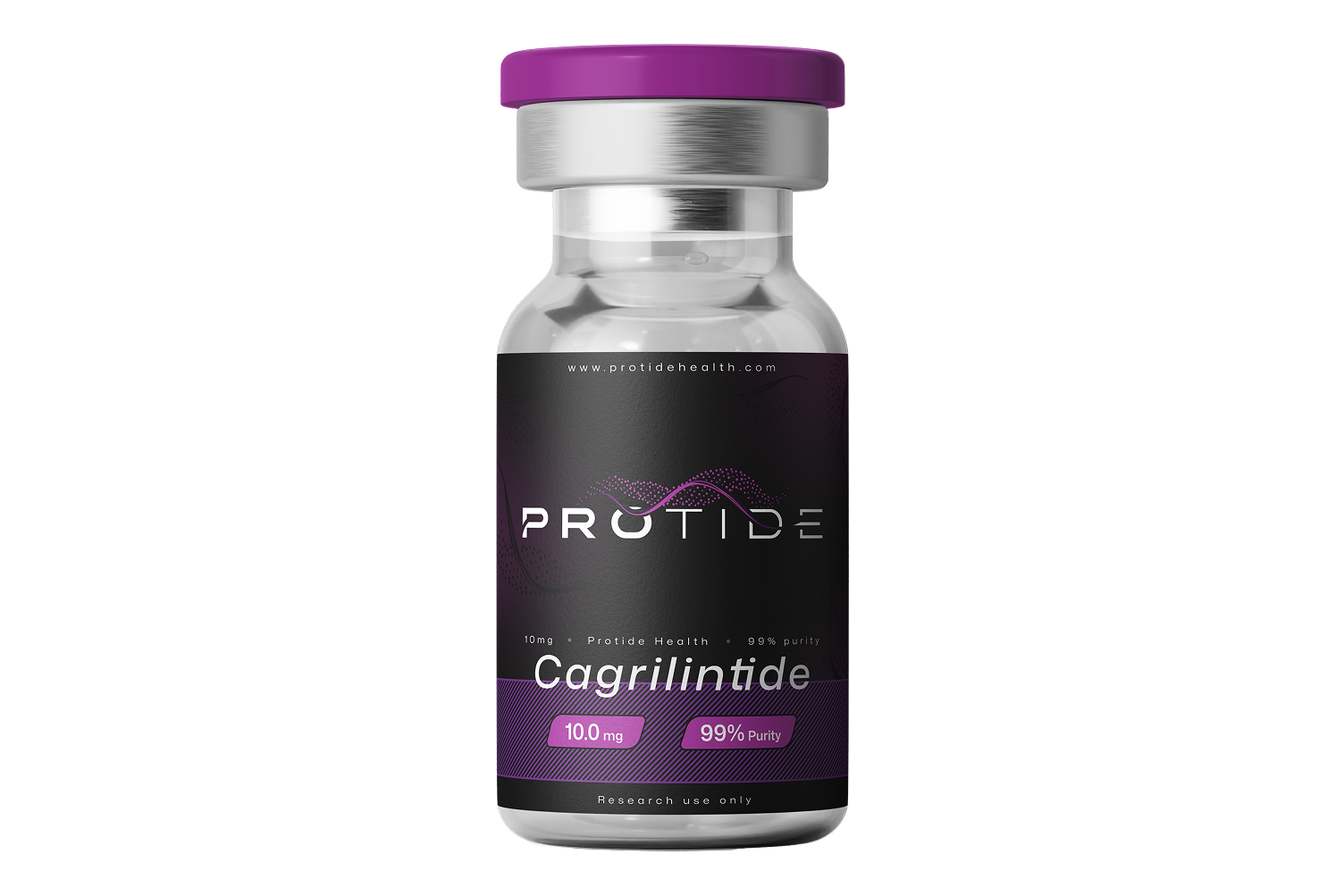
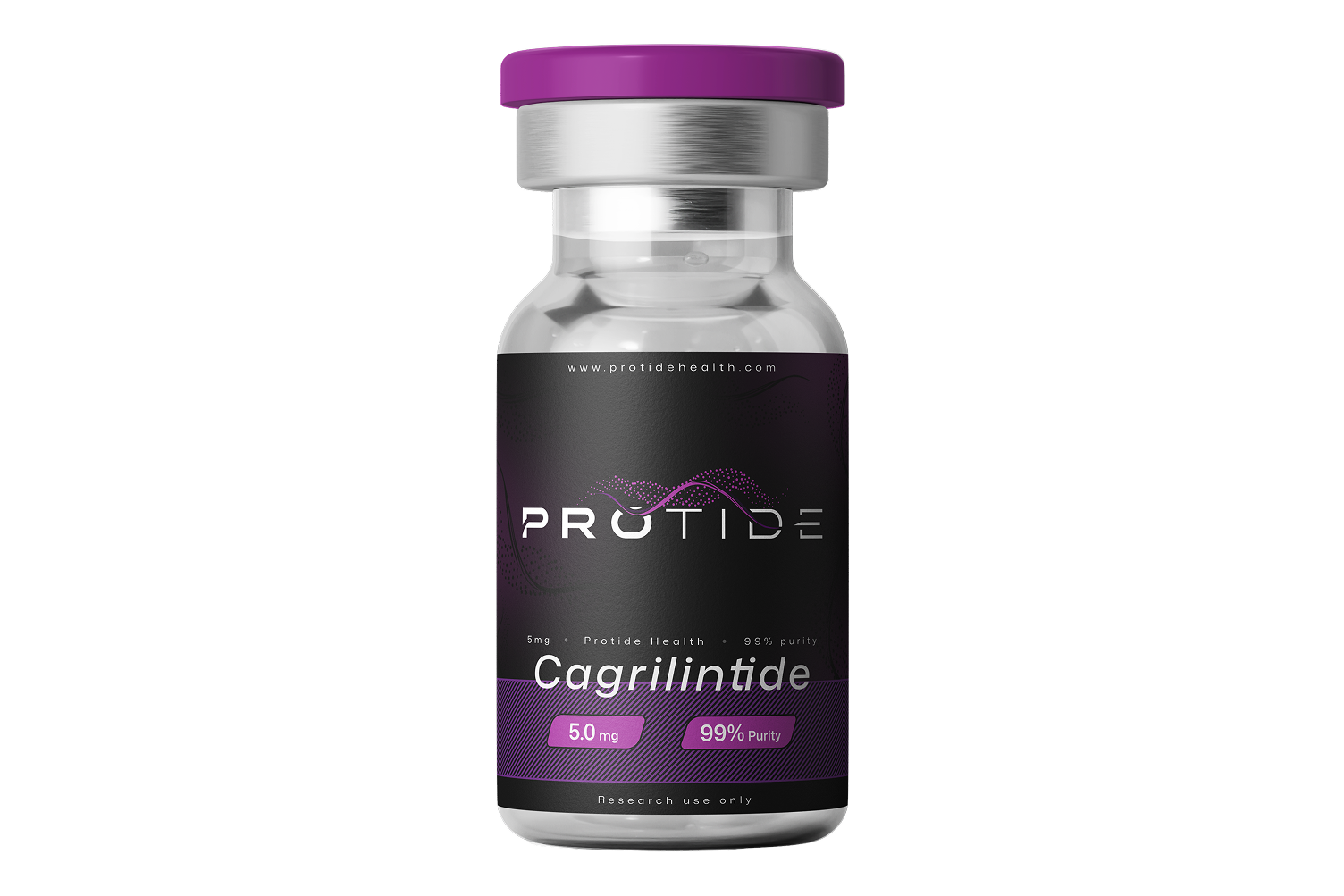
Cagrilintide peptide product shot featuring professionally labeled Protide Health 3mL research vials containing white to off-white lyophilized material in 5mg and 10mg sizes, with long-acting acylated amylin analogue identity, 99% purity, HPLC-MS verification, and laboratory-research-only labeling clearly displayed against a clean scientific background.


Cagrilintide Peptide 5mg & 10mg – Protide Health USA
Cagrilintide Overview & Technical Specifications
Cagrilintide is a synthetic, long-acting acylated amylin analogue designed for extended amylin-receptor research.
The molecule contains a 37-amino-acid peptide backbone with:
- A C20 fatty diacid modification
- A γ-glutamyl linker
- An intramolecular Cys2-Cys7 disulfide bond
- A C-terminal prolinamide
Protide Health supplies cagrilintide as 99% purity, HPLC-MS verified, third-party tested lyophilized research material in:
- 5mg
- 10mg
The material is supplied in a 3mL vial exclusively for qualified laboratory research.
Technical Specifications
- Product Name: Cagrilintide
- Development Name: NNC0174-0833 / AM833
- Available Sizes: 5mg, 10mg
- Form: Lyophilized powder
- Vial Size: 3mL
- Purity: 99%
- Testing: HPLC-MS verified; third-party tested
- Peptide Type: Long-acting synthetic acylated amylin analogue
- Peptide Length: 37 amino acids
- Lipid Modification: C20 fatty diacid linked through γ-glutamate
- Disulfide Bond: Cys2-Cys7
- C-Terminus: Pro-NH₂
- CAS Number: 1415456-99-3
- PubChem CID: 171397054
- Molecular Formula: C194H312N54O59S2
- Molecular Weight: approximately 4409.01 g/mol
- Appearance: White to off-white lyophilized powder
- Solubility: Soluble in water
- Storage: Store sealed at ≤6°C and protected from heat, light, and moisture
- Research Use: Amylin-receptor, metabolic-signaling, receptor-pharmacology, biochemical, analytical, and qualified preclinical research only
PubChem identifies cagrilintide as CID 171397054 with molecular formula C194H312N54O59S2, molecular weight approximately 4409 g/mol, and CAS 1415456-99-3.
Cagrilintide Peptide Structure
The cagrilintide peptide sequence is represented as:
Lys(C20 diacid-γGlu)-Cys-Asn-Thr-Ala-Thr-Cys-Ala-Thr-Gln-Arg-Leu-Ala-Glu-Phe-Leu-Arg-His-Ser-Ser-Asn-Asn-Phe-Gly-Pro-Ile-Leu-Pro-Pro-Thr-Asn-Val-Gly-Ser-Asn-Thr-Pro-NH₂
The peptide contains an intramolecular disulfide connection between:
Cys2 and Cys7
The published medicinal-chemistry development program describes cagrilintide as a stable, lipidated, long-acting amylin analogue selected after extensive structure-activity optimization.
What Is Cagrilintide?
The search phrase what is cagrilintide refers to an investigational long-acting analogue of the pancreatic hormone amylin.
Amylin is normally co-secreted with insulin from pancreatic beta cells.
Amylin biology has been studied in relation to:
- Satiety signaling
- Food-intake regulation
- Gastric-emptying pathways
- Glucagon-associated signaling
- Energy-balance systems
- Central nervous system pathways
Cagrilintide was engineered to retain amylin-like receptor pharmacology while extending molecular exposure through lipidation.
Published research describes it as a long-acting amylin analogue developed for metabolic research.
Cagrilintide & Amylin Receptor Research
Amylin receptor pharmacology is more complex than a single receptor protein.
Functional amylin receptors are formed through combinations of:
- Calcitonin receptor
- Receptor activity-modifying proteins, or RAMPs
These combinations produce receptor phenotypes commonly described as:
- AMY1
- AMY2
- AMY3
Cagrilintide is investigated as an amylin analogue capable of engaging this receptor system.
Research into these pathways may examine:
- Receptor activation
- cAMP signaling
- Neuronal appetite pathways
- Energy-balance signaling
- Gastric physiology
- Metabolic regulation
The Protide Health product is supplied for receptor and laboratory research only.
Why Cagrilintide Is Acylated
The cagrilintide peptide incorporates a C20 fatty diacid attached through a γ-glutamyl linker.
Lipid modification is used in peptide engineering to influence:
- Albumin association
- Proteolytic stability
- Molecular exposure
- Clearance
- Pharmacokinetic duration
The 2021 medicinal-chemistry paper describing cagrilintide development specifically identifies the compound as a lipidated long-acting amylin analogue.
This structural modification is one of the key distinctions between cagrilintide and endogenous human amylin.
Cagrilintide vs Native Amylin
Native human amylin and cagrilintide share the same broad hormonal research system but are not chemically identical.
Native Amylin
- Endogenous pancreatic peptide
- 37 amino acids
- Shorter biological exposure
- Strong amyloid-forming tendency under some conditions
Cagrilintide
- Synthetic amylin analogue
- 37-residue peptide backbone
- Multiple sequence substitutions
- C20 diacid lipid modification
- Designed for prolonged exposure
- Developed to improve physicochemical properties
One challenge in amylin drug design is the native peptide’s tendency to aggregate and form amyloid fibrils.
The cagrilintide development program specifically addressed stability, receptor activity, and duration of action.
Cagrilintide Peptide Benefits: Research Context
The phrase cagrilintide peptide benefits commonly reflects interest in outcomes reported in clinical-development programs.
Published research has investigated cagrilintide in relation to:
- Amylin receptor activation
- Satiety pathways
- Food-intake regulation
- Body-weight change
- Metabolic signaling
- Combination research with GLP-1 receptor agonists
These findings involve investigational pharmaceutical development under controlled clinical protocols.
They do not establish therapeutic benefits for the Protide Health research vial.
Protide Health therefore does not claim that this material:
- Produces weight loss
- Treats obesity
- Suppresses appetite in humans
- Treats diabetes
- Provides metabolic therapy
The product is supplied strictly for qualified laboratory investigation.
Cagrilintide & Semaglutide Research
One of the largest areas of clinical cagrilintide research involves combination with semaglutide.
This combination is commonly known in clinical development as:
CagriSema
The rationale combines two different hormonal pathways:
Cagrilintide
Amylin receptor-related signaling.
Semaglutide
GLP-1 receptor signaling.
An early randomized phase 1b trial examined concomitant administration of cagrilintide with semaglutide and evaluated safety, tolerability, pharmacokinetics, and pharmacodynamics.
More recently, a large randomized trial involving 3,417 participants reported significant body-weight reductions with the pharmaceutical cagrilintide-semaglutide combination relative to placebo, while gastrointestinal adverse events were common.
Those findings apply to controlled investigational formulations and do not establish use instructions for independently supplied research material.
Cagrilintide Dosage Search Context
The phrase cagrilintide dosage generally concerns human administration.
Protide Health does not provide human dosing instructions.
The quantities on this page:
- 5mg
- 10mg
represent total research material supplied in each vial.
They are not recommended human doses.
No guidance is provided for:
- Human injection
- Dose escalation
- Weekly administration
- Titration
- Body-weight calculations
- Treatment cycles
- Appetite-management protocols
- Reconstitution for human administration
Clinical trial dosing schedules should not be transferred to independently supplied laboratory material.
Cagrilintide Dosage With Tirzepatide
The phrase cagrilintide dosage with tirzepatide concerns combined human administration of two potent investigational or pharmaceutical metabolic agents.
Protide Health does not provide such a protocol.
Importantly, published cagrilintide combination development has focused primarily on semaglutide, not on an established cagrilintide-plus-tirzepatide regimen.
Tirzepatide acts through:
- GIP receptors
- GLP-1 receptors
Cagrilintide acts through the amylin-receptor system.
Theoretical pathway complementarity does not establish that combining them is safe or effective.
No cagrilintide-plus-tirzepatide dosing schedule is provided here.
Cagrilintide Side Effects: Clinical Research Context
The search phrase cagrilintide side effects reflects interest in adverse events observed during investigational studies.
Clinical trials involving cagrilintide alone or combined with semaglutide have reported gastrointestinal adverse events including:
- Nausea
- Vomiting
- Diarrhea
- Constipation
- Abdominal discomfort or pain
In the large cagrilintide-semaglutide trial, gastrointestinal adverse events were frequent and were generally described as transient and mild-to-moderate.
These findings describe controlled clinical pharmaceutical research.
They do not establish the safety profile of the Protide Health product.
Cagrilintide vs Retatrutide
The keyword cagrilintide vs retatrutide compares two fundamentally different investigational peptide systems.
Cagrilintide
- Long-acting amylin analogue
- 37 amino acids
- C20 fatty diacid modification
- Amylin-receptor-related pharmacology
Retatrutide
- Multi-receptor metabolic peptide
- Designed to activate GLP-1, GIP, and glucagon receptors
- Chemically and pharmacologically distinct from cagrilintide
The two compounds should therefore be compared primarily by:
- Molecular structure
- Receptor targets
- Clinical-development strategy
- Experimental endpoints
They should not be declared interchangeable or universally superior to one another.
Cagrilintide vs GLP-1 Agonists
Cagrilintide is not itself a GLP-1 receptor agonist.
That distinction is scientifically important.
Cagrilintide primarily belongs to the amylin analogue class, whereas compounds such as semaglutide act through GLP-1 receptors.
This difference is one reason combination research has received attention: two separate hormonal signaling systems can be studied simultaneously.
Cagrilintide & Appetite Signaling Research
Amylin-related signaling is involved in neural circuits associated with meal termination and satiety.
Research has investigated pathways in areas such as:
- Area postrema
- Nucleus of the solitary tract
- Hindbrain signaling
- Hypothalamic pathways
- Reward-related feeding circuits
Cagrilintide research builds on this established amylin biology while using a modified peptide designed for longer exposure.
These mechanistic findings should not be interpreted as consumer appetite-control instructions.
Cagrilintide & Gastric Physiology
Amylin physiology also includes effects related to gastric emptying.
Delayed gastric emptying can alter:
- Nutrient delivery
- Postprandial signaling
- Satiety
- Glucose appearance
However, the relative importance of gastric effects can depend on exposure, dose, duration, and experimental context.
This is one reason cagrilintide research should be evaluated through controlled receptor and physiological models rather than simplified into a single mechanism.
Cagrilintide & Amyloid-Formation Research
Human amylin has a strong tendency to form amyloid aggregates.
That physicochemical property complicates development of stable amylin-based therapeutic molecules.
Cagrilintide was created through structure-activity research aimed at producing a molecule with:
- Reduced aggregation liability
- Retained amylin receptor pharmacology
- Improved physicochemical stability
- Extended biological exposure
The published development program describes cagrilintide as the result of systematic analogue optimization.
Cagrilintide Clinical Research Status
Cagrilintide remains an investigational compound in ongoing clinical development rather than a standard over-the-counter peptide or routine approved therapy.
PubChem currently describes cagrilintide as being investigated in clinical trials, including research comparing cagrilintide-semaglutide with tirzepatide in type 2 diabetes.
Protide Health research material should not be represented as equivalent to investigational pharmaceutical formulations used in those trials.
Research Applications
Qualified laboratories may investigate cagrilintide in research involving:
- Amylin receptor pharmacology
- Calcitonin receptor/RAMP systems
- Receptor activation
- cAMP signaling
- Lipidated peptide chemistry
- Albumin-association models
- Peptide stability
- Amyloid-related peptide design
- Metabolic signaling
- Comparative receptor pharmacology
- Analytical peptide characterization
Study conditions should be established according to validated experimental methodology.
Related Protide Health Research Products
Researchers comparing neuroendocrine peptide systems may review Oxytocin 10mg for a structurally and pharmacologically distinct cyclic peptide research model.
The P21 10mg research peptide provides a separate experimental neuropeptide system.
Researchers may also examine Pinealon 20mg for a short regulatory peptide model with a different molecular mechanism.
These products are chemically and mechanistically distinct from cagrilintide.
Research Format & Storage
Protide Health supplies cagrilintide peptide in:
- 5mg
- 10mg
Product specifications include:
- Form: Lyophilized powder
- Vial Size: 3mL
- Purity: 99%
- Testing: HPLC-MS verified
- Verification: Third-party tested
- Appearance: White to off-white
- Solubility: Soluble in water
Storage specifications:
- Store at ≤6°C
- Keep sealed
- Protect from heat
- Protect from direct light
- Protect from moisture
These conditions describe laboratory storage only.
Research Limitations
Several limitations should be considered when interpreting cagrilintide research:
- Cagrilintide is an investigational long-acting amylin analogue.
- It is not equivalent to endogenous human amylin.
- Its lipid modification substantially alters pharmacokinetic behavior.
- Clinical findings involve pharmaceutical-grade investigational formulations under controlled conditions.
- Trial dosing cannot be transferred to independently supplied research material.
- CagriSema research involves cagrilintide plus semaglutide and cannot be attributed to cagrilintide alone.
- A standardized cagrilintide-plus-tirzepatide dosing regimen is not established by the supplied evidence.
- Gastrointestinal adverse events have been reported in controlled clinical research.
- The 5mg and 10mg quantities identify vial contents, not human doses.
- Protide Health cagrilintide is not supplied as an approved pharmaceutical product.
For these reasons, cagrilintide peptide is supplied strictly for qualified laboratory research.
Literature & Citation Index
Development of Cagrilintide, a Long-Acting Amylin Analogue
Year: 2021
PMID: 34288673
DOI: 10.1021/acs.jmedchem.1c00565
Research Context: Cagrilintide chemistry, C20 lipidation, amylin analogue design, structure-activity relationships, peptide stability, receptor pharmacology, and candidate selection.
Safety, Tolerability, Pharmacokinetics, and Pharmacodynamics of Cagrilintide With Semaglutide
Year: 2021
PMID: 33894838
DOI: 10.1016/S0140-6736(21)00845-X
Research Context: Cagrilintide, semaglutide, combination pharmacology, controlled clinical investigation, tolerability, pharmacokinetics, and pharmacodynamic endpoints.
Cagrilintide: A Long-Acting Amylin Analog for the Treatment of Obesity
Year: 2023
PMID: 36883831
Research Context: Amylin biology, satiety signaling, cagrilintide, semaglutide combination development, and metabolic research.
Coadministered Cagrilintide and Semaglutide in Adults With Overweight or Obesity
Year: 2025
PMID: 40544433
Research Context: Large randomized clinical research involving cagrilintide plus semaglutide, body-weight outcomes, gastrointestinal adverse events, and controlled pharmaceutical development.
Researchers can review broader cagrilintide and amylin research indexed by PubMed for additional peer-reviewed literature.
Frequently Asked Questions
What is cagrilintide?
Cagrilintide is a synthetic, lipidated, long-acting amylin analogue containing a 37-amino-acid peptide backbone and a C20 fatty diacid modification.
What is cagrilintide peptide?
The cagrilintide peptide is an engineered amylin analogue developed for prolonged amylin-receptor signaling research.
How many amino acids does cagrilintide contain?
Cagrilintide contains a 37-amino-acid peptide backbone.
What is the cagrilintide molecular formula?
The molecular formula is:
C194H312N54O59S2
What is the molecular weight?
The molecular weight is approximately:
4409.01 g/mol
What is the cagrilintide CAS number?
The CAS number is:
1415456-99-3
What is the PubChem CID?
The PubChem identifier is:
CID 171397054
What does cagrilintide research investigate?
Research includes amylin-receptor pharmacology, satiety pathways, metabolic signaling, lipidated peptide design, pharmacokinetics, and combination research with GLP-1 receptor agonists.
What are cagrilintide peptide benefits?
Clinical-development studies have investigated metabolic and body-weight outcomes, but these findings do not establish therapeutic benefits for Protide Health research material.
What is the cagrilintide dosage?
Protide Health does not provide human cagrilintide dosage instructions. The 5mg and 10mg values describe vial contents only.
What is cagrilintide dosage with tirzepatide?
No human cagrilintide dosage with tirzepatide is provided. The evidence supplied here does not establish a standardized cagrilintide-plus-tirzepatide regimen.
What are cagrilintide side effects?
Controlled clinical research has reported gastrointestinal adverse events including nausea, vomiting, diarrhea, constipation, and abdominal discomfort. These findings do not establish the safety profile of independently supplied research material.
What is the difference between cagrilintide vs retatrutide?
Cagrilintide vs retatrutide compares an amylin analogue with a multi-receptor GLP-1/GIP/glucagon agonist. They target different receptor systems and are chemically distinct investigational peptides.
Is cagrilintide a GLP-1 agonist?
No. Cagrilintide is primarily an amylin analogue. Its combination with GLP-1 agonists such as semaglutide is studied because the compounds engage different signaling systems.
What sizes does Protide Health supply?
Protide Health supplies cagrilintide in:
- 5mg
- 10mg
What purity does Protide Health specify?
Protide Health specifies 99% purity, HPLC-MS verification, and third-party testing.
Is cagrilintide intended for human use?
No. It is supplied exclusively for amylin-receptor, metabolic-signaling, biochemical, molecular, analytical, in-vitro, and qualified preclinical research.
Laboratory Terms & Compliance
Laboratory Research Use Only
This cagrilintide product is supplied exclusively for laboratory research, amylin-receptor investigation, metabolic-signaling studies, analytical testing, peptide-chemistry research, biochemical experimentation, cellular investigation, in-vitro research, and qualified preclinical experimentation.
It is not intended for human or veterinary consumption, medical use, obesity treatment, weight-loss treatment, appetite management, diabetes treatment, injection, diagnostic use, therapeutic use, or clinical administration.
No human dosage, injection schedule, titration plan, cagrilintide-plus-tirzepatide protocol, weight-loss protocol, body-weight calculation, treatment cycle, or reconstitution instructions for human administration are provided.
The purchaser is responsible for appropriate laboratory handling, storage, and use under applicable institutional, federal, state, and local requirements.
For research use only.
| Select vial strength |
10mg ,5mg |
|---|


MAECENAS IACULIS
Vestibulum curae torquent diam diam commodo parturient penatibus nunc dui adipiscing convallis bulum parturient suspendisse parturient a.Parturient in parturient scelerisque nibh lectus quam a natoque adipiscing a vestibulum hendrerit et pharetra fames nunc natoque dui.
ADIPISCING CONVALLIS BULUM
- Vestibulum penatibus nunc dui adipiscing convallis bulum parturient suspendisse.
- Abitur parturient praesent lectus quam a natoque adipiscing a vestibulum hendre.
- Diam parturient dictumst parturient scelerisque nibh lectus.
Scelerisque adipiscing bibendum sem vestibulum et in a a a purus lectus faucibus lobortis tincidunt purus lectus nisl class eros.Condimentum a et ullamcorper dictumst mus et tristique elementum nam inceptos hac parturient scelerisque vestibulum amet elit ut volutpat.
Related products
AOD-9604
$60.00
MOTS-c Peptide
Price range: $65.00 through $195.00
Reviews
There are no reviews yet.