
Vesugen 20mg
$75.00
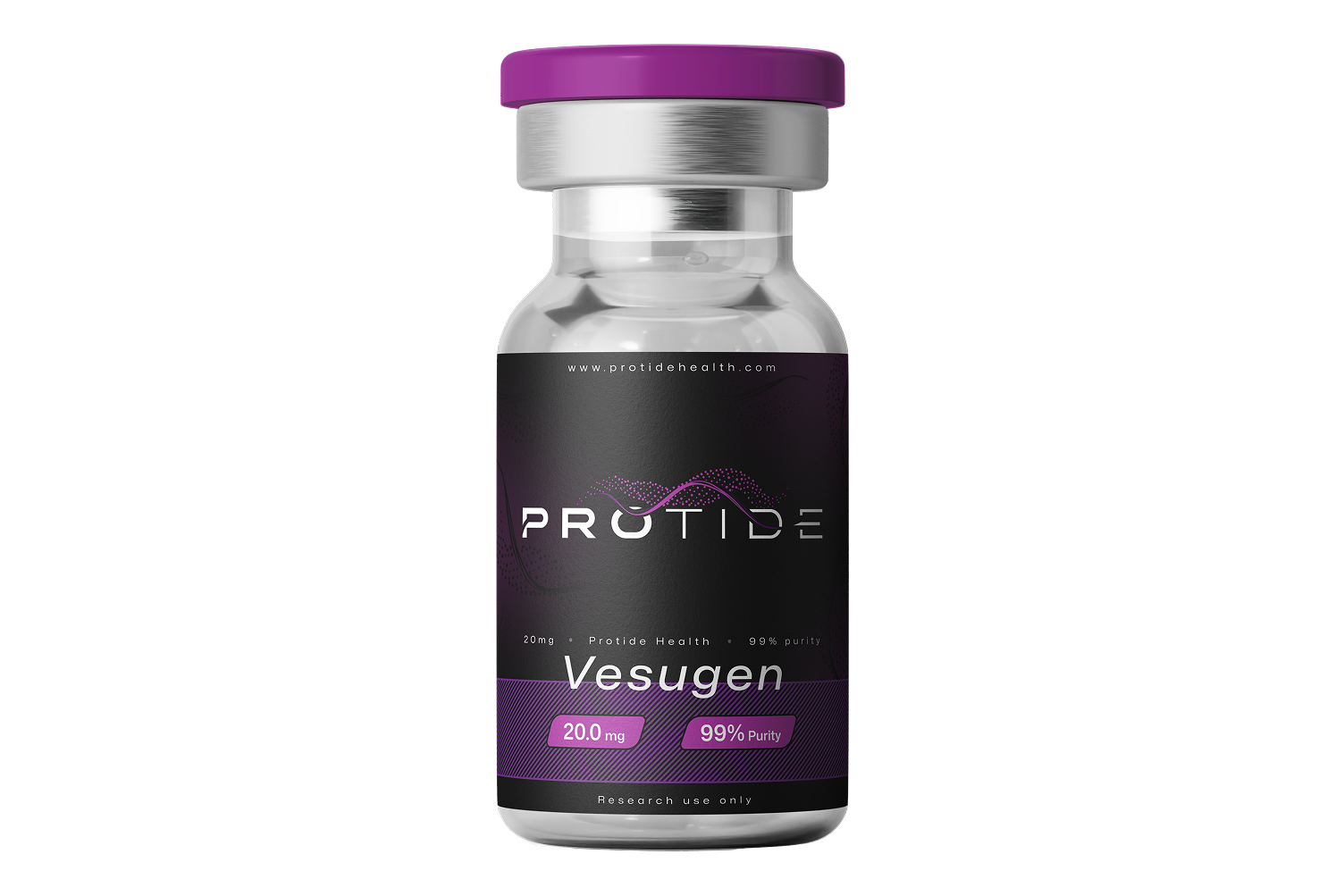
Vesugen 20mg product shot featuring a professionally labeled Protide Health research vial containing white to off-white lyophilized KED peptide powder, presented against a clean laboratory-style background with clear 20mg identification and research-use-only labeling.


Buy Vesugen 20mg – Protide Health USA
Vesugen Peptide Overview & Technical Specifications
Vesugen is the short synthetic tripeptide Lys-Glu-Asp (KED). The verified PubChem compound record identifies lysyl-glutamyl-aspartic acid as a three-residue peptide with the sequence KED, molecular formula C15H26N4O8, molecular weight 390.39 g/mol, CAS number 204271-66-9, and PubChem CID 87571363.
Researchers can examine the authoritative Vesugen KED peptide chemical record on PubChem for independently cataloged structural and chemical information.
The peptide belongs to a group of short regulatory peptides that have been investigated in experimental models of gene regulation, cellular differentiation, and vascular endothelial signaling. The vesugen peptide literature is comparatively specialized, with much of the published research focusing on cultured cells and other preclinical systems rather than established clinical applications.
Protide Health supplies Vesugen as a 20mg lyophilized powder for controlled laboratory, biochemical, molecular, and preclinical research.
Technical Specifications
- Product Name: Vesugen
- Peptide Sequence: Lys-Glu-Asp
- One-Letter Sequence: KED
- Quantity: 20mg
- Form: Lyophilized powder
- Vial Size: 3mL
- Purity: 99%
- Analytical Testing: HPLC-MS verified; third-party tested
- CAS Number: 204271-66-9
- PubChem CID: 87571363
- Molecular Formula: C15H26N4O8
- Molecular Weight: 390.39 g/mol
- Appearance: White to off-white lyophilized powder
- Solubility: Soluble in water
- Storage: Store at ≤6°C, sealed and away from heat, light, and moisture
- Research Classification: Synthetic KED tripeptide
Vesugen 20mg Mechanism of Action & Research Context
Research involving Vesugen has concentrated largely on changes in gene expression and protein markers in cultured cells.
One published cell-culture study investigated short regulatory peptides in aging cellular systems and reported that KED was associated with changes in expression of differentiation-related factors in human prostatic fibroblast cultures. The effect was reported to be more evident in later-passage cultures, making cellular differentiation and age-associated gene regulation one experimental area of interest. Published KED peptide research indexed by PubMed provides the original research context for these findings.
Another study examined KED in cultured vascular endothelial cells and investigated expression of signaling proteins including endothelin-1, connexins, and SIRT1 in experimental models designed to represent normal, atherosclerotic, and restenotic endothelial conditions. These findings came from in-vitro research, not evidence establishing therapeutic effects in people.
A separate study investigated the proliferation-associated protein Ki-67 and reported that short peptides including KED influenced Ki-67-associated activity in cultured vascular endothelial systems. Molecular docking was also used to investigate possible interactions with a promoter region of the MKI67 gene.
These studies suggest several molecular hypotheses for laboratory investigation, but they do not establish a complete mechanism of action or clinical efficacy.
Preclinical Research Applications
Vascular Endothelial Cell Research
A major focus of Vesugen research has involved vascular endothelial cell biology.
In experimental endothelial models, researchers have evaluated markers associated with cell-to-cell communication, proliferation, and endothelial signaling. Published work involving KED has examined proteins such as endothelin-1, connexins, SIRT1, and Ki-67. Research on KED and vascular endothelial signaling provides an example of this specialized preclinical literature.
Because the research was conducted in cell-based experimental systems, these observations should be interpreted as mechanistic findings rather than demonstrated human outcomes.
Gene Expression and Epigenetic Research
Another area of investigation involves peptide-associated regulation of gene expression.
Research on KED has used cultured endothelial cells and molecular-docking techniques to explore interactions associated with the MKI67 promoter and expression of the proliferation marker Ki-67. PubMed-indexed research on KED and Ki-67 regulation describes these experimental observations.
These experiments provide a framework for studying how very short peptides may influence transcription-associated processes in controlled laboratory systems.
Cellular Differentiation Research
Vesugen peptide research has also included experiments involving cellular differentiation.
A study using cultured human cells investigated tissue-specific changes in differentiation markers following treatment with several short peptides. KED was evaluated in human prostatic fibroblast cultures, where investigators reported changes involving the differentiation-associated factor CXCL12.
The experiment involved cultured cells and should not be extrapolated to treatment or disease-prevention claims.
Neurological and Molecular Research
The KED sequence has also appeared in preclinical neuroscience research.
For example, studies of aging brain-cortex cell cultures reported changes in serotonin-associated expression following exposure to Lys-Glu-Asp. Molecular-docking analyses were used to investigate possible gene-regulatory interactions involving tryptophan hydroxylase.
Additional research has examined KED in molecular-genetic models related to neurogenesis. Such studies expand the experimental scope of the peptide but remain laboratory and preclinical investigations rather than evidence of clinical effects.
What Research on Vesugen Peptide Benefits Actually Shows
Searches for vesugen peptide benefits or vesugen benefits can lead to commercial descriptions that overstate what the published literature establishes.
The scientific evidence is more appropriately described in terms of research observations. Experimental studies have reported changes in selected markers of cellular differentiation, endothelial signaling, proliferation-associated proteins, and gene expression in cell cultures and other preclinical systems.
Those observations are useful for forming laboratory hypotheses, but they do not demonstrate that the compound provides a medical, cardiovascular, neurological, anti-aging, or other therapeutic benefit in humans.
Protide Health therefore describes the compound strictly in the context of qualified laboratory experimentation.
Lyophilized Powder Research Format
The product is supplied as a lyophilized powder, meaning the material has undergone freeze-drying to remove water and produce a dry research preparation.
Lyophilization is commonly used for peptide research materials because the dry format can facilitate laboratory storage and handling. This product should remain sealed and stored at ≤6°C, away from heat, light, and moisture, according to the supplied product specification.
No human preparation, dosing, administration, or injection instructions are provided.
Research Limitations
The published research surrounding Vesugen is considerably narrower than the literature available for many extensively characterized endogenous peptides.
Relevant studies include cultured human fibroblasts, vascular endothelial cultures, animal-derived cell systems, molecular-docking analyses, and related preclinical models.
Important limitations include:
- Cell-culture findings do not demonstrate effects in intact humans.
- Molecular docking predicts possible molecular interactions but does not by itself establish biological causation.
- Changes in individual gene or protein markers cannot be assumed to produce clinical outcomes.
- Much of the available research comes from a relatively concentrated group of investigators.
- Further independent replication and mechanistic characterization are needed.
Accordingly, laboratory findings should not be interpreted as evidence that KED prevents, diagnoses, or treats cardiovascular, neurological, age-related, or other medical conditions.
Literature & Citation Index
Peptides Tissue-Specifically Stimulate Cell Differentiation During Their Aging
Authors: V. Kh. Khavinson, N. S. Linkova, V. O. Polyakova, O. V. Kheifets, S. I. Tarnovskaya, I. M. Kvetnoy
Journal: Bulletin of Experimental Biology and Medicine
Year: 2012
PMID: 22808515
DOI: 10.1007/s10517-012-1664-1
Research context: Cultured-cell differentiation markers and short regulatory peptides, including KED.
Source: PubMed research on short peptides and cell differentiation
Epigenetic Aspects of Peptidergic Regulation of Vascular Endothelial Cell Proliferation During Aging
Authors: V. Kh. Khavinson et al.
Journal: Advances in Gerontology
Year: 2014
PMID: 25051766
Research context: Ki-67 expression, vascular endothelial cell cultures, and molecular docking involving short peptides.
Source: PubMed research on KED and endothelial cell proliferation
Molecular Aspects of Vasoprotective Peptide KED Activity During Atherosclerosis and Restenosis
PMID: 28539025
Research context: In-vitro endothelial models investigating endothelin-1, connexins, SIRT1, and related signaling markers.
Source: PubMed KED endothelial research
Short Peptides Stimulate Serotonin Expression in Cells of Brain Cortex
Authors: V. Kh. Khavinson et al.
Journal: Bulletin of Experimental Biology and Medicine
Year: 2014
PMID: 24909721
DOI: 10.1007/s10517-014-2496-y
Research context: Aging brain-cortex cell cultures, serotonin expression, and molecular-docking analysis involving KED.
Source: PubMed KED peptide molecular research
Chemical Identity Reference
The authoritative Lys-Glu-Asp PubChem compound record confirms PubChem CID 87571363, molecular formula C15H26N4O8, molecular weight 390.39 g/mol, CAS 204271-66-9, and the KED sequence.
Related Protide Health Research Products
Researchers building broader experimental inventories may also review:
- ARA-290 research peptide for a separate peptide research model involving receptor-signaling investigations.
- BPC-157 research peptide for distinct laboratory and preclinical peptide research.
- Bacteriostatic Water 0.9% Benzyl Alcohol as a separate laboratory product in the Protide Health catalog.
These products represent different compounds and experimental applications and should not be interpreted as mechanistically equivalent to KED.
Frequently Asked Questions
What is Vesugen?
Vesugen is a synthetic three-amino-acid peptide with the sequence Lys-Glu-Asp, abbreviated KED. Published experimental research has investigated KED in cultured-cell systems involving endothelial biology, cellular differentiation, gene expression, and other molecular pathways.
What is Vesugen peptide?
The term vesugen peptide refers to the short tripeptide Lys-Glu-Asp. Its chemical identity is cataloged by PubChem as lysyl-glutamyl-aspartic acid with the sequence KED.
What does research say about vesugen peptide benefits?
Published studies report experimental observations involving cellular differentiation markers, endothelial signaling proteins, proliferation-associated Ki-67 expression, and gene-regulatory models. These are predominantly cell-culture and preclinical findings and do not establish human therapeutic benefits.
Is this product Vesugen acetate?
No acetate form is identified in the supplied specification or the referenced PubChem record. The product is therefore described as Lys-Glu-Asp/KED rather than vesugen acetate.
What is the sequence of the peptide?
The verified sequence is Lys-Glu-Asp, abbreviated KED. PubChem independently identifies the compound as H-Lys-Glu-Asp-OH.
What is the purity?
The supplied product specification states 99% purity, with HPLC-MS verification and third-party testing.
What form is the product supplied in?
The peptide is supplied as a 20mg white to off-white lyophilized powder in a 3mL vial.
Is the product intended for human use?
No. It is supplied strictly for laboratory research, analytical testing, in-vitro studies, molecular research, and qualified preclinical experimentation.
Laboratory Terms & Compliance
Laboratory Research Use Only
This product is supplied exclusively for laboratory research, analytical testing, in-vitro studies, preclinical research, and qualified scientific experimentation.
It is not intended for human or veterinary consumption, medical use, diagnostic use, therapeutic use, or clinical administration.
The purchaser is responsible for appropriate laboratory handling, storage, and use in accordance with applicable institutional, federal, state, and local requirements.
For research use only.


MAECENAS IACULIS
Vestibulum curae torquent diam diam commodo parturient penatibus nunc dui adipiscing convallis bulum parturient suspendisse parturient a.Parturient in parturient scelerisque nibh lectus quam a natoque adipiscing a vestibulum hendrerit et pharetra fames nunc natoque dui.
ADIPISCING CONVALLIS BULUM
- Vestibulum penatibus nunc dui adipiscing convallis bulum parturient suspendisse.
- Abitur parturient praesent lectus quam a natoque adipiscing a vestibulum hendre.
- Diam parturient dictumst parturient scelerisque nibh lectus.
Scelerisque adipiscing bibendum sem vestibulum et in a a a purus lectus faucibus lobortis tincidunt purus lectus nisl class eros.Condimentum a et ullamcorper dictumst mus et tristique elementum nam inceptos hac parturient scelerisque vestibulum amet elit ut volutpat.
Related products
Reviews
There are no reviews yet.