
Tesamorelin & Ipamorelin Blend
Price range: $100.00 through $140.00
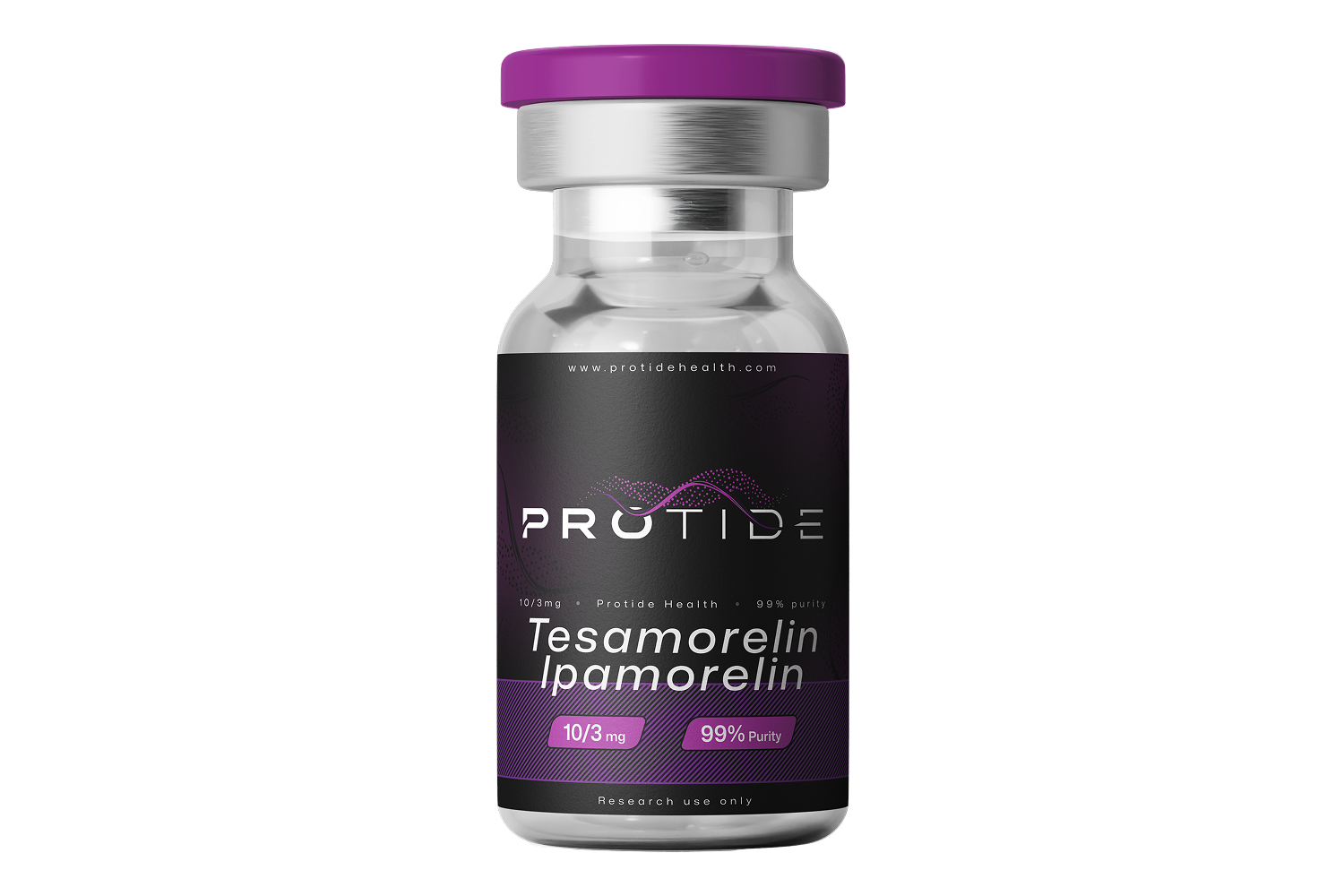
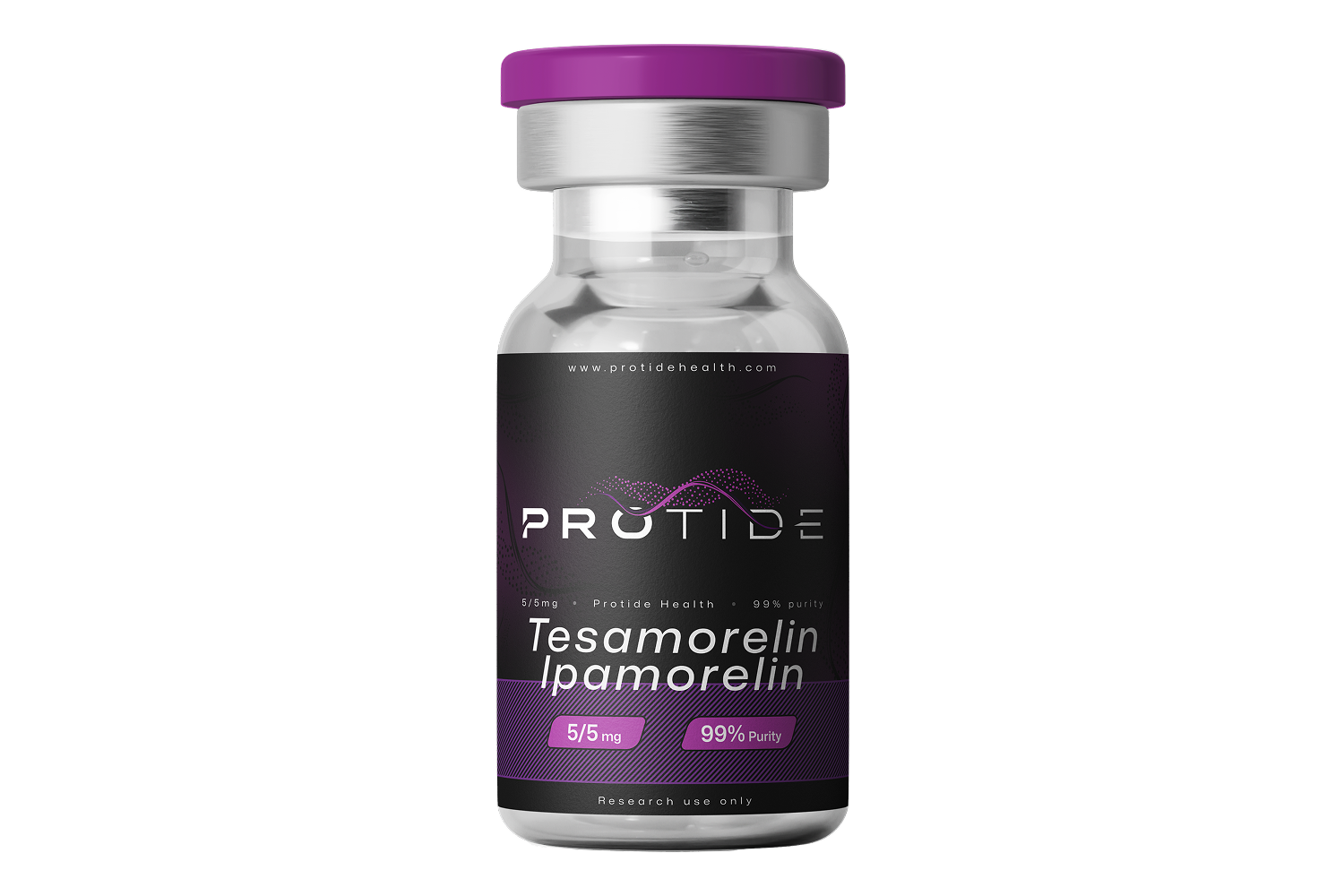
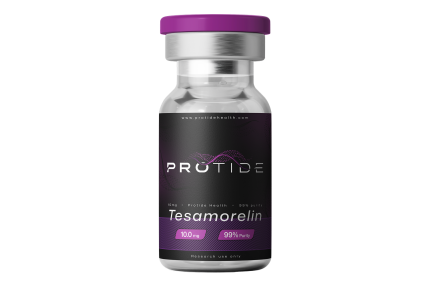
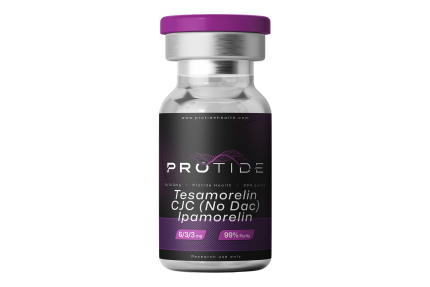
Tesamorelin and ipamorelin blend product shot featuring a professionally labeled Protide Health 3mL research vial containing white to off-white lyophilized powder, with the available 5mg/5mg or 10mg/3mg Tesamorelin/Ipamorelin strength clearly displayed against a clean laboratory-style background with research-use-only labeling.


Tesamorelin and Ipamorelin Blend – Protide Health USA
Tesamorelin and Ipamorelin Blend Overview & Technical Specifications
The tesamorelin and ipamorelin blend from Protide Health combines two structurally and pharmacologically distinct research peptides within a single lyophilized formulation.
Tesamorelin is a synthetic 44-amino-acid growth hormone-releasing hormone analogue. Its modified N-terminal structure distinguishes it from native GHRH while maintaining activity at the growth hormone-releasing hormone receptor.
Ipamorelin is a synthetic pentapeptide with the sequence Aib-His-D-2-Nal-D-Phe-Lys-NH₂. Published pharmacological research characterizes it as a selective growth-hormone secretagogue acting through the growth-hormone secretagogue receptor pathway rather than directly through the GHRH receptor.
The tesamorelin and ipamorelin blend is available in two research configurations:
- 5mg Tesamorelin / 5mg Ipamorelin
- 10mg Tesamorelin / 3mg Ipamorelin
These formulations provide laboratory researchers with a platform for investigating two separate upstream receptor systems that may converge on related pituitary and endocrine signaling endpoints.
Technical Specifications
Blend Specifications
- Available Sizes: 5mg/5mg and 10mg/3mg
- Components: Tesamorelin and Ipamorelin
- Form: Lyophilized powder
- Vial Size: 3mL
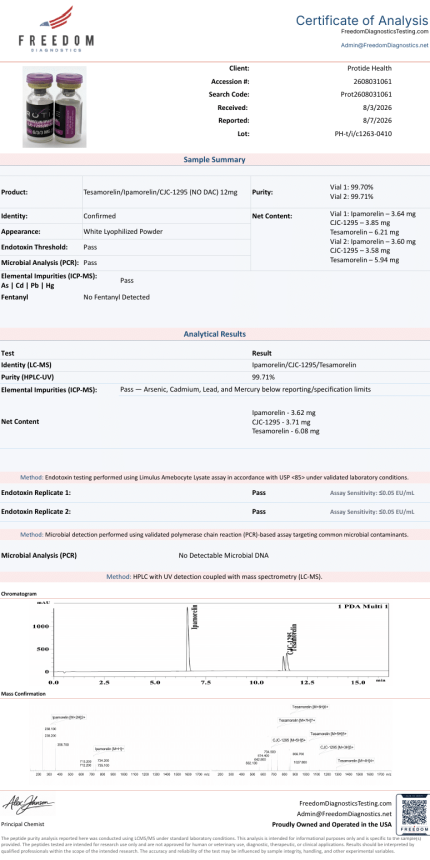
- Purity: 99%
- Testing: HPLC-MS verified; third-party tested
- Appearance: White to off-white lyophilized powder
- Solubility: Soluble in water
- Storage: Store sealed at ≤6°C and protected from heat, light, and moisture
Tesamorelin Specifications
- Classification: Synthetic 44-amino-acid GHRH analogue
- CAS Number: 218949-48-5
- PubChem CID: 16137828
- Molecular Formula: C221H366N72O67S
- Molecular Weight: 5135.91 g/mol
- Synonym: TH9507
- Sequence: (trans-3-hexenoic acid)-YADAIFTNSYRKVLGQLSARKLLQDIMSRQQGESNQERGARARL-NH₂
Researchers can review the authoritative Tesamorelin chemical record on PubChem.
Ipamorelin Specifications
- Classification: Synthetic growth-hormone-secretagogue pentapeptide
- CAS Number: 170851-70-4
- PubChem CID: 9831659
- Molecular Formula: C38H49N9O5
- Molecular Weight: 711.86 g/mol
- Synonym: NNC 26-0161
- Sequence: Aib-His-D-2-Nal-D-Phe-Lys-NH₂
Researchers can review the authoritative Ipamorelin chemical record on PubChem.
Tesamorelin and Ipamorelin Blend Mechanism & Research Context
The tesamorelin and ipamorelin blend is particularly relevant to laboratory research because its two components engage different receptor systems.
Tesamorelin is based on GHRH and is studied primarily through the growth hormone-releasing hormone receptor (GHRH-R). Research on this receptor demonstrates predominant Gs-protein coupling, activation of adenylate cyclase, increased intracellular cyclic AMP, and downstream signaling involving protein kinase A and transcriptional pathways in somatotroph models.
A detailed PubMed review of GHRH synthesis and signaling describes GHRH receptor activation, intracellular cAMP accumulation, and associated signaling within pituitary somatotroph research.
Ipamorelin follows a different pathway. Its original pharmacological characterization identified it as a potent and selective GH secretagogue. Researchers observed activity in cultured rat pituitary cells and animal models and differentiated its receptor-mediated activity from direct GHRH signaling.
The original PubMed study of Ipamorelin as a selective growth-hormone secretagogue provides key mechanistic context for this compound.
Because these receptor systems are distinct, this formulation provides a research model for investigating receptor selectivity and convergent endocrine signaling without assuming that combining the compounds produces synergistic biological effects.
Preclinical Research Applications
GHRH Receptor Signaling
Tesamorelin is used as a GHRH-related research compound because of its structural relationship to endogenous GHRH.
GHRH-R is a G protein-coupled receptor expressed prominently in pituitary somatotrophs. Activation of this receptor has been linked experimentally with cAMP-dependent signaling, GH gene transcription, somatotroph function, and other downstream molecular responses.
More recent research on the GHRH receptor signaling mechanism continues to describe cAMP signaling as a central pathway associated with receptor activation.
The tesamorelin and ipamorelin blend therefore provides one experimental framework for examining GHRH-receptor signaling alongside a separate secretagogue pathway.
Ipamorelin and GHS-R Research
Ipamorelin belongs to the growth-hormone-secretagogue family rather than the GHRH analogue family.
PubChem identifies Ipamorelin as the synthetic pentapeptide Aib-His-D-2-Nal-D-Phe-Lys-NH₂ and associates its pharmacology with the ghrelin/growth-hormone-secretagogue receptor system.
Its original 1998 characterization reported substantial GH-secretagogue activity in experimental systems while distinguishing its pharmacological profile from several earlier secretagogues.
This receptor distinction is fundamental when researchers investigate ipamorelin and tesamorelin within the same experimental framework.
Tesamorelin vs Ipamorelin
The keyword phrase tesamorelin vs ipamorelin describes a mechanistic comparison rather than a question of which compound is superior.
Tesamorelin is:
- A 44-amino-acid GHRH analogue
- Associated primarily with the GHRH receptor
- Studied through Gs/cAMP-associated signaling
Ipamorelin is:
- A synthetic pentapeptide
- Associated with GHS-R1a / ghrelin-receptor signaling
- Classified as a growth-hormone secretagogue
Accordingly, ipamorelin vs tesamorelin experiments can compare two different receptor pathways that may converge on related pituitary signaling endpoints.
This mechanistic distinction is central to understanding the tesamorelin and ipamorelin blend in laboratory research.
Somatotroph and cAMP Signaling Research
GHRH signaling has been studied extensively in pituitary somatotroph systems.
Experimental work demonstrates that GHRH receptor activation can increase intracellular cAMP and influence signaling pathways associated with GH synthesis and secretion. Research has also linked this pathway with CREB activation and transcriptional regulation.
A PubMed review of GHRH receptor molecular and cell biology describes the receptor as a seven-transmembrane G-protein-linked receptor essential to normal somatotroph signaling.
These studies provide mechanistic context for Tesamorelin but do not establish the behavior of a dual research formulation in humans.
Tesamorelin / Ipamorelin Blend Compared With Other Research Peptides
A tesamorelin / ipamorelin blend differs from research formulations containing CJC-1295 because Tesamorelin itself serves as the GHRH-related component.
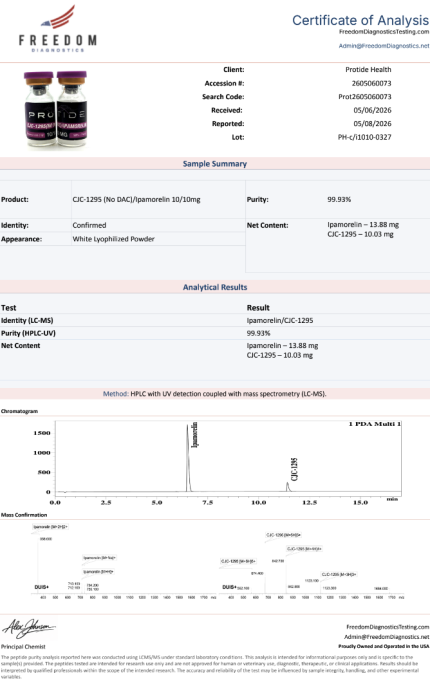
For comparison, Protide Health also lists a CJC-1295 No DAC and Ipamorelin research blend containing a different GHRH analogue paired with Ipamorelin.
Queries such as CJC 1295 Ipamorelin vs Tesamorelin therefore involve comparison of different GHRH-related research compounds rather than interchangeable chemical entities.
Likewise, searches for sermorelin vs ipamorelin vs tesamorelin or tesamorelin vs sermorelin vs ipamorelin involve compounds with distinct molecular structures and receptor classifications. Such comparisons should focus on chemical identity and receptor pharmacology rather than unsupported claims about effectiveness.
Research Limitations
Research involving the individual components of the tesamorelin and ipamorelin blend includes biochemical experiments, cultured pituitary cells, animal models, receptor pharmacology, and human studies involving specific pharmaceutical preparations.
Several limitations are important:
- Most scientific literature evaluates Tesamorelin and Ipamorelin separately.
- The two compounds act through different upstream receptor systems.
- Combining the peptides does not by itself demonstrate synergy.
- Findings in cultured pituitary cells cannot automatically be extrapolated to humans.
- Animal studies do not establish equivalent human outcomes.
- Research involving pharmaceutical Tesamorelin does not establish safety or efficacy for an independently supplied research blend.
- Changes in GH-associated research endpoints do not establish bodybuilding, performance, weight-management, anti-aging, or therapeutic outcomes.
The tesamorelin and ipamorelin blend supplied by Protide Health is therefore positioned strictly as laboratory research material.
Literature & Citation Index
Ipamorelin, the First Selective Growth Hormone Secretagogue
Authors: K. Raun, B. S. Hansen, N. L. Johansen, H. Thøgersen, K. Madsen, M. Ankersen, P. H. Andersen
Journal: European Journal of Endocrinology
Year: 1998
PMID: 9849822
DOI: 10.1530/eje.0.1390552
Research Focus: Ipamorelin pharmacology, cultured pituitary cells, secretagogue activity, and receptor selectivity.
Source: PubMed research on Ipamorelin
Growth Hormone-Releasing Hormone: Synthesis and Signaling
PMID: 7740167
Research Focus: GHRH receptor structure, Gs signaling, adenylate cyclase, cAMP, PKA/CREB pathways, and pituitary somatotroph biology.
Source: PubMed GHRH signaling research
Molecular and Cell Biology of the Growth Hormone-Releasing Hormone Receptor
Author: B. D. Gaylinn
Journal: Growth Hormone & IGF Research
Year: 1999
PMID: 10429879
DOI: 10.1016/S1096-6374(99)80008-2
Research Focus: GHRH receptor structure, pituitary expression, somatotroph proliferation, GH synthesis, and secretion.
Source: PubMed GHRH receptor research
Signaling Mechanism of Growth Hormone-Releasing Hormone Receptor
Year: 2023
PMID: 37717982
DOI: 10.1016/bs.vh.2023.06.004
Research Focus: GHRH receptor activation, receptor variants, intracellular signaling, and cAMP pathways.
Source: PubMed GHRH receptor signaling review
Chemical Identity References
The PubChem Tesamorelin record identifies Tesamorelin as CID 16137828 with molecular formula C221H366N72O67S and molecular weight approximately 5136 g/mol.
The PubChem Ipamorelin record identifies Ipamorelin as CID 9831659, CAS 170851-70-4, molecular formula C38H49N9O5, and molecular weight approximately 711.9 g/mol.
Related Protide Health Research Products
Researchers expanding a laboratory peptide inventory may also review:
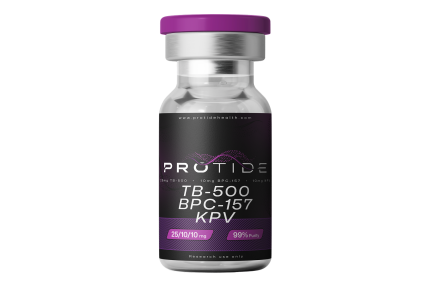
- BPC-157 & TB-500 Wolverine Blend — a structurally distinct two-peptide research formulation.
- CJC-1295 No DAC & Ipamorelin Blend — a separate formulation pairing Ipamorelin with a different GHRH analogue.
- GHK-Cu & KPV Blend — a distinct research blend involving copper-peptide and KPV research pathways.
These products have different sequences, molecular targets, and experimental contexts and should not be considered interchangeable.
Frequently Asked Questions
What is a tesamorelin and ipamorelin blend?
A tesamorelin and ipamorelin blend combines a synthetic GHRH analogue with a synthetic growth-hormone-secretagogue pentapeptide in one laboratory research formulation. Protide Health offers 5mg/5mg and 10mg/3mg configurations.
Are Tesamorelin and Ipamorelin the same peptide?
No. Tesamorelin is a 44-amino-acid GHRH analogue, while Ipamorelin is a five-residue growth-hormone secretagogue. They have different structures and interact with different upstream receptor systems.
What is the difference between tesamorelin vs ipamorelin?
Tesamorelin is primarily studied through GHRH-receptor signaling, whereas Ipamorelin is associated with GHS-R1a signaling. Both pathways may influence related pituitary research endpoints, but the peptides are pharmacologically distinct.
What sizes are available?
The product is available as:
- 5mg Tesamorelin / 5mg Ipamorelin
- 10mg Tesamorelin / 3mg Ipamorelin
Both are supplied as lyophilized powder in a 3mL vial.
What purity does Protide Health specify?
The supplied product specification states 99% purity with HPLC-MS verification and third-party testing.
How does this differ from CJC-1295 and Ipamorelin research blends?
The principal difference is the GHRH-related component. This formulation uses Tesamorelin, while a CJC-1295/Ipamorelin formulation uses a CJC-derived GHRH analogue alongside Ipamorelin.
Is this product intended for human use?
No. It is supplied exclusively for laboratory analysis, receptor research, biochemical testing, in-vitro studies, endocrine-signaling investigation, and qualified preclinical experimentation.
Laboratory Terms & Compliance
Laboratory Research Use Only
This product is supplied exclusively for laboratory research, analytical testing, in-vitro studies, preclinical research, and qualified scientific experimentation.
It is not intended for human or veterinary consumption, medical use, diagnostic use, therapeutic use, bodybuilding, athletic-performance enhancement, weight-loss use, or clinical administration.
No human dosage, dosing, administration, injection, or preparation instructions are provided.
The purchaser is responsible for appropriate laboratory handling, storage, and use in accordance with applicable institutional, federal, state, and local requirements.
For research use only.
| Select vial strength |
10/3mg ,5/5mg |
|---|


MAECENAS IACULIS
Vestibulum curae torquent diam diam commodo parturient penatibus nunc dui adipiscing convallis bulum parturient suspendisse parturient a.Parturient in parturient scelerisque nibh lectus quam a natoque adipiscing a vestibulum hendrerit et pharetra fames nunc natoque dui.
ADIPISCING CONVALLIS BULUM
- Vestibulum penatibus nunc dui adipiscing convallis bulum parturient suspendisse.
- Abitur parturient praesent lectus quam a natoque adipiscing a vestibulum hendre.
- Diam parturient dictumst parturient scelerisque nibh lectus.
Scelerisque adipiscing bibendum sem vestibulum et in a a a purus lectus faucibus lobortis tincidunt purus lectus nisl class eros.Condimentum a et ullamcorper dictumst mus et tristique elementum nam inceptos hac parturient scelerisque vestibulum amet elit ut volutpat.
Related products
BPC-157 & TB-500 “Wolverine” Blend
Price range: $145.00 through $305.00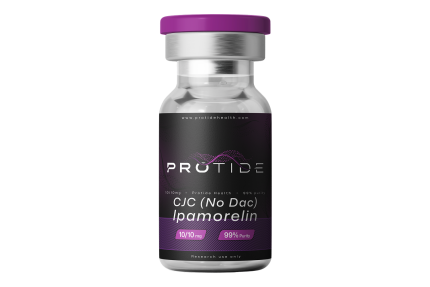
Reviews
There are no reviews yet.