
GLP-2
Price range: $110.00 through $400.00
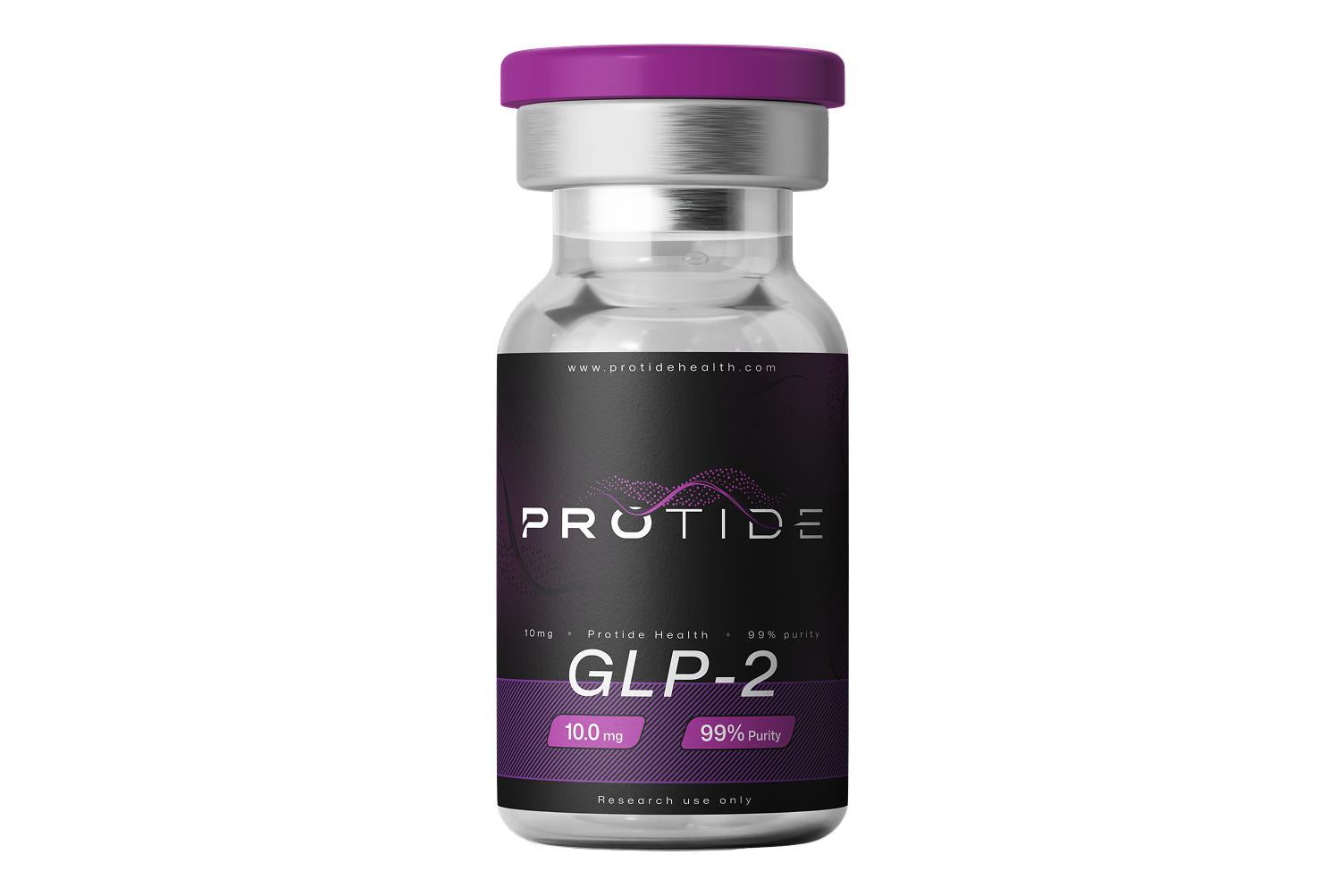
GLP 2 peptide product shot featuring professionally labeled Protide Health 3mL research vials containing white to off-white lyophilized material in 10mg, 15mg, 30mg, and 60mg sizes, with fatty-acid-modified peptide research positioning, 99%+ purity, and laboratory-research-only labeling clearly displayed against a clean scientific background.


GLP 2 Peptide – Protide Health USA
GLP 2 Overview & Technical Specifications
GLP 2 is the product name used by Protide Health for a synthetic, modified polypeptide research material associated with glucagon-like peptide-2 research.
The supplied product specification describes the material as a fatty-acid-modified synthetic polypeptide with an approximate molecular weight of:
~4800 g/mol
Protide Health supplies GLP 2 as white to off-white lyophilized research material in the following quantities:
- 10mg
- 15mg
- 30mg
- 60mg
The material is specified as 99%+ purity, HPLC-MS verified, and tested by an independent third-party laboratory.
Technical Specifications
- Product Name: GLP-2
- Available Sizes: 10mg, 15mg, 30mg, 60mg
- Form: Lyophilized powder
- Vial Size: 3mL
- Purity: 99%+
- Testing: HPLC-MS verified; independent third-party laboratory
- Peptide Type: Synthetic fatty-acid-modified polypeptide
- Supplied Molecular Weight: approximately 4800 g/mol
- Appearance: White to off-white lyophilized powder
- Solubility: Soluble in water
- Storage: Store sealed at ≤6°C and protected from heat, light, and moisture
- Research Use: GLP-2 receptor, intestinal-signaling, cellular, biochemical, analytical, and qualified preclinical research only
Molecular Identity Note
The supplied ~4800 g/mol molecular weight and fatty-acid-modified description do not correspond exactly to native human GLP-2.
Native human GLP-2 is a 33-amino-acid peptide with a molecular weight of approximately 3766 Da.
Known GLP-2 receptor agonist analogues also differ:
- Teduglutide: approximately 3752 Da
- Apraglutide: approximately 3765 Da
- Glepaglutide: approximately 4316–4359 Da
- Dapiglutide: approximately 4167 Da and additionally acts at GLP-1R
Because the supplied product specifications do not include a verified sequence, formula, CAS number, or PubChem CID, Protide Health should not assign one of these named compounds to the product without lot-specific analytical confirmation.
What Is a GLP 2?
The search phrase what is a GLP 2 usually refers to glucagon-like peptide-2.
Endogenous human GLP-2 is a 33-amino-acid peptide derived from proglucagon.
Its native sequence is:
HADGSFSDEMNTILDNLAARDFINWLIQTKITD
GLP-2 is produced primarily by intestinal enteroendocrine L cells after proglucagon processing.
Published research has investigated GLP-2 in relation to:
- Intestinal mucosal biology
- Enterocyte survival
- Crypt-villus architecture
- Nutrient absorption
- Intestinal blood flow
- Gastrointestinal signaling
- GLP-2 receptor activation
Native GLP-2 should not be confused automatically with the modified GLP 2 peptide product specified on this page.
GLP 2 Peptide & GLP2R Research
The GLP 2 peptide research field centers on the glucagon-like peptide-2 receptor:
GLP2R
GLP2R belongs to the class B family of G protein-coupled receptors.
Receptor activation can involve:
- Gs-protein signaling
- Adenylate cyclase
- Cyclic AMP
- Protein kinase A
- Downstream intestinal signaling
- Growth-factor-associated pathways
GLP2R expression is found in specialized gastrointestinal cell populations rather than being uniformly distributed across intestinal epithelial cells.
This has led researchers to investigate indirect signaling mechanisms involving other mediators.
GLP 2 & Intestinal Signaling Research
One of the best-established areas of GLP 2 biology is intestinal adaptation.
Experimental research has examined changes involving:
- Crypt-cell proliferation
- Villus height
- Intestinal mucosal mass
- Enterocyte survival
- Intestinal barrier biology
- Nutrient absorption
- Gastrointestinal transit
- Mesenteric and portal blood flow
These effects are part of the reason GLP-2 receptor agonism has become an important research area in intestinal physiology.
They do not establish that the Protide Health laboratory product is an approved intestinal therapy.
GLP 2 Agonist Research
The phrase GLP 2 agonist generally refers to compounds that activate GLP2R.
Several structurally different GLP-2 receptor agonists have been developed.
Native GLP-2
Endogenous 33-amino-acid peptide.
Teduglutide
A 33-residue GLP-2 analogue with a Gly substitution at position 2 that increases resistance to DPP-4 degradation.
Teduglutide is an FDA-approved pharmaceutical for specific patients with short bowel syndrome dependent on parenteral support. Its molecular weight is approximately 3752 Da.
Apraglutide
A long-acting modified 33-amino-acid GLP-2 receptor agonist with a molecular weight around 3765 Da.
Glepaglutide
A longer modified GLP-2 analogue with additional lysine residues and a molecular weight around 4316–4359 Da.
These compounds differ from one another chemically and should not be treated as interchangeable.
GLP 2 Peptides & Modified Analogues
The phrase GLP 2 peptides can include native GLP-2 and synthetic analogues designed to alter:
- Enzymatic stability
- Receptor potency
- Exposure duration
- Protein binding
- Pharmacokinetics
- Resistance to proteolysis
The supplied Protide Health product is described as containing a fatty-acid modification.
Fatty-acid modification is a peptide-engineering strategy that can alter:
- Albumin association
- Distribution
- Enzymatic stability
- Clearance
- Molecular exposure
However, without a verified sequence and modification site, the exact pharmacological properties of this GLP 2 peptidecannot be inferred solely from the approximate molecular weight.
GLP 2 vs Native GLP-2
A major distinction must be maintained between endogenous GLP-2 and the modified research material on this page.
Native GLP-2
- 33 amino acids
- Endogenous proglucagon-derived peptide
- Molecular weight approximately 3766 Da
- No fatty-acid modification
- Defined sequence and PubChem identity
Protide Health GLP 2
According to the supplied specifications:
- Synthetic polypeptide
- Fatty-acid modified
- Approximate molecular weight ~4800 Da
- Available in 10mg, 15mg, 30mg, and 60mg
- 99%+ purity
- HPLC-MS verified
Until the exact sequence and modification chemistry are analytically identified, these should not be represented as the same chemical compound.
What Is a GLP 2 Medication?
The phrase what is a GLP 2 medication usually refers to pharmaceutical GLP-2 receptor agonists rather than native GLP-2 itself.
The best-established example is teduglutide.
Teduglutide is a GLP-2 analogue and GLP2R agonist used as a regulated pharmaceutical for short bowel syndrome in patients who are dependent on parenteral support.
That regulatory status applies to the approved pharmaceutical product.
It does not apply to independently supplied GLP 2 peptide research material.
Protide Health does not represent this product as teduglutide, Gattex, Revestive, or any other approved medication.
GLP 2 Dosing Chart Search Context
The phrase GLP 2 dosing chart generally concerns human administration.
Protide Health does not provide a human dosing chart.
The available quantities:
- 10mg
- 15mg
- 30mg
- 60mg
represent total research material supplied in each vial.
They are not recommended doses.
No guidance is provided for:
- Human injection
- Daily or weekly administration
- Body-weight calculations
- Treatment cycles
- Short bowel syndrome treatment
- Reconstitution for administration
- Clinical titration
Published dosing information for teduglutide or investigational GLP-2 agonists should not be transferred to this independently supplied research product.
GLP 2 & Enterocyte Research
GLP-2 signaling has been studied extensively in intestinal epithelial biology.
Researchers have investigated:
- Enterocyte survival
- Apoptosis
- Crypt-villus architecture
- Nutrient transport
- Barrier function
- Mucosal adaptation
Interestingly, GLP2R does not appear to be broadly expressed directly on all enterocytes.
This has led to models in which receptor activation in specialized cells causes release of downstream mediators that then influence epithelial biology.
GLP 2 & IGF-1 Signaling
Research into GLP-2 receptor biology has identified insulin-like growth factor signaling as one potential downstream pathway in intestinal growth responses.
Studies have examined relationships involving:
- GLP2R
- IGF-1
- IGF-1 receptor signaling
- Intestinal epithelial growth
- Mesenchymal cells
- Crypt-villus adaptation
This provides an example of how GLP 2 biology can depend on indirect signaling rather than simple direct action on epithelial cells.
GLP 2 & Intestinal Blood Flow Research
GLP-2 research has also investigated effects on intestinal and portal circulation.
Experimental and clinical research has examined:
- Mesenteric blood flow
- Portal blood flow
- Intestinal perfusion
- Nutrient-associated vascular responses
These physiological effects are distinct from the trophic effects observed in intestinal mucosal models.
GLP 2 & Barrier Function Research
Another major research area involves gastrointestinal barrier integrity.
Studies of GLP-2 receptor signaling and GLP-2 analogues have investigated:
- Tight-junction-associated systems
- Intestinal permeability
- Mucosal integrity
- Inflammatory responses
- Gut barrier adaptation
A newer area of research also involves compounds combining GLP-2 receptor activity with other incretin pathways.
For example, dapiglutide is a dual GLP-1/GLP-2 receptor agonist containing a C18 acyl modification. It is chemically distinct from native GLP-2 and from the current Protide Health product unless analytical identity demonstrates otherwise.
Fatty-Acid-Modified GLP Research
The supplied GLP 2 peptide is described as fatty-acid modified.
Lipid or fatty-acid modification is used in peptide engineering to influence properties such as:
- Protein binding
- Half-life
- Molecular exposure
- Enzymatic degradation
- Tissue distribution
- Clearance
However, fatty-acid modification alone does not identify a particular compound.
For example, dapiglutide contains a C18 acyl group and activates both GLP-1R and GLP-2R, but PubChem reports a molecular weight of approximately 4167 Da rather than ~4800 Da.
The Protide Health material should therefore remain generically identified as the supplied modified GLP 2 research peptide unless further analytical data are available.
Related Protide Health Research Products
Researchers examining intestinal and cellular peptide signaling may review BPC-157 for a structurally distinct synthetic pentadecapeptide investigated primarily in preclinical vascular and gastrointestinal models.
The Cagrilintide research peptide provides a separate amylin-receptor-related peptide research system.
Researchers may also examine Cartalax 20mg for a chemically distinct short regulatory peptide model.
These products should not be considered interchangeable with GLP 2 peptide research material.
Research Format & Storage
Protide Health supplies GLP 2 as white to off-white lyophilized material in:
- 10mg
- 15mg
- 30mg
- 60mg
Product specifications state:
- Purity: 99%+
- Testing: HPLC-MS verified
- Laboratory Verification: Independent third-party testing
- Vial Size: 3mL
- Solubility: Soluble in water
- Supplied Molecular Weight: approximately 4800 g/mol
Storage specifications:
- Store at ≤6°C
- Keep sealed
- Protect from heat
- Protect from direct light
- Protect from moisture
These statements describe laboratory storage conditions and do not constitute human preparation or administration guidance.
Research Limitations
Several limitations are important when interpreting this GLP 2 peptide product:
- Native human GLP-2 is approximately 3766 Da, not ~4800 Da.
- Native human GLP-2 is not fatty-acid modified.
- The supplied specifications do not include a verified amino-acid sequence.
- No verified molecular formula has been supplied.
- No verified CAS number has been supplied.
- No verified PubChem CID has been supplied.
- The ~4800 Da specification does not exactly match teduglutide, apraglutide, glepaglutide, or dapiglutide.
- Fatty-acid modification alone does not identify the compound.
- Clinical findings from approved or investigational GLP-2 receptor agonists cannot establish the identity, efficacy, or safety of this material.
- Animal and cellular intestinal findings do not establish equivalent human outcomes.
- The available mg quantities identify vial contents rather than human doses.
- Protide Health material is not an FDA-approved GLP-2 medication.
For these reasons, exact molecular identity should be confirmed with lot-specific analytical data, and the material should be supplied strictly for qualified laboratory research.
Literature & Citation Index
Glucagon-Like Peptide II / Native Human GLP-2
Research Context: Native 33-amino-acid GLP-2, proglucagon processing, intestinal L cells, GLP2R biology, intestinal mucosal growth, nutrient homeostasis, and gastrointestinal physiology.
Native human GLP-2 is represented in PubChem as a 33-amino-acid peptide with molecular weight approximately 3766.1 g/mol.
Teduglutide — GLP-2 Analogue
Research Context: GLP2R agonism, DPP-4-resistant GLP-2 analogue, short bowel syndrome, intestinal adaptation, and regulated pharmaceutical development.
Teduglutide contains 33 amino acids and has a molecular weight of approximately 3752.1 g/mol.
Therapeutic GLP-2 Analogues: Comparative Molecular Research
Year: 2025
Research Context: Teduglutide, apraglutide, glepaglutide, elsiglutide, peptide sequences, molecular weights, GLP2R bioactivity, and comparative cell-based assays.
Dapiglutide, a Dual GLP-1 and GLP-2 Receptor Agonist
Year: 2026
Research Context: C18-acylated peptide engineering, GLP-1R/GLP-2R dual agonism, sustained signaling, intestinal-barrier hypotheses, and investigational clinical research.
Researchers can review broader GLP-2 and GLP2R literature indexed by PubMed for additional peer-reviewed research.
Frequently Asked Questions
What is GLP 2?
GLP 2 usually refers to glucagon-like peptide-2, an endogenous 33-amino-acid proglucagon-derived peptide involved in intestinal signaling.
What is a GLP 2 peptide?
A GLP 2 peptide may refer to native GLP-2 or a synthetic GLP-2 receptor agonist analogue. The Protide Health product is specified as a synthetic fatty-acid-modified polypeptide.
Is Protide Health GLP 2 the same as native human GLP-2?
Not necessarily. Native human GLP-2 is approximately 3766 Da and is not fatty-acid modified, whereas the supplied Protide Health specification describes a ~4800 Da modified peptide.
What is the native GLP-2 sequence?
Native human GLP-2 contains 33 amino acids:
HADGSFSDEMNTILDNLAARDFINWLIQTKITD
What is a GLP 2 agonist?
A GLP 2 agonist activates the GLP-2 receptor, GLP2R. Examples in pharmaceutical research include teduglutide, apraglutide, and glepaglutide.
Is GLP 2 a medication?
Native GLP-2 is an endogenous peptide, not itself a medication. Certain synthetic GLP-2 analogues, such as teduglutide, have been developed as regulated pharmaceuticals.
Is this product teduglutide?
No such identity has been established. Teduglutide has a molecular weight of approximately 3752 Da, which does not match the supplied ~4800 Da product specification.
Is this product dapiglutide?
There is insufficient evidence to identify it as dapiglutide. Dapiglutide is a C18-acylated dual GLP-1/GLP-2 agonist with a molecular weight around 4167 Da.
What is the GLP 2 dosing chart?
Protide Health does not provide a human GLP 2 dosing chart. The 10mg, 15mg, 30mg, and 60mg values describe vial contents only.
What sizes are available?
Protide Health supplies the product in:
- 10mg
- 15mg
- 30mg
- 60mg
What purity does Protide Health specify?
Protide Health specifies 99%+ purity, with HPLC-MS verification and independent third-party laboratory testing.
Is GLP 2 intended for human use?
No. This material is supplied exclusively for GLP-2 receptor, intestinal-signaling, biochemical, cellular, molecular, analytical, in-vitro, and qualified preclinical research.
Laboratory Terms & Compliance
Laboratory Research Use Only
This GLP 2 peptide product is supplied exclusively for laboratory research, GLP2R studies, gastrointestinal signaling research, analytical testing, biochemical experimentation, cellular investigation, in-vitro research, and qualified preclinical experimentation.
It is not intended for human or veterinary consumption, medical use, short bowel syndrome treatment, gastrointestinal treatment, weight-loss treatment, diagnostic use, therapeutic use, injection, or clinical administration.
No human dosage, GLP 2 dosing chart, injection schedule, treatment protocol, body-weight calculation, administration frequency, reconstitution protocol for human use, or clinical guidance is provided.
The purchaser is responsible for appropriate laboratory handling, storage, and use under applicable institutional, federal, state, and local requirements.
For research use only.
| Select vial strength |
10mg ,15mg ,30mg ,60mg |
|---|


MAECENAS IACULIS
Vestibulum curae torquent diam diam commodo parturient penatibus nunc dui adipiscing convallis bulum parturient suspendisse parturient a.Parturient in parturient scelerisque nibh lectus quam a natoque adipiscing a vestibulum hendrerit et pharetra fames nunc natoque dui.
ADIPISCING CONVALLIS BULUM
- Vestibulum penatibus nunc dui adipiscing convallis bulum parturient suspendisse.
- Abitur parturient praesent lectus quam a natoque adipiscing a vestibulum hendre.
- Diam parturient dictumst parturient scelerisque nibh lectus.
Scelerisque adipiscing bibendum sem vestibulum et in a a a purus lectus faucibus lobortis tincidunt purus lectus nisl class eros.Condimentum a et ullamcorper dictumst mus et tristique elementum nam inceptos hac parturient scelerisque vestibulum amet elit ut volutpat.
Related products
BPC-157
Price range: $65.00 through $195.00
MOTS-c Peptide
Price range: $65.00 through $195.00
Reviews
There are no reviews yet.