
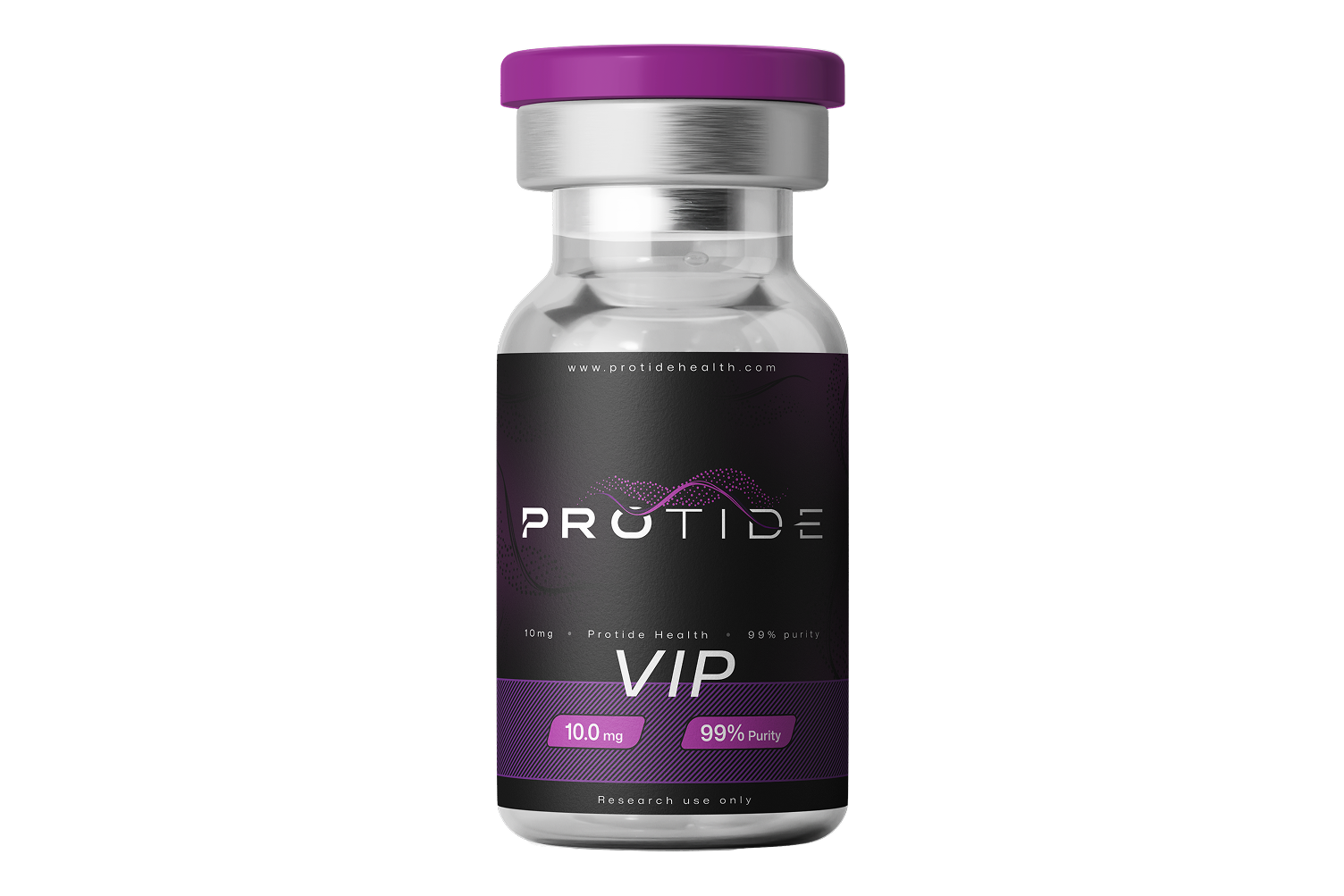
VIP 10mg
$75.00
- Quantity / Mass: 10mg
- Contents: VIP 10mg
- Form: Lyophilized powder
- Vial Size: 3mL
- Peptide Type: Endogenous 28-amino-acid neuropeptide; secretin/glucagon peptide superfamily
- Purity: 99%
- Analytical Verification: HPLC-MS verified; third-party tested
- Sequence: His-Ser-Asp-Ala-Val-Phe-Thr-Asp-Asn-Tyr-Thr-Arg-Leu-Arg-Lys-Gln-Met-Ala-Val-Lys-Lys-Tyr-Leu-Asn-Ser-Ile-Leu-Asn
- Appearance: White to off-white lyophilized powder
- Research Classification: Neuropeptide and VPAC receptor ligand
VIP peptide 10mg is supplied as a lyophilized research material for controlled biochemical, receptor-binding, cellular, and preclinical investigation. The peptide is widely studied in experimental systems involving VPAC1 and VPAC2 receptor signaling, cyclic AMP pathways, neuronal communication, and immune signaling.
Buy VIP Peptide 10mg – Protide Health USA
VIP Peptide Overview & Technical Specifications
VIP peptide, also known as vasoactive intestinal peptide or vasoactive intestinal polypeptide, is an endogenous 28-amino-acid neuropeptide belonging to the secretin/glucagon peptide superfamily. Its primary sequence is:
His-Ser-Asp-Ala-Val-Phe-Thr-Asp-Asn-Tyr-Thr-Arg-Leu-Arg-Lys-Gln-Met-Ala-Val-Lys-Lys-Tyr-Leu-Asn-Ser-Ile-Leu-Asn
The peptide has been extensively investigated in biochemical, cellular, receptor-pharmacology, and animal research models. Research literature identifies VIP as a high-affinity endogenous ligand for VPAC1 and VPAC2, two class B G protein-coupled receptors that also respond to PACAP.
Protide Health supplies this VIP peptide as a 10mg lyophilized powder for qualified laboratory experimentation and analytical research. The dry format is consistent with the broader use of lyophilized powder preparations in peptide research because removal of water helps preserve material during storage and handling prior to use in appropriately designed laboratory protocols.
Technical Specifications
- Product Name: VIP 10mg
- Contents: Vasoactive Intestinal Peptide
- Quantity: 10mg
- Vial Size: 3mL
- Form: Lyophilized powder
- Purity: 99%
- Testing: HPLC-MS verified; third-party tested
- Peptide Length: 28 amino acids
- Research Class: Endogenous neuropeptide
- Peptide Family: Secretin/glucagon superfamily
- Appearance: White to off-white lyophilized powder
- Sequence: HSDAVFTDNYTRLRKQMAVKKYLNSILN
- Intended Use: Laboratory research, analytical testing, biochemical assays, in-vitro studies, and preclinical research only
VIP Peptide Mechanism of Action & Research Context
The primary molecular research focus of VIP peptide centers on the VPAC receptor family. VIP binds with high affinity to VPAC1 and VPAC2 receptors, which are class B G protein-coupled receptors distributed across numerous experimental tissue and cellular systems. PACAP can also activate these receptors, while PAC1 displays substantially greater selectivity for PACAP than for VIP.
Experimental receptor studies indicate that VPAC receptors preferentially couple to Gαs proteins, leading to activation of adenylate cyclase, increased intracellular cyclic AMP, and downstream protein kinase A signaling. Additional signaling routes, including calcium-associated and other intracellular pathways, have also been described in specific experimental models.
Researchers can review broader VIP peptide research indexed by PubMed when evaluating the evolving literature surrounding receptor pharmacology, neurobiology, gastrointestinal signaling, endocrine signaling, and immunological pathways.
Preclinical Research Applications
Receptor-Binding and Cell-Signaling Research
A central use of VIP peptide in experimental research is the study of VPAC1 and VPAC2 receptor pharmacology.
The VIP/PACAP receptor family has been investigated through receptor-binding assays, mutagenesis experiments, structural modeling, cell-based functional assays, and other biochemical methodologies. These studies have helped characterize how VIP interacts with the extracellular and transmembrane regions of class B GPCRs and how receptor activation is translated into intracellular signaling.
Neurobiological Research
VIP is distributed throughout central and peripheral neuronal systems and has therefore been studied in experimental models examining neuronal communication and neuroendocrine signaling.
Published reviews describe VIP/PACAP receptor systems in research involving circadian biology, neuronal signaling, learning-related experimental models, stress-response pathways, and other CNS processes. These findings originate from biochemical, cellular, genetic, and animal-model research and do not establish therapeutic effects in humans.
Gastrointestinal and Endocrine Research
The VIP peptide research literature also includes extensive investigation of gastrointestinal signaling.
Experimental studies have examined VIP-associated pathways involved in intestinal secretion, motility, epithelial function, nutrient-related signaling, endocrine activity, and communication between neural and gastrointestinal systems. Genetic and animal models have contributed substantially to this field.
Immunological and Inflammatory-Signaling Research
VIP and VPAC receptors are also used as experimental systems for studying immune-cell signaling and inflammatory pathways.
Reviews of VIP/PACAP signaling describe receptor expression across immune and inflammatory research models and investigate how downstream signaling may alter cellular responses. These remain active areas of molecular and preclinical research rather than evidence supporting treatment claims.
Molecular and Structural Research
Structural studies of VIP-family receptors have expanded understanding of how peptide ligands interact with class B1 GPCRs.
Recent structural and pharmacological research has examined ligand binding, receptor selectivity, conformational activation, extracellular-domain interactions, and downstream signaling. Such work makes the VIP peptide system useful for receptor biology and peptide–protein interaction studies.
Lyophilized Powder in Laboratory Research
Lyophilization is a freeze-drying process in which water is removed from frozen material under reduced pressure. In peptide research, a lyophilized powder format is commonly used to improve handling and physical stability of research material before downstream laboratory preparation.
What Is Lyophilized Powder?
Researchers asking what is lyophilized powder are generally referring to a dry material produced through freeze-drying. For peptide materials, the process reduces water content and creates a dry preparation that can be packaged and transported more conveniently than an aqueous solution.
Protide Health describes its research peptides as freeze-dried materials supplied for laboratory use, with batch purity and molecular identity evaluated through analytical testing.
No administration, dosing, injection, or human-use instructions are provided or implied.
Research Limitations
Research involving VIP peptide spans biochemical assays, receptor-binding experiments, cultured-cell systems, genetic models, isolated tissues, and animal studies.
Results obtained in these systems can help researchers investigate receptor pharmacology and molecular mechanisms, but findings from preclinical systems should not be interpreted as demonstrating equivalent safety, efficacy, or clinical outcomes in humans.
The biological effects of endogenous VIP are also context-dependent because VPAC receptor expression, receptor density, downstream signaling proteins, tissue type, and experimental conditions can differ substantially between research models.
Literature & Citation Index
Pharmacology and Functions of Receptors for Vasoactive Intestinal Peptide and Pituitary Adenylate Cyclase-Activating Polypeptide: IUPHAR Review 1
Authors: Anthony J. Harmar et al.
Journal: British Journal of Pharmacology
Year: 2012
PMID: 22289055
DOI: 10.1111/j.1476-5381.2012.01871.x
Research focus: VIP/PACAP receptor nomenclature, VPAC1, VPAC2, PAC1, receptor pharmacology, and physiological research.
VPAC and PAC Receptors: From Ligands to Function
Authors: Louise Dickson, Keith Finlayson
Journal: Pharmacology & Therapeutics
Year: 2009
PMID: 19109992
DOI: 10.1016/j.pharmthera.2008.11.006
Research focus: VIP/PACAP receptor distribution, signaling pathways, pharmacology, and experimental models.
Mechanisms Involved in VPAC Receptors Activation and Regulation
PMID: 23115557
Journal: Frontiers in Endocrinology
Year: 2012
DOI: 10.3389/fendo.2012.00129
Research focus: VPAC1/VPAC2 activation, G-protein coupling, adenylate cyclase, cAMP signaling, and receptor regulation.
Signal Transduction by VIP and PACAP Receptors
PMID: 35203615
Research focus: Molecular switches, class B GPCR activation, VPAC1, VPAC2, PAC1, and structural mechanisms of peptide-receptor signaling.
Related Protide Health Research Products
Researchers expanding a broader laboratory inventory may also review these Protide Health research materials:
- 5-Amino 1-MQ research compound — a separate small-molecule research compound for biochemical and metabolic pathway investigation.
- Acetic Acid 0.6% laboratory research solution — available as part of the Protide Health research-material catalog.
- AOD-9604 research peptide — another peptide available for qualified laboratory and preclinical research.
These materials have different structures and experimental research contexts and should not be interpreted as interchangeable with VIP.
Frequently Asked Questions
What is VIP peptide?
VIP peptide is vasoactive intestinal peptide, an endogenous 28-amino-acid neuropeptide in the secretin/glucagon peptide superfamily. It is widely investigated in laboratory models studying VPAC1 and VPAC2 receptor pharmacology, intracellular signaling, neurobiology, gastrointestinal signaling, and immune-system pathways.
What form does Protide Health VIP 10mg come in?
Protide Health supplies VIP 10mg as a lyophilized powder in a 3mL vial for laboratory research and analytical use.
Is VIP a research peptide?
Yes. The product offered by Protide Health is supplied strictly as a research material for biochemical assays, in-vitro testing, molecular pathway research, receptor studies, and qualified preclinical experimentation.
Which receptors are studied with VIP?
VIP is principally studied as a ligand for VPAC1 and VPAC2 receptors. Both belong to the class B family of G protein-coupled receptors and commonly activate adenylate cyclase/cAMP-associated signaling pathways in experimental systems.
Is the VIP product analytically tested?
The supplied product specification states 99% purity with HPLC-MS verification and third-party testing. Protide Health also states that its peptide batches undergo independent analytical testing with HPLC used to assess purity and mass spectrometry used to evaluate identity.
Is VIP intended for human use?
No. Protide Health supplies this material exclusively for laboratory research. It is not intended for human or veterinary consumption, clinical use, diagnosis, treatment, or administration.
Laboratory Terms & Compliance
Laboratory Research Use Only
This product is supplied exclusively for laboratory research, analytical testing, in-vitro studies, preclinical research, and qualified scientific experimentation.
It is not intended for human or veterinary consumption, medical use, diagnostic use, therapeutic use, or clinical administration.
The purchaser is responsible for appropriate laboratory handling, storage, and use in accordance with applicable institutional, federal, state, and local requirements.
For research use only.
3. Meta Title
4. Meta Description
VIP peptide 10mg from Protide Health is 99% purity, HPLC-MS verified lyophilized material for USA laboratory, in-vitro, and preclinical research.
5. Image Alt Text
VIP Peptide 10mg Laboratory Research Peptide – Protide Health
6. Product Shot Description
VIP peptide 10mg product shot featuring a professionally labeled Protide Health research vial containing lyophilized powder, presented against a clean laboratory-style background with clear 10mg identification and research-use-only branding.


MAECENAS IACULIS
Vestibulum curae torquent diam diam commodo parturient penatibus nunc dui adipiscing convallis bulum parturient suspendisse parturient a.Parturient in parturient scelerisque nibh lectus quam a natoque adipiscing a vestibulum hendrerit et pharetra fames nunc natoque dui.
ADIPISCING CONVALLIS BULUM
- Vestibulum penatibus nunc dui adipiscing convallis bulum parturient suspendisse.
- Abitur parturient praesent lectus quam a natoque adipiscing a vestibulum hendre.
- Diam parturient dictumst parturient scelerisque nibh lectus.
Scelerisque adipiscing bibendum sem vestibulum et in a a a purus lectus faucibus lobortis tincidunt purus lectus nisl class eros.Condimentum a et ullamcorper dictumst mus et tristique elementum nam inceptos hac parturient scelerisque vestibulum amet elit ut volutpat.
Related products
DSIP
$100.00
GLP-3
Price range: $145.00 through $550.00
Reviews
There are no reviews yet.